A 400-horsepower sedan
Whats more American than a Cadillac? How about a Cadillac CTS-V with a whopping V-8 that can blister the tires and lunge to 60 miles per hour in 4.6 seconds? Tire-scorching horsepower is about as American as you can get.
This high-performance version of the CTS was created to challenge comparable performance models from Audi, BMW and Mercedes-Benz. Cadillac will build only a few thousand, so expect waiting lists and premium prices. The test cars sticker price was $52,495, and that compares favorably with the Audi S4. BMWs new M5 and the Mercedes-Benz E55 are both in the $80,000 plus range.

Cadillac, the brand, is in the middle of an extreme makeover, and the CTS-V has received a major heart transplant. For the ultra-performance model, the standard 3.6-liter, 255-horse V-6 has been shelved, and a 400-horsepower, 5.7-liter heart based on the current Corvette has been stuffed inside the simple suit of sharply pressed sheetmetal. Talk about kickin things up a notch.
| Category: | $50,000 – $60,000 High Performance Rear-Drive Sport Sedan |
| Who should buy this car: | A person looking for a luxury sedan with the performance of a Corvette |
| Comparable models in this class: | Audi S4, Jaguar S Type R, Mercedes C55 |
Visually, you can tell the CTS-V by its fat tires, squat stance and deeper front spoiler. Scoops by the fog lights provide ventilation for the front brakes. Honeycomb mesh is used for the grille. The V is currently available in silver, black, red and stealth gray.
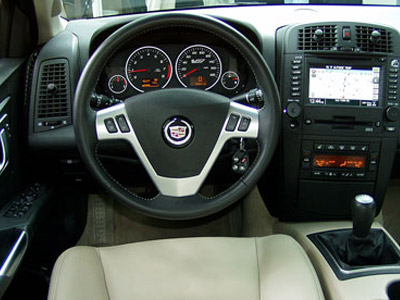 The aluminum 5.7-liter engine is mated to a six-speed manual transmission for maximum performance, and it’s a great combination, with one exception. Accelerate gently, and the CTS-V forces you to shift from first to fourth gear, just like the Corvette. The skip-shift feature is there to achieve better city fuel economy numbers in the Environmental Protection Agency’s test, but it’s annoying. I know it can be defeated with an aftermarket switch, but I wish it weren’t there to begin with.
Tighter ratios in the six-speed gearbox would make the driving experience more fun because fifth and sixth are both overdrive gears. No automatic transmission is offered.
 The rear-drive CTS-V is a well-balanced platform that handles copious amounts of horsepower reasonably well, thanks to a reworked suspension, 18-inch tires and huge, 14-inch Brembo disc brakes. Hydroformed steel cradles are used front and rear to handle the extra demand from the V-8. Stiffer springs, bigger shocks and fat stabilizer bars keep the CTS-V pretty flat in turns. The suspension was tuned during extensive testing at the famous Nurburgring track in Germany.
In city driving, the CTS-Vs ride is just this side of being too firm. The car is secure and well-planted. Probing its performance envelope is not something one can do safely on the street. It would be fun to spend some time with it on a track.
 An understated interior matches the subtle exterior. There are brushed aluminum accents on the steering wheel and gearshift knob. The deeply contoured leather buckets have suede inserts to hold occupants in place during spirited driving.
The gauge package is subtle with white letters on a black background. A digital readout at the bottom of the tachometer supplies various bits of information, and includes a gauge that shows peak and momentary lateral acceleration in turns. This g-meter is clever and fun.
The Cadillacs center stack is shaped to resemble a computer tower, and it looks a bit dated. A navigation system and XM satellite radio are standard, as is OnStar.
Side-curtain airbags, antilock brakes, traction control and the Stabilitrak vehicle stability program are also standard.
While the CTS-V is a low-volume model, it is the best evidence yet that Cadillac intends to position itself as a major competitor with the best performance sedans from Europe.
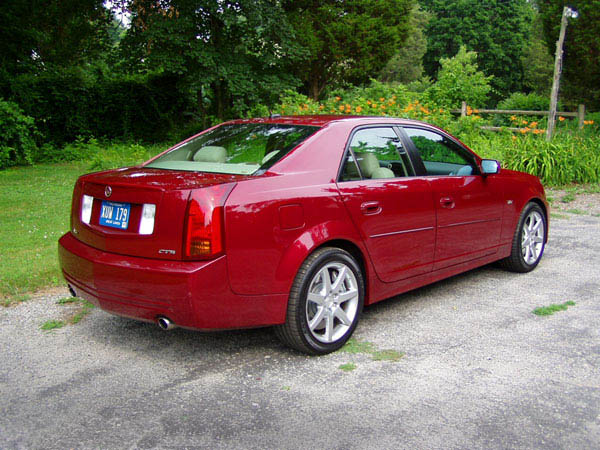
Click here for more pictures of the CTS-V
2005 Cadillac CTS-V
Specifications
| Engine Type | 5.7 liter Overhead Valve (OHV) 16 Valve V8 |
| Horsepower | 400 @ 6,000 rpm |
| Torque | 395 @ 4,800 rpm |
| Fuel Recommended | Premium |
| Transmission | 6 Speed Manual Transmission |
| Drive Type | Rear Wheel Drive |
| Tires – Standard | P245/45WR18 Goodyear Eagle F1 Run-Flat |
| Overall Length | 191.5″ |
| Wheelbase | 113.4″ |
| Width | 70.6″ |
| Turning Diameter | 36.1 ft. |
| Curb Weight | 3,850 lbs. |
| Fuel Tank | 17.5 gallons |
| Performance 0 to 60 | 4.6 seconds |
| Miles Per Gallon | 15 mpg City, 23 mpg Highway |
| Base Sticker Price | $50,675 plus $720 destination charge |
Standard Equipment
- 400 horsepower V8 Engine
- 6 speed standard transmission
- High Performance W speed rated Run-Flat tires
- Front and rear ventilated disc brakes with ABS
- Traction control
- Stability control
- Leather/suede upholstery
- 8-way power driver and front passenger sport seats
- Memory settings for two drivers
- Heated front seats
- Dual zone climate controls
- DVD navigation system
- OnStar telecommunications service
- Tilt and slide sunroof
- Dual front side-mounted airbags
- Front and rear head airbags
- Xenon high intensity discharge headlamps
- Tire pressure monitoring
- AM/FM in-dash 6 CD player stereo with Bose speakers
Major Available Options
- Sunroof Delete
- Goodyear Eagle EMT tires
Keep Reading: Related Posts




Any information provided on this Website is for informational purposes only and is not intended to replace consultation with a professional mechanic. The accuracy and timeliness of the information may change from the time of publication.