Not all of your vehicle’s instrument panel lights should illuminate after you remove your key from the ignition.
The instrument panel lights will warn you when your vehicle has issues, but they only do this when the engine is on. So, if your dash lights stay on when the car is off, there’s obviously a problem that needs to be addressed.
Instrument panel lights, like the door ajar indicator and the handbrake light on some vehicles, can illuminate even when the keys aren’t inserted into the ignition. Let’s explore the possible reasons why the other dash lights can illuminate even after the key is removed.
Why Do Car Dashboard Lights Stay On When the Car Is Off?
These might be the reasons why your dash lights remain lit even when your car is off.
Faulty Ignition Switch
On older cars, the ignition switch completes a lot of circuits when you turn the key to the ON position.
On newer vehicles, the switch may be part of the vehicle network or it may simply energize the modules that communicate on the network.
A faulty ignition switch might fail so that it continues to keep the network, the modules, or the instrument cluster lights and other circuits powered up even though the key is turned OFF. If it’s keeping other electrical components awake (and it probably is), it’ll kill the battery.
Short Circuit
Alternatively, a short circuit in a wire harness or within a component like the body control module (BCM) or the instrument cluster itself might be to blame. The BCM controls several vehicle electronics like the lights, windows, and locks.
Short circuits occur when current flows on a different unintended path, which could lead to some devices staying on.
Stuck Relay
Lights on the instrument panel can be controlled by a relay on newer vehicles where the fuse panel is actually a computer (Ford Smart Junction Box, Chrysler TIPM, Nissan IPDM), etc., which is a switch that controls the flow of power to certain components.
Relays can get stuck in the closed position, rendering the circuit complete and conducting electricity all the time. Modules can “leak” voltage to the relay coil circuit, keeping the relay closed when they’re not supposed to.
Blown Fuse
While it almost never happens, in some rare cases, a blown fuse can interact with a relay in a way that causes the dashboard lights to stay on. The fuse that sends power to the relay might be blown. In this case, it would get stuck in the closed position, keeping the dashboard lights on.
Some Troubleshooting Tips
- Check your vehicle’s headlights, doors, hood, and trunk. The door ajar light and headlight warning light will illuminate if these are open.
- Try restarting your vehicle.
What Do Different Dashboard Lights Indicate When They Illuminate?
Here are the most common dashboard warning lights and what they mean:
Check Engine Light

The check engine light is a warning light in red, yellow, or orange that’s shaped like an engine. When this light illuminates, your vehicle can have a wide range of issues related to your engine or emissions system.
Given the number of possible issues, this light is fairly ambiguous and requires an OBD scanner for diagnosis. While you can still drive when this light is illuminated, it’s best to determine and address what triggered this light as soon as possible.
Battery Light

This battery-shaped light means there’s a problem with your battery, alternator, or other electrical components. If it’s lit, it might mean your battery is flat or it isn’t charging.
Your vehicle can function when this light is on but don’t put off addressing it to avoid issues on the road.
Coolant Temperature Light

This light looks like a thermometer floating on water. It lets you know when the coolant is too hot, which might mean that your engine is creating too much heat or your cooling system can’t cool itself down.
A broken water pump, low coolant levels, and other cooling system issues can activate the coolant temperature light. These can cause serious engine issues if ignored.
Transmission Temperature
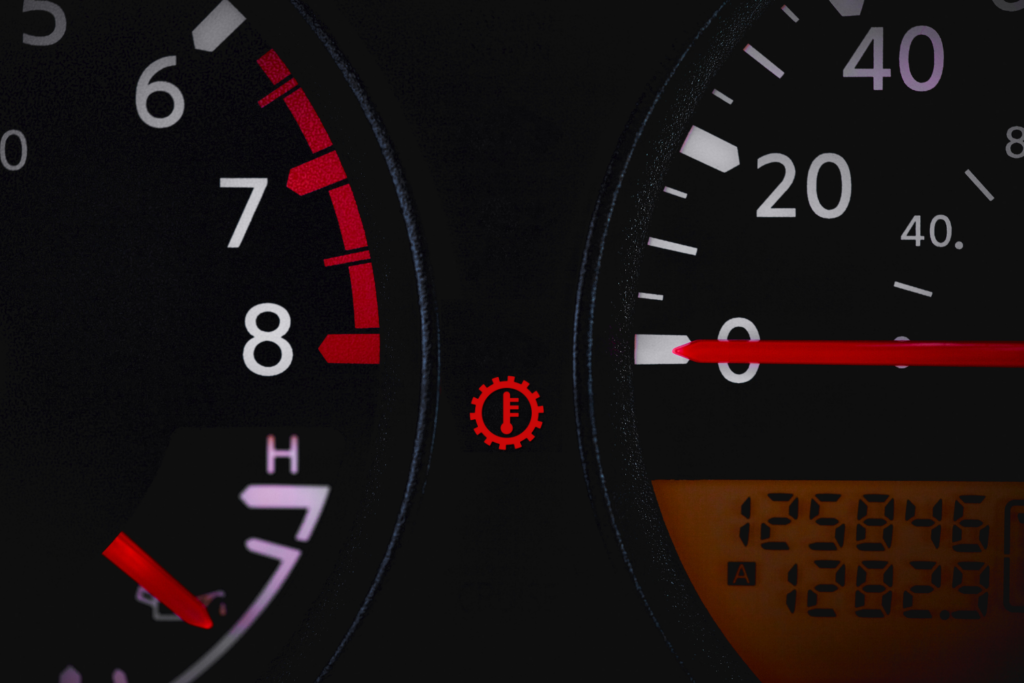
This light looks like a thermometer inside a gear. It illuminates when internal transmission components are becoming too hot because of heavy towing, low transmission fluid levels, or excessive wear on transmission components.
Oil Pressure Warning

An oil pressure warning light looks like an oil can with a drop of oil pouring out. It illuminates when your vehicle needs more oil in the engine. Alternatively, it could mean there’s a leak in the engine or worn parts like a blown piston ring or broken oil pump.
Tire Pressure Monitoring System

This light resembles two-thirds of a circle with an exclamation point in the center. The small lines across the bottom mimic the tread of an automobile tire. You might be driving with severely underinflated or overinflated tires if this light is on.
Brake System

This light usually illuminates when you engage your hand brake. It can also activate when there are issues with your brake system, like worn brake pads, low brake fluid levels, or a problem with the anti-lock braking system (ABS).
Traction or Stability Control Light

This light is shaped like a vehicle’s front with two squiggly lines underneath. It shows what these systems are trying to avoid, which is your vehicle slipping and sliding all over the road.
This light only turns on when the traction control and stability control systems activate, which is when your vehicle loses grip.
Airbag Warning Light

This light looks like the side view of the airbag activating with the seated driver. It illuminates when there’s a problem with the vehicle’s airbags.
Keep Reading: Related Posts






Any information provided on this Website is for informational purposes only and is not intended to replace consultation with a professional mechanic. The accuracy and timeliness of the information may change from the time of publication.