There’s a small but critical component tucked between the steering wheel and the steering column that most drivers never think about until something goes wrong. The air bag clockspring is a spiral-wound flat ribbon cable inside a plastic disc housing. It keeps the driver’s air bag, horn, and every steering-mounted control connected to the rest of the vehicle while the wheel rotates freely. It’s basically a flexible printed circuit in a coil shape.

Pro Tips are nuggets of information direct from ASE-certified automobile technicians working with CarParts.com, which may include unique, personal insights based on their years of experience working in the automotive industry. These can help you make more informed decisions about your car.
Pro Tip: Older vehicles used a brass contact ring with a sliding, spring-loaded brush to feed power to the horn, or a set of rings and brushes to feed the cruise control buttons. With the advent of supplemental restraint systems (SRS) and steering-wheel air bags, manufacturers needed a more reliable way to maintain those circuits while the wheel rotated. That’s where the air bag clockspring came in.
How Does the Air bag Clockspring Work?
Every time the steering wheel turns, that ribbon cable coils and uncoils inside the housing. It’s the only practical solution to a wiring problem that’s existed since manufacturers started putting buttons and air bags on steering wheels. A fixed wire connection would bind and snap. The clockspring solves that by giving the wiring enough range of motion to follow the wheel through its designed steering travel. The exact rotational range varies by vehicle and clockspring design.
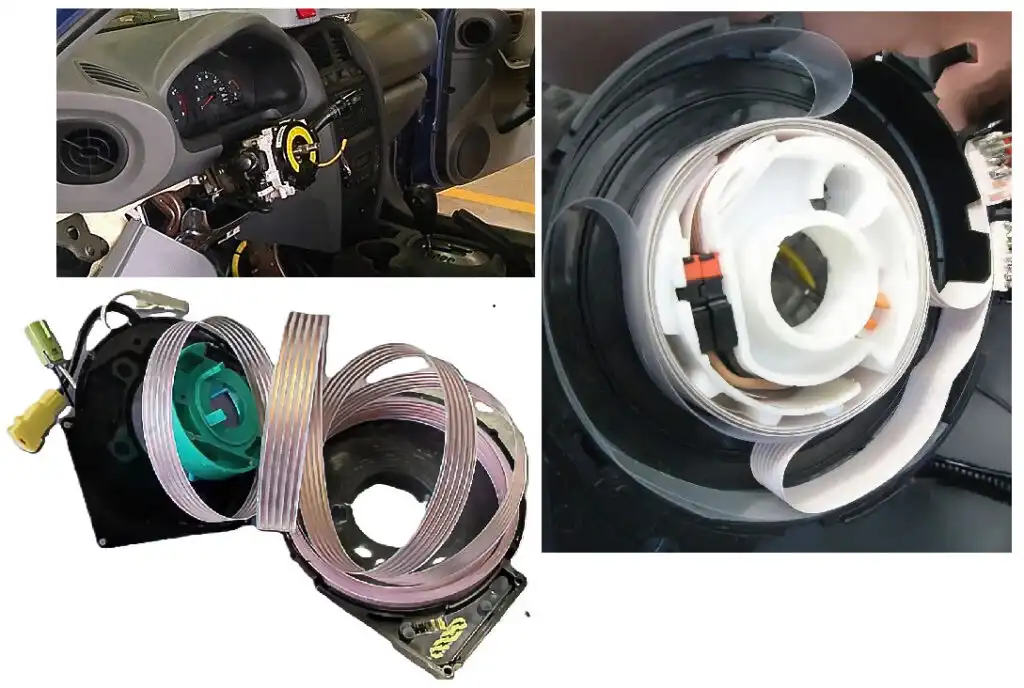
What Else Does It Control?
Beyond the air bag circuit, the same ribbon cable carries current for the car horn, cruise control buttons, audio controls, and hands-free phone functions. On many modern vehicles, the clockspring assembly may also incorporate or sit alongside a steering angle sensor. That sensor feeds real-time wheel position data to the Electronic Stability Control (ESC) and traction control systems, which use it to calculate the correct response during hard cornering or a skid. That sensor reports wheel position in degrees, and the stability system uses those readings to modulate braking and power during cornering.
The clockspring is centered so the ribbon has enough travel for steering in both directions. Its total available rotation varies by application and must match the vehicle’s steering range.
What Are the Signs of a Failing Clockspring?
The SRS warning light is the most serious signal. When the ribbon cable breaks or loses contact, the air bag control module detects the open circuit and lights up the supplemental restraint system warning immediately. Warning: with that light on, the air bag system has detected a fault, and the driver air bag may not deploy as intended in a crash. That’s not a light to defer.
Other symptoms often show up before or alongside the SRS light:
- Horn works only at certain steering wheel positions, or goes silent entirely
- Steering wheel buttons for audio, cruise, or phone functions become intermittent or stop working
- Traction control or stability control warning lights appear
- A rubbing or scratching sound from the steering column during turns
- Air bag light flickers only when the wheel’s in a specific position
Note: If the air bag light is on but the horn still works, don’t assume the clockspring is fine. The circuits are separate paths inside the ribbon, and one can fail while others stay intact.
Why Do Clocksprings Fail?
Repeated flexing can eventually wear the ribbon cable and conductors. Every steering input cycles the ribbon through an expand-and-contract motion, and over many steering cycles, the conductors can develop fatigue or fractures. Frequent steering inputs and full-lock maneuvers increase the number of cycles the clockspring sees, but service life varies by design and use. Heat and age degrade the plastic housing and internal contacts over time, too. Many clocksprings can last the life of the vehicle, but they can also fail from age, wear, manufacturing defects, or damage during steering or air bag service.
Some vehicles have been recalled for clockspring or spiral cable defects, so it’s worth checking NHTSA’s VIN recall lookup before ordering a replacement to see if an open recall applies.
What Should Buyers Check Before Ordering an Air bag Clockspring?
Fitment is everything with clocksprings. The connector pin count, pin gender, and wiring pinout have to match the original unit exactly. A clockspring listed for a slightly different trim level or model year can have a different terminal count, and that mismatch will trigger persistent warning lights even after a clean installation.
Before ordering, confirm:
- Year, make, model, and specific trim level
- Whether the vehicle has steering-mounted controls, since some base trims don’t
- Whether the vehicle has ESC or a steering angle sensor integrated into the clockspring
- The OEM part number from the old unit or the vehicle’s service manual
Always confirm fitment using the year, make, model, and trim. Don’t rely on make and model alone.
OEM vs. Aftermarket: Which One to Buy?
OEM clocksprings are built to the vehicle manufacturer’s specifications for fitment and electrical configuration. They make the most sense when the vehicle’s still under warranty, when the air bag system has recently been serviced, or when the trim level includes advanced driver-assistance features that depend on the steering angle sensor.
Quality aftermarket clocksprings are a solid, cost-effective choice for most other situations. Reputable suppliers like Standard Motor Products offer direct-fit replacement clocksprings for many applications. Some Standard clockspring listings on CarParts.com carry a 3-year/36,000-mile limited warranty, but warranty terms should be checked for the exact part. For a well-maintained daily driver that’s out of warranty, a quality aftermarket unit makes good financial sense without cutting corners on safety.

How Do You Install a Clockspring Without Breaking It?
Getting the centering step right is what separates a clean install from a repeat repair job. If the ribbon isn’t centered when the steering wheel goes back on, it’ll bind at the limits of steering travel and fail prematurely.
Warning: disable the SRS exactly as specified in the vehicle’s service information before touching anything near the air bag system. This commonly includes disconnecting and isolating the negative battery cable and waiting the manufacturer-specified time for reserve energy to discharge, which can vary by vehicle. Accidental deployment can cause serious injury.
The exact centering procedure varies by vehicle and replacement part. Many new clocksprings arrive pre-centered and locked, so do not rotate them before installation unless the service instructions require it. If the clockspring must be recentered, follow the alignment marks, turn count, and procedure specified for that exact application. General precautions include:
- Point the front wheels straight ahead before removing the steering wheel.
- Keep the steering shaft and clockspring from rotating independently once the steering wheel is removed.
- If the replacement clockspring comes with a centering lock or tab, leave it in place until the service instructions specify its removal.
- If recentering is required, use the exact alignment marks and turn count specified for the application, and never force the rotor beyond its stop.
- Confirm that the clockspring is centered before reinstalling the steering wheel.
Tip: Mark the steering wheel’s position relative to the column before pulling it off. Reinstalling the wheel off-center can misalign the clockspring or steering angle sensor and may damage the ribbon or trigger fault codes.
After reinstalling and reconnecting the battery, verify the SRS light clears. Vehicles with an integrated steering angle sensor may also require a calibration or relearn after service. The procedure varies by vehicle. Some systems self-calibrate, some use a manufacturer-specified driving procedure, and others require a scan tool, so check the service manual for the specific procedure.
Is It Worth Buying a Clockspring Online?
Absolutely, as long as fitment’s confirmed with a VIN or exact OEM part number match. Online pricing can be lower than dealership pricing, but the difference varies by vehicle, brand, and seller. Look for listings that specify connector type, terminal count, and warranty terms. A 1-year or longer warranty is a reasonable baseline for a safety-critical component.
CarParts.com carries air bag clocksprings for a wide range of domestic and import applications, including Chevrolet, Nissan, Jeep, and BMW. The vehicle selector filters results down to direct-fit units for the specific year, make, model, and trim, so compatibility’s already sorted before anything goes in the cart.
Keep Reading: Related Posts





Any information provided on this Website is for informational purposes only and is not intended to replace consultation with a professional mechanic. The accuracy and timeliness of the information may change from the time of publication.