When an automatic won’t start, the key is splitting the problem into two categories before you touch anything: no-crank or crank-no-start. Check the shifter, brake interlocks, key recognition, and battery health first, then work your way into the starter circuit or the fuel and ignition systems based on what you find.
Automatic Won’t Start: Fast Triage That Prevents Parts Swapping
The fastest way to diagnose a car that won’t start is to identify which system is failing before you replace anything. Let the sounds and dash behavior guide your next test, and let each test guide the next move.
Run this triage in order and stop as soon as a check points clearly to one system.
| Symptom | Likely Cause | First Test |
| No crank, lights dim or reset | Weak battery or bad connections | Measure battery voltage, check terminal tightness |
| Rapid clicking | Battery voltage collapses under load | Jump-start or load test, then clean and retighten |
| Single click, lights stay bright | Starter relay, solenoid, motor, or ground | Try Neutral, then check starter power and grounds |
| Cranks normally but never catches | Fuel or spark | Listen for fuel pump prime, scan for codes |
| Cranks faster than normal | Timing or compression | Stop cranking, verify timing integrity |
| Starts then stalls immediately | Immobilizer or fuel | Watch security light, try spare key |
You’ll want three tools on hand to speed things up: a digital multimeter, jumper cables or a jump pack, and an OBD-II scanner.
Before anything else, try starting in Park, then in Neutral with the brake pedal firmly pressed. Watch the dash while cranking: flickering lights or a sudden reset point to a battery power issue. Listen carefully to what you hear: rapid clicking, a single click, or steady cranking each tell a different story. If the cranking suddenly sounds unusually fast, stop immediately.
No Crank on an Automatic: Battery, Cables, Starter Control, and Interlocks
If the engine won’t crank at all, fuel and spark aren’t your problem yet. The highest-percentage fix at this stage is either restoring battery power or clearing a blockage in the start signal path through the brake and shifter interlocks.
Common no-crank culprits include a discharged battery or one that can no longer hold a charge, corroded or loose battery terminals and ground straps, a failed starter relay, solenoid, or motor, a faulty brake pedal switch or blown brake light fuse, a transmission range switch mismatch (sometimes called the neutral safety switch), an unrecognized key fob or immobilizer lockout, a blown fuse or damaged wiring, and, on cars parked with the wheels turned, a steering lock loaded against the curb.
Diagnostic steps:
- First, confirm the car is actually allowed to crank. Try starting in Neutral. If it works there but not in Park, the range switch or shifter adjustment is likely the culprit. On push-button cars, verify the brake lights come on, since no brake lights often means no crank and no shift release either.
- If the key won’t turn, unload the steering lock by gently turning the wheel toward the side with free play, then try the key while holding that light pressure. Don’t force it.
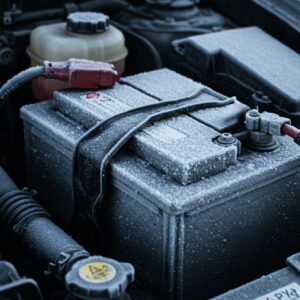
- Next, prove out the battery and its connections. Twist each terminal by hand. Any movement at all is too loose. Clean any corrosion until you have bright metal at both the post and inside the clamp, then retighten. After the car has sat for a few minutes, measure resting voltage: around 12.6 volts is a healthy charge. Significantly lower and you should treat the battery as discharged. Always disconnect the negative cable first and reconnect it last.
- If voltage is low, jump-start it correctly. Set both vehicles in Park with parking brakes set, connect positive to positive, then connect the negative lead to a clean engine or chassis ground on the disabled vehicle, not the battery terminal. If you don’t have good heavy duty jumper cables or one of those handy starter “bricks,” first let the donor idle for a few minutes before attempting a start. If the car starts and dies when you disconnect the jumper cables or very soon after, the alternator isn’t charging. It helps to have a voltmeter you can connect to the battery with the engine running. If the alternator is charging you’ll see between 13 and 14 volts with the engine running. If the battery is bleeding voltage, the alternator isn’t charging.
- If the battery checks out, shift your focus to the starter circuit. A single solid click at the starter with no rotation often points to a bad starter or a high-resistance connection. No click at all usually points further back: to the relay, ignition switch, immobilizer, or a blown starter fuse.
A useful rule of thumb: bright dash lights plus one click pushes you toward the starter circuit. Bright lights with no brake lights pushes you toward the brake switch or its fuse.

Pro Tips are nuggets of information direct from ASE-certified automobile technicians working with CarParts.com, which may include unique, personal insights based on their years of experience working in the automotive industry. These can help you make more informed decisions about your car.
Pro Tip: This is useful on Push Button start vehicles where the brake pedal has to be pressed for the starter to engage.
Cranks but Won’t Fire: Fuel, Spark, Air, Timing, and Security
If the engine cranks normally but won’t start, the starter circuit is doing its job; the problem is that the engine isn’t catching. Focus on fuel delivery, spark, and whether the engine computer is blocking the start due to a security issue or missing sensor input.
- Start by confirming there’s fuel in the tank and that the right fuel was added, especially if the problem appeared right after a fill-up. If the gauge is near empty and the car is parked on a steep incline, the fuel pickup can actually uncover and behave like an empty tank.
- With the key on and engine off, listen near the rear seat or fuel filler area for a brief hum. That’s the fuel pump priming. No prime means you should check the pump fuse and relay before assuming the pump itself is bad.
- Plug in an OBD-II scanner early in the process. Crankshaft or cam sensor faults can kill spark or injector pulse, and security faults on some vehicles will allow cranking while quietly blocking a start.
- On the ignition side, a failed coil can produce a clean no-start with no other obvious symptoms. On the air side, a major intake leak or throttle problem can cause a sputter-and-stall or prevent starting altogether.
- If the exhaust smells strongly of fuel, the engine may be flooded — stop cranking. Hold the accelerator fully to the floor and crank in short bursts. Most modern fuel-injected vehicles have a clear-flood mode that cuts fuel injection when the pedal is floored. Once it catches, release the pedal and let it stabilize. Keep in mind that continuous cranking overheats the starter quickly.
- If the engine cranks unusually fast, take it seriously. That behavior can indicate low compression from a timing belt or chain failure, and continuing to crank can make things worse. Stop and verify timing integrity first.
One note for diesel owners: many modern diesels will eventually prevent a restart if the diesel exhaust fluid is empty or the DEF system is faulting.
Moving an Automatic That Won’t Start: Shift-Lock Release and Safe Towing Prep
If you need to move the car before you’ve fixed it, the safe method is shift-lock release plus controlled rolling, not attempting a bump start. Plan for reduced or absent power assist on the brakes and steering, and always use a spotter.
You’ll need wheel chocks, a helper to steer and brake, the owner’s manual, and a small screwdriver or trim tool.
Set the parking brake and chock at least one wheel before you do anything. Turn the ignition to ACC or ON if the vehicle allows it. Find the shift-lock release slot near the shifter base, remove the cover, press the release tab, and shift to Neutral. Move the vehicle slowly with your spotter guiding you, then reapply the parking brake and chocks as soon as you’ve reached the target position.
Two important warnings: many automatics can’t be flat-towed with the drive wheels on the ground without damaging the transmission, so use a flatbed or wheel dollies when in doubt. And never release Park on a slope until you’re certain the parking brake is holding.
Engine Starts but the Car Will Not Move: Quick Automatic Transmission Checks
If the engine starts fine but the car won’t move, the starting system is no longer your concern; the problem is in the transmission, driveline, or engagement. Start with external checks and resist the urge to rev the engine to force things to engage.
Confirm the parking brake is fully released and that the brakes aren’t seized. Check that the shifter indicator actually matches the gear the transmission is in. A loose cable can leave it sitting in Neutral while the indicator shows Drive. Look under the car for fresh transmission fluid on the ground, and if the transmission has a dipstick, check the fluid level and condition using the manufacturer’s procedure, typically with the engine running and warmed up.
If there’s no engagement in any range, you’re likely looking at a major hydraulic failure, a torque converter problem, or a broken axle. If drive disappeared suddenly rather than gradually, stop trying to power through it. A tow is far cheaper than burned clutch packs.
Keep Reading: Related Posts


Any information provided on this Website is for informational purposes only and is not intended to replace consultation with a professional mechanic. The accuracy and timeliness of the information may change from the time of publication.