A distributor cap is the plastic, terminal-studded cover that sits on top of the distributor and passes high voltage from the ignition coil to each spark plug wire in turn. When the cap cracks, wears, or corrodes, this voltage can no longer reach the spark plugs the way it should, so the engine misfires, runs rough, becomes hard to start, or cranks without starting at all.
Quick Answer
- Meaning: A distributor cap is a plastic cap with metal terminals that sits on top of the distributor and routes high voltage from the ignition coil to the spark plug wires.
- What it affects: Spark delivery, which means starting, idle quality, and overall engine performance in vehicles with a distributor-style ignition system.
- How serious it is: A lot can go wrong when driving with a cracked distributor cap, and it can even render your vehicle undrivable if left unaddressed for too long. A heavy, sustained misfire can also damage the catalytic converter.
- Possible causes: Worn terminals, corrosion, cracks, tiny holes, a worn center terminal, and carbon tracking. Caps operate under high voltage in extreme conditions, so they wear out over time.
- What to do first: Remove the cap and inspect it for cracks, tiny holes, corroded terminals, and excessive terminal wear, then check it with a digital multimeter set to ohms.
- Can you keep driving with it: Not for long. Address a misfire promptly, and avoid driving at all if the engine cranks but won’t start or the misfire is severe.
- Typical cost: Roughly $80 to $200 to have a professional replace a distributor cap, depending on your vehicle’s year, make, and model.
- Related part to check: distributor pickup coil symptoms can look almost identical to cap problems, so rule the cap in or out before replacing other ignition parts.
What Is a Distributor Cap?

Distributor caps are only found in vehicles that have a distributor-style ignition system. It helps to know how the ignition system works to understand the role the cap plays.
Like any ignition system, a distributor setup is designed to fire the spark plugs to ignite the air-fuel mixture inside the engine. The heart of the system is the distributor, an engine-driven device that passes high voltage from the ignition coil to the spark plugs.
The distributor cap is made of plastic and has metal terminals. High voltage from the ignition coil is sent to the middle terminal of the cap whenever the engine is running. From there, the voltage travels to the rotor inside the distributor. The rotor turns with the distributor, delivering voltage to the cap’s terminals one at a time.
Each terminal connects to a spark plug wire that provides a path for voltage to reach one of the engine’s spark plugs and make the plug fire. The firing spark plugs produce a series of small explosions, creating the energy needed to propel your vehicle down the road.
Although newer vehicles no longer have distributors and rely on individual ignition coils instead, there are still many older models on the road with distributor-style ignition systems. If you’re reading this article, your car is probably one of them.
What Are the Symptoms of a Bad Distributor Cap?
Like spark plugs and spark plug wires, distributor caps are considered a maintenance item that wears out over time. If you neglect to service the cap, it will eventually fail, resulting in one or more noticeable symptoms.
Note: Because other problems can present the same symptoms as a bad distributor cap, you’ll want to perform a thorough diagnosis of the vehicle before doing any repairs. Issues as unrelated as oil in the throttle body can also cause rough running.
Misfiring and Rough Running
Issues with the cap, including worn terminals, corrosion, cracks, and carbon tracking, can prevent voltage from reaching the spark plugs as it should. As a result, the engine will misfire, run rough, and exhibit an overall lack of performance.
Illuminated Check Engine Light
In all vehicles built after 1996, and some built prior, the engine computer, which is often referred to as the powertrain control module (PCM), monitors the engine for misfires. If the PCM detects a misfire for any reason, including a bad distributor cap, the module will turn on the check engine light and store a diagnostic trouble code in its memory. Misfire codes in the P0300 series are the most likely to appear, while primary ignition codes such as P2331 Ignition Coil K Primary Control Circuit High point toward the coil circuit rather than the cap.
Hard Starting
The same distributor cap problems that can lead to misfiring and rough running can also result in extended cranking and difficulty starting. Hard starting that is worst on cold, damp mornings often points to moisture or condensation inside the cap.
Engine Cranks But Doesn’t Start
Problems with the distributor cap, such as cracks, a worn center terminal, or severe carbon tracking, can also lead to an engine that cranks but doesn’t start.
No Spark From Distributor Cap Terminals
No spark from distributor cap terminals is the most extreme version of the same problem. If a spark tester connected to a plug wire shows nothing while the engine cranks, voltage is either not reaching the cap or not getting through it, which points to a failed center terminal, a cracked cap, severe carbon tracking, or a problem further upstream in the ignition system.
Corroded Distributor Cap Terminals
A corroded distributor cap shows green or white powdery buildup on the metal terminals inside the cap. This buildup adds resistance in the spark path, which weakens the spark and produces the same misfiring, rough running, and hard starting listed above.
Why Do Distributor Caps Go Bad?
Distributor caps operate under high voltage in extreme conditions. They’re considered maintenance items that should be replaced periodically. It’s a good idea to replace the distributor cap and rotor whenever you do a tune-up.
Possible causes of failure include the following:
- Normal wear on the terminals from constant high-voltage arcing
- Corrosion on the metal terminals inside the cap
- Cracks or tiny holes in the plastic housing
- A worn center terminal that no longer contacts the rotor properly
- Carbon tracking, a tiny line of carbon that creates an unwanted path for electricity
- Moisture or condensation trapped under the cap, which lets voltage jump to the wrong place
- Oil or coolant contamination from a leaking distributor seal or nearby gasket
How Serious Is a Bad Distributor Cap?
A lot can go wrong when driving with a cracked distributor cap. It can even render your vehicle undrivable if left unaddressed for too long.
A mild misfire will usually still get you home, but it shouldn’t be ignored. Sustained misfiring sends unburned fuel into the exhaust, which can overheat and damage the catalytic converter, and a cap that’s arcing internally can fail completely without warning. If the engine cranks but won’t start, or the check engine light is flashing, stop driving and diagnose the problem before continuing.
How Do You Test for a Bad Distributor Cap?

Work through the checks below in order, starting with the easiest and least expensive.
Step 1: Remove the Cap and Inspect It
One of the best ways to check a distributor cap is to remove it and perform a visual inspection. You’ll want to look for problems such as cracks, tiny holes, corrosion on the terminals, and excessive terminal wear. Inspect the rotor at the same time, since it wears along with the cap.
- If you find cracks, holes, heavy corrosion, or badly worn terminals: replace the cap and rotor.
- If the cap looks clean: continue to the multimeter tests below.
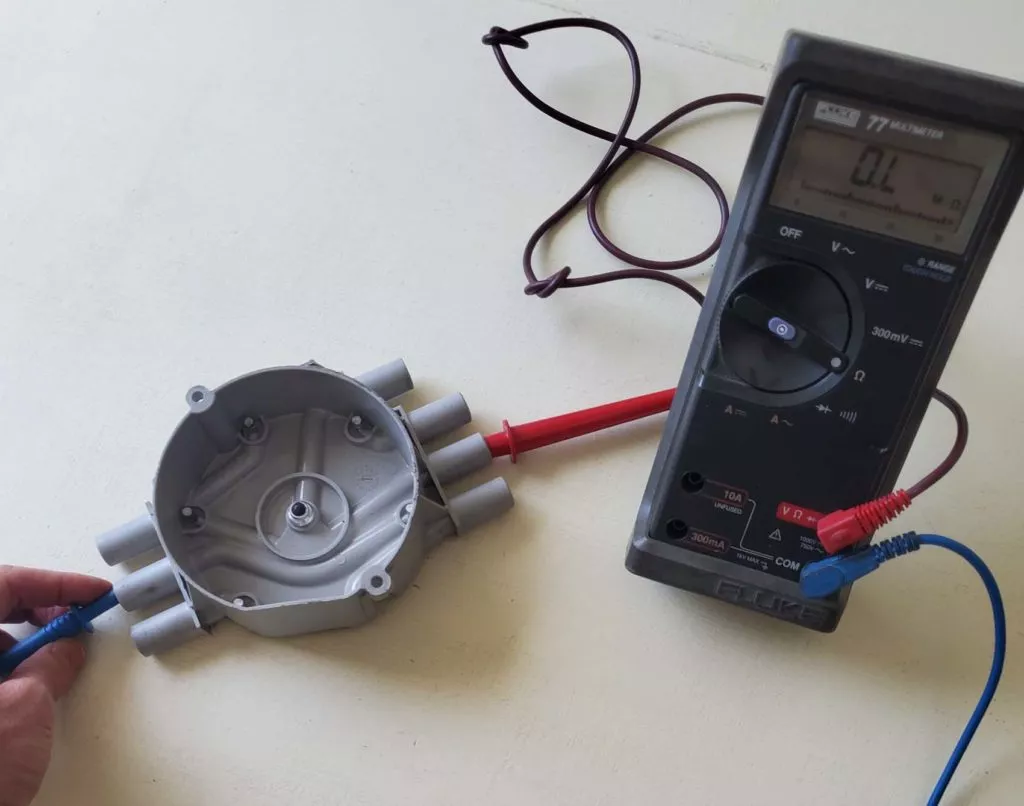
Step 2: Test the Path Between the Coil Terminal and Center Terminal
You can test the cap for carbon tracking using a digital multimeter (DMM) set to ohms. The same method can reveal whether the internal path between the cap’s ignition coil terminal and center terminal is intact. Here’s how it’s done:
- Place one meter lead on the cap’s coil terminal and the other meter lead on the center terminal.
- There should be continuity between the two terminals. If not, the cap is defective and needs to be replaced.
Step 3: Test for Carbon Tracking Between Terminals
- Place one meter lead on one of the cap’s outer terminals.
- Place the other meter lead on each of the remaining outer terminals one at a time.
- There should NOT be continuity between any of the two outer terminals. If there is, the cap is defective and needs to be replaced.
- Place one meter lead on the cap’s center terminal.
- Place the other meter lead on each of the spark plug terminals one at a time.
- There should NOT be continuity between the center terminal and any of the spark plug terminals. If there is, the cap is defective and needs to be replaced.
Step 4: If the Cap Tests Good, Look Upstream
A cap that passes both inspection and the continuity tests probably isn’t your problem. From there, check the rotor, the spark plug wires, the ignition coil, and the trigger sensor inside the distributor before replacing parts.


Distributor Pickup Coil Symptoms vs. Bad Cap Symptoms
Many distributors house a pickup coil, also called a magnetic pickup or reluctor sensor, that tells the ignition module when to fire. Because it sits in the same housing and feeds the same spark path, its failure looks a lot like a bad cap.
Distributor pickup coil symptoms typically include the following:
- Intermittent stalling that happens without warning, often once the engine is warm
- A no-start with no spark at any plug wire, even though the engine cranks normally
- A tachometer that drops to zero or jumps erratically while driving
- Misfires that come and go rather than staying in one cylinder
The practical difference is that cap faults usually show up as visible damage, corrosion, or a failed continuity test, while a pickup coil fault leaves the cap looking perfect. A pickup coil is checked by measuring resistance across its two leads and comparing the reading to the specification in the service manual for your vehicle’s year, make, and model.
How To Change the Distributor Cap
If testing points to the cap, replacing it is a straightforward job for most engines. Here’s how to change the distributor cap without disturbing the ignition timing:
- Park on level ground, shut the engine off, and let it cool. Disconnect the negative battery cable.
- Label each spark plug wire and the cap terminal it plugs into, or plan to move the wires one at a time so the firing order can’t get mixed up.
- Release the cap by removing its two hold-down screws or unclipping its spring clips, depending on the design.
- Lift the cap straight off and inspect the rotor. Replace the rotor along with the cap.
- Set the new cap next to the old one and confirm the terminal layout matches before transferring anything.
- Move the spark plug wires from the old cap to the new one, one wire at a time, into the matching terminal position.
- Seat the new cap on the distributor housing, then tighten the screws or clips evenly and only until snug. Overtightening cracks the plastic.
- Reconnect the battery, start the engine, and confirm a smooth idle. Clear any stored misfire codes and recheck that the check engine light stays off.
Safety note: Ignition systems produce tens of thousands of volts. Never handle spark plug wires or the cap while the engine is running or cranking, and keep the battery disconnected while the cap is off. Don’t loosen the distributor hold-down bolt or rotate the distributor housing, because doing so changes the ignition timing.
How Much Does It Cost To Replace a Distributor Cap?
If you choose to have a professional replace your car’s distributor cap, you can usually expect to pay somewhere between $80 and $200 to get the job done. Of course, the exact cost will depend on various factors, such as your vehicle’ year, make, and model. Doing the job yourself removes the labor portion of this estimate, and most caps take less than an hour to swap.
Distributor Cap FAQ
Remove the cap and look for cracks, tiny holes, corrosion on the terminals, and excessive terminal wear, then test it with a multimeter set to ohms. There should be continuity between the coil terminal and center terminal, and no continuity between any two outer terminals. Failing either test means the cap is defective.
Yes. Cracks, a worn center terminal, or severe carbon tracking can lead to an engine that cranks but doesn’t start. Because no spark from distributor cap terminals can also be caused by the coil, the ignition module, or the pickup coil, confirm the cap is faulty before replacing it.
Light cleaning can restore a spark temporarily, but it isn’t a repair. Corrosion on a corroded distributor cap means the terminals have already been eroded by arcing, and the cap is a wear item by design. Replace it along with the rotor.
There’s no universal interval, which is why the cap is treated as a tune-up item rather than a fixed-mileage part. Many owner’s manuals group the cap and rotor with spark plug service, so check the maintenance schedule for your vehicle. It is a good idea to replace the distributor cap and rotor whenever you do a tune-up.
Yes. Distributor caps are wear-and-tear items that should be replaced along with the rotor whenever you do a tune-up. The two parts wear together because voltage arcs between them every time a plug fires.
It isn’t a good idea. A lot can go wrong by driving with a cracked distributor cap, and it can even render your vehicle undrivable if left unaddressed for too long. A sustained misfire can also damage the catalytic converter, so have the problem diagnosed rather than putting it off.
Carbon tracking is a tiny line of carbon that creates an unwanted path for electricity inside the cap. It lets voltage take a shortcut instead of reaching the intended spark plug terminal. You can detect it with a multimeter by checking for continuity between terminals that should be isolated from each other.
It can. In all vehicles built after 1996, and some built prior, the powertrain control module monitors the engine for misfires, and it will illuminate the check engine light and store a diagnostic trouble code when it detects one. The code identifies a misfire, not the cap specifically, so testing is still required.
In most engines with good access, the job takes about 15 to 30 minutes. Tight engine bays, seized hold-down screws, or brittle spark plug wires can stretch this considerably.
No. Distributor caps are only found in vehicles that have a distributor-style ignition system. Newer vehicles no longer have distributors and rely on individual ignition coils instead, so they have no cap or rotor to service.
Yes. Condensation or water that gets under the cap gives voltage an easy path to the wrong terminal, which shows up as a misfire or hard start that’s worst on cold or damp mornings and improves as the engine warms up. Inspect the cap for moisture and check that it’s sealing properly against the distributor housing.
Distributor pickup coil symptoms include intermittent stalling, a crank with no spark at any wire, an erratic or dropping tachometer, and wandering misfires. Because those overlap with cap failures, inspect and test the cap first, then measure the pickup coil resistance against the specification for your vehicle.
When To Get Professional Help
Bring in a professional if the engine still has no spark after the cap and rotor are replaced, if misfire codes return after the repair, if you find oil or coolant inside the distributor housing, or if the distributor has been rotated and the ignition timing needs to be reset. A shop can also load-test the coil and ignition module, which is difficult to do accurately with a basic multimeter.
Where To Get a New Distributor Cap for Your Vehicle
A lot can go wrong by driving with a cracked distributor cap. It can even render your vehicle undrivable if left unaddressed for too long. Fortunately, CarParts.com makes it easy for you to shop for a top-notch replacement.
You don’t have to leave the comfort of your home to buy a replacement distributor cap from us. Sit back, relax, and click away on our website. Enter your vehicle’s year, make, and model into our vehicle selector to narrow down the search results to compatible products for your ride. All our distributor caps passed strict quality checks, so you’re sure to get a durable replacement.
Our distributor caps come with a low-price guarantee to help you get the best value for your money. Order now, and we’ll deliver your product straight to your doorstep in as fast as two business days. You can also call us using our toll-free hotline to place an order with the help of our round-the-clock customer service.
Get your vehicle running like it’s good as new when you shop for a distributor cap replacement here at CarParts.com!
Keep Reading: Related Posts




Any information provided on this Website is for informational purposes only and is not intended to replace consultation with a professional mechanic. The accuracy and timeliness of the information may change from the time of publication.