A deep cycle car battery delivers steady power over extended periods and bounces back from repeated discharge cycles, making it ideal for accessories and loads that run when the engine is off. For most daily drivers, it works best as an auxiliary battery or in a dual-purpose configuration rather than as a direct replacement for your factory starting battery.
What is a deep-cycle battery for a car, and when should you use one?
A deep-cycle battery is designed for repeated charge and discharge cycles. Its lifespan is measured in cycles until capacity drops to around 80% of its original rating. It’s the right choice when you’re running loads like refrigerators, lights, air compressors, ham radios, winch control circuits, or extended tailgate audio sessions with the engine off.
Common use cases:
- Camping and overlanding: powering fridges, lights, fans, and device charging
- Work trucks: running inverters, tool charging stations, and on-site lighting
- Marine-style vehicle loads: stereos, pumps, and electronics
- Fleet and utility vehicles: providing extended accessory power without idling
If your only concern is reliable cold starts, a standard automotive starting battery that matches your vehicle’s required group size and CCA rating is usually the better choice.
Can a deep-cycle automotive battery replace your normal car battery?
Sometimes, but it depends on your cranking requirements, climate, and the specific battery design. And it’s surprisingly easy to pick the wrong one.
The Risks of Making the Switch
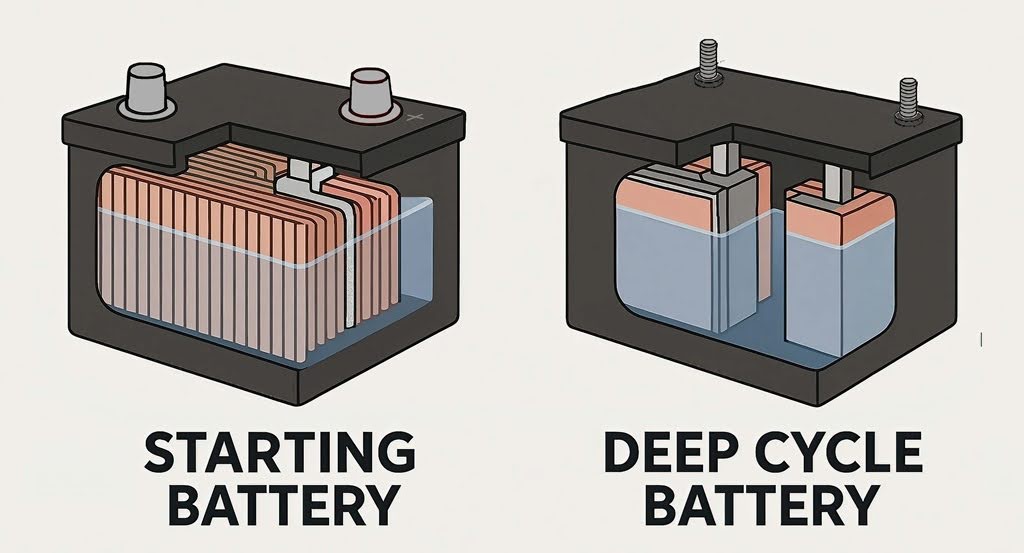
Deep-cycle batteries are built for “slow and steady” discharge; they often lack the “punch” needed to start a car, especially in cold weather when engine oil is thick.
While deep-cycle batteries are tougher when it comes to charging and discharging repeatedly, they are actually stressed by the rapid, high-current draw of spinning a starter. Starting a vehicle with one of these can cause the thicker plates to warp or degrade prematurely.
Car batteries are designed for the hot engine compartment, but most deep-cycle batteries can’t handle the heat. Besides that, a car’s alternator may not have the correct charging profile to properly maintain a deep-cycle battery, leading to undercharging.
A deep-cycle automotive battery can start an engine if it has sufficient cold cranking amps (CCA), but many deep-cycle models prioritize capacity and cycling performance over maximum cranking output. If you live somewhere with freezing mornings or your vehicle has high electrical demands—large engines, diesel glow plugs, heavy accessory loads—the wrong choice can result in slow cranking or a no-start condition.
Better alternatives to a straight swap:
- Dual-purpose battery: designed to handle both starting and cycling duties (popular in overlanding and marine crossover applications). These use plates that are thicker than a starting battery but thinner than a true deep-cycle.
- Function: They offer enough surface area to start an engine while maintaining enough durability to handle moderate deep cycling.
- Second battery system: keep your proper starter battery for starting and add an auxiliary deep-cycle battery for accessories, typically with an isolator or DC-to-DC charger
Safety note: If you’re using any lead-acid battery inside a vehicle cabin or enclosed box, ventilation is critical. Even sealed VRLA AGM batteries shouldn’t be operated or charged in a completely sealed, gas-tight enclosure.
Which deep-cycle battery types work best in vehicles?
In cars and trucks, the “best” type depends on mounting location, cycling frequency, and charging speed requirements.
Deep-cycle battery options compared
| Battery type | Best use in a vehicle | Pros | Watch-outs | Typical street price (Jan 2026) |
| Flooded lead-acid deep cycle | Budget auxiliary battery in a ventilated area | Lowest upfront cost | Must stay upright, can vent gas, corrosion risk, requires ventilation | $80–$130 for common marine/RV sizes |
| AGM (VRLA) deep-cycle | Under-hood or interior-adjacent auxiliary power where spill resistance matters | Spill-resistant, lower maintenance, good power delivery | Sensitive to chronic undercharging and overvoltage; requires proper charge profile | Around $180 for common AGM marine/RV models |
| Gel (VRLA) | Specialty cyclic use where gel is specified | Good cycling performance when charged correctly | Stricter charging profile; wrong charger can significantly shorten life | Varies widely by brand and size |
| LiFePO4 (lithium iron phosphate) | High-cycle, lighter auxiliary setups with proper charging hardware | High usable capacity, excellent cycle life in many setups | Requires correct charging system; alternator integration typically needs DC-to-DC charging | Around $600 for a 12V 100Ah example |
A nuance that causes confusion: Some AGM batteries are specifically built for deep-cycling, particularly marine/RV-style models, because AGM is a sealed VRLA construction commonly used for cyclic applications.
Another important nuance: AGM on the label doesn’t automatically mean the battery is designed for repeated deep discharge. There are AGM starter designs and AGM dual-purpose designs, so always verify the ratings and intended use in the spec sheet.
How many amp-hours do you actually need for accessory run-time?
Amp-hours (Ah) measure capacity: a battery rated at 100Ah at the 10-hour rate can deliver 10A for 10 hours before voltage drops to the standard cutoff (typically 10.5V for a 12V battery). This rating method explains why you’ll see different “rates” listed in spec sheets.
Typical 12V deep-cycle batteries used for auxiliary power range from about 70Ah to 120Ah, depending on physical size and construction. For example, a Trojan Group 27 deep-cycle model is rated at 115Ah at the 20-hour rate.
A simple sizing method for DIY planning
- List all loads you’ll run with the engine off (fridge, lights, inverter, etc.)
- Convert watts to amps when needed: amps = watts ÷ 12 (use 12V for rough calculations; actual voltage varies)
- Estimate total amp-hours consumed: amps × hours
- Add a buffer for cold weather, battery aging, and inefficiency (inverters and compressors draw more power than you might expect)
Important limits to protect your battery
Deep discharge and high heat significantly reduce battery life. In cyclic use, battery life is defined by the number of cycles until capacity drops, with depth of discharge being a primary factor. Trojan’s user guidance specifically warns against excessive depth of discharge to maximize longevity.
How do you charge a deep-cycle battery correctly at home?
Use a smart, multi-stage charger that matches your battery chemistry (flooded vs. AGM vs. gel vs. lithium). Lead-acid charging typically follows a constant-current phase, then constant-voltage “topping,” then float maintenance. Regularly skipping the topping stage can reduce performance over time.
Step-by-step charging process (DIY-friendly)
- Inspect first: A cracked case, bulging, or leaking means stop immediately. If you smell an odor or see venting, remove the battery from service and ventilate the area before disconnecting.
- Clean terminals: Corrosion increases resistance and slows charging.
- Ensure ventilation: Charge in a well-ventilated area—hydrogen gas produced during charging is explosive.
- Select the right charger mode: flooded, AGM, gel, or lithium.
- Connect correctly: Attach the positive clamp to the positive terminal and negative to negative (or to a designated ground point per charger instructions).
- Let it finish: For lead-acid batteries, full charging can take many hours. Faster charging may reduce time but might not fully top off the battery depending on the charger and current.
- After charging flooded batteries: Only add distilled water if needed, and do it correctly (don’t overfill before charging).
Two critical “stop right now” warnings
- Never charge a frozen battery, and don’t let lead-acid batteries freeze in the first place
- Don’t charge in a sealed enclosure, even with AGM VRLA batteries
Charging from the alternator (especially important for lithium)
Vehicle alternators are designed for automotive starting systems, not every auxiliary battery chemistry. For modern dual-battery setups, DC-to-DC charging is commonly used to manage charge profiles and work with smart alternators in newer vehicles.
How do you test a deep-cycle battery when it feels weak?
Start with state-of-charge, then distinguish between “low charge” and “low health.” A battery can show decent voltage at rest and still have poor capacity. Many quick testers focus more on resistance/CCA than true capacity.
Fast triage in 5–10 minutes
- Let the battery rest: For accurate voltage-based state-of-charge readings, allow the battery to rest. Battery University recommends at least a few hours, and manufacturers may suggest longer for lead-acid batteries.
- Measure open-circuit voltage with a digital multimeter. Using BCI reference values at around 78°F after rest:
- ~12.65V: ~100% charged
- ~12.24V: ~50% charged
- ~11.89V: ~0% charged (discharged)
- Look for obvious problems: loose terminals, corrosion, damaged cables, or a swollen case. Loose connections can overheat and create fire risk.
Deeper checks for actual diagnosis
Flooded batteries only: hydrometer test
Specific gravity rises with charge and drops with discharge, providing a direct window into the battery’s chemistry.
Capacity reality check (most accurate)
A true capacity test takes time because capacity is the leading health indicator and can’t be measured quickly.
Conductance/rapid testers (useful but limited)
Many shop testers estimate condition primarily from resistance or CCA-related behavior rather than full capacity, so results can be misleading if the battery is simply undercharged.
If your “battery problem” is actually the charging system
Verify that the battery gets fully recharged after use. Chronic partial state of charge promotes sulfation and performance loss.
How long should a deep-cycle battery last, and what kills it early?
Service life depends on discharge depth and frequency, plus heat, charging quality, and storage conditions. Generally, deep-cycle batteries last around 3 to 6 years, but heavy cycling, high temperatures, or chronic undercharging can significantly shorten that lifespan.
Two ways to think about lifespan
Cycle life
In cyclic use, life is measured in number of cycles until capacity falls (typically to 80% of rated capacity).
Abuse factors that dramatically shorten life
- Leaving lead-acid batteries at low charge (sulfation risk)
- Overheating during charging or operating in high ambient temperatures
- Overcharging flooded batteries (water loss) or applying overvoltage to VRLA batteries (can vent and lose capacity)
Storage note: ODYSSEY documents long cold-storage capability and provides trickle/float voltage ranges for maintaining batteries during extended storage periods.
Is it safe to keep driving with a failing deep-cycle setup?
If the deep-cycle battery is only an auxiliary battery and it’s properly isolated, you can usually drive to a parts store or service center, but stop using the accessory loads and address the root cause. If your vehicle depends on that battery for starting, failure can quickly leave you stranded.
Do not continue driving or charging if you see:
- Swollen case, leaking, or cracked housing
- Odor or visible venting: remove from service and ventilate before disconnecting
- Hot cables or melting insulation: treat as an electrical fire risk and stop immediately
What does a deep-cycle setup cost, and what parts get replaced together?
Costs divide into the battery itself and the supporting components that keep it healthy.
Battery-only pricing examples (varies by size and region)
- Flooded deep-cycle: $80–$130 for common marine/RV sizes
- AGM deep-cycle: Around $180 for common AGM marine/RV models
- LiFePO4: Around $600 for a 12V 100Ah example
Parts commonly replaced or added with the battery
- Smart charger or maintainer sized for the battery chemistry
- Battery cables and terminals if corrosion or voltage drop is present
- Isolator or DC-to-DC charger for dual-battery setups, especially with lithium or smart alternators
- Fuse protection near the battery for accessory circuits (critical for fire prevention)
Keep Reading: Related Posts





Any information provided on this Website is for informational purposes only and is not intended to replace consultation with a professional mechanic. The accuracy and timeliness of the information may change from the time of publication.