If you’ve ever wondered what is an axle shaft, it’s the rotating rod that transfers power from your differential to your wheels, making them spin so you can actually move. Without it, all that engine power would have nowhere to go. These shafts come in different designs depending on your vehicle. Some are solid one-piece units, while others have CV joints that flex with steering and suspension movement.
A worn or damaged axle shaft can silently mess with your car for weeks, affecting how it handles, how smooth the ride feels, and even your safety, long before it actually breaks. If you let issues go unnoticed, you might end up needing way more than a simple part replacement. That’s why understanding what an axle shaft does and how it works is so important before you start looking into repairs or upgrades.
What Is an Axle Shaft?
An axle shaft is the mechanical link between a vehicle’s differential (or transmission, depending on drivetrain layout) and its wheels. It transfers torque and rotational force so the wheels can turn. In many designs, it also bears part of the vehicle’s weight, especially in solid axle or live-axle setups.
Because of the torque and stresses involved, axle shafts are robust components, typically made of alloy or heat-treated steel to resist torsion, bending, and fatigue under load.
How Does It Work?
The drivetrain of a vehicle moves power from the engine to the wheels via a series of components. In many conventional rear-wheel drive vehicles, power leaves the transmission through a driveshaft (also called propeller shaft), goes into the differential, and from there gets distributed to each wheel via axle shafts.
Cars with independent suspensions have half-shafts (axle shafts) connect to the wheels through joints and bearings, allowing the wheels to move independently while still receiving power.
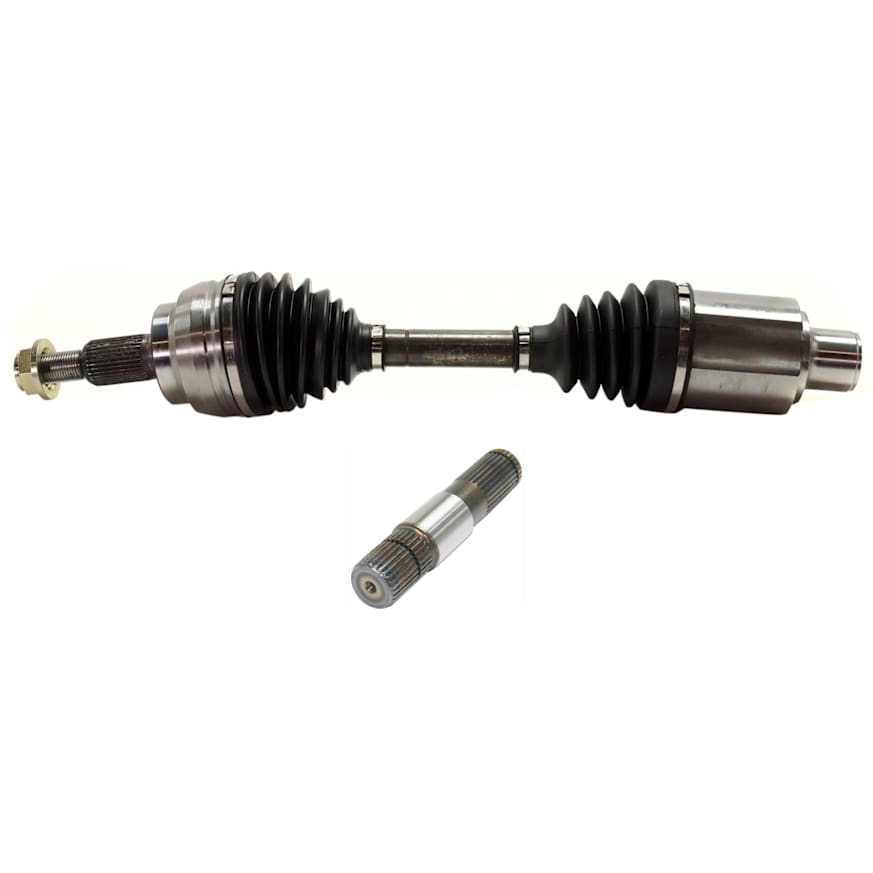
A common configuration in front-wheel-drive or all-wheel-drive vehicles involves a “CV axle,” which integrates the axle shaft with flexible joints to handle steering and suspension articulation without losing torque transmission.
The term “CV shaft” sometimes refers specifically to that flexible half-shaft assembly used in front or all-wheel-drive cars, distinguished from a straight, solid axle shaft often found in simpler rear-wheel-drive designs.
Axle Shaft Replacement
Axle shafts can fail or degrade over time for several reasons, and recognizing these helps prevent sudden breakdowns.
Vehicles that frequently carry heavy loads or tow can overstress axle shafts, because the shafts must handle both the weight of the load and the torque required to move it. Occasional overloads can gradually reduce the shaft’s structural integrity. Rough roads, potholes, off-road excursions, or sudden impacts generate shocks and bending forces that can deform or crack axle shafts. Even small bends or cracks compromise reliability drastically.
In assemblies using flexible joints, the protective rubber boot around the joint can eventually tear, allowing grease to leak out and dirt or debris to enter. That contamination accelerates wear and can ultimately ruin the joint or entire shaft assembly.
Manufacturing defects, corrosion (especially in salty or wet climates), or extreme age can also degrade axle shafts. In solid-axle or live-axle vehicles, bearing wear or misalignment inside the axle housing may cause uneven stress distribution, leading to premature shaft damage.
Common Symptoms of Failure
Detecting axle shaft problems early can save you from dangerous failures and costly repairs.
One common sign is unusual vibrations or shimmying while driving. A bent or warped axle shaft won’t spin perfectly, which leads to vibrations that intensify with speed, affecting ride comfort and control.
You might hear clicking, popping or clunking noises when turning or accelerating, especially in vehicles with CV axles. These sounds often stem from worn or failing joints at the ends of the axle shaft.
Grease or dark grime around the wheel rims or tire edges signals a torn CV boot or leaking axle lubricant. Without grease, joints overheat quickly and fail.
Finally, you might notice poor handling, uneven tire wear or reduced vehicle stability. An axle shaft that isn’t transmitting torque or holds misaligned wheels compromises traction and steering response.
If axle shaft damage becomes severe, the vehicle may fail to drive at all. A broken axle shaft can disconnect the wheel from the drivetrain entirely.
Cost to Replace an Axle Shaft
Replacement cost varies significantly depending on drivetrain layout, vehicle make and model, and the type of axle shaft your vehicle uses.
For a standard axle shaft replacement, you’re typically looking at parts costs ranging from $50 to $250 per shaft. Higher-performance or heavy-duty axle shafts designed for towing or off-road use can push that number higher.
Labor costs depend heavily on your vehicle’s design and how accessible the axle shaft is. Simple replacements on some rear axle setups might only take an hour or two of shop time, while more complex jobs requiring suspension disassembly or differential work could take significantly longer. Expect to pay anywhere from $100 to $400 in labor, with more complicated vehicles or rear axle configurations pushing toward the higher end.
Total cost for axle shaft replacement usually falls between $150 and $650 per shaft, though specialized vehicles or heavy-duty applications can exceed that range.
Because the opposite side axle shaft typically experiences similar wear patterns and stress, some mechanics recommend replacing both axle shafts at the same time. While this increases upfront cost, it can save you money and trouble in the long run.
Tips for Axle Shaft Repairs
Before you commit to a repair or replacement, consider several important factors regarding axle shafts.
First, verify whether your vehicle uses a solid axle shaft or a more flexible assembly (such as a CV axle or CV shaft). Replacement parts differ significantly between these designs, especially in length, spline count, and interface geometry.
If you drive with heavy loads, in rough terrain, or frequent potholes, consider upgrading to a stronger axle or one built with heavier-duty materials. For off-road or utility use, a full-floating axle or reinforced axle shaft design may offer better durability than a semi-floating or standard shaft.
When working with axle shafts that use CV joints, always inspect the CV boots and grease. If a boot shows cracks or leaks, replace it or the entire assembly before permanent damage occurs. Preventive maintenance here can greatly extend service life.
Finally, make sure any replacement shaft or assembly matches the vehicle’s specifications precisely. Check the length, spline count, bolt pattern, and hub interface. Incorrect fitment can lead to vibration, poor handling, or even catastrophic failure.
How to Replace a CV Axle Shaft
Here is a general procedure to guide you if you plan to replace a CV axle shaft. Always consult a repair manual specific to your vehicle make and model.
- Park the vehicle on level ground, engage the parking brake, and use jack stands to securely lift the relevant wheel.
- Remove the wheel and, if needed, detach any components that block access to the axle nut and hub.
- Loosen and remove the axle nut securing the axle to the wheel hub.
- Disconnect the inner end of the axle shaft from the transmission or differential (this may involve removing bolts or releasing circlips, depending on the design).
- Carefully withdraw the old axle shaft from the hub and transmission/differential. Keep track of spacers, shims, or any alignment hardware.
- Compare the old and new shaft: verify length, spline count, and boot orientation.
- Apply fresh grease to CV joints (if required) and install any new seals or boots.
- Insert the new axle shaft into the transmission/differential, ensuring it seats fully and engages securely.
- Reinstall hub components, tighten the axle nut to the specified torque, and reassemble suspension or brake components.
- Reinstall wheel, lower the vehicle, and test drive carefully to ensure smooth operation, no unusual noises, and firm steering response.
Proper Maintenance Matters
Axle shafts remain mostly out of sight, hidden under the chassis or inside suspension housings. However, they play a central role in driving dynamics, safety, and vehicle reliability.
Maintaining axle shafts prevents performance issues, reduces vibration and noise, and safeguards against sudden failures that could leave you stranded or cause accidents.
Proactive inspection helps catch boot tears, leaks, or misalignment before they escalate into full shaft failure. In many cases, replacing a boot or re-greasing a joint early is far cheaper and simpler than replacing the entire axle shaft assembly.
Ensuring proper fitment and using high-quality replacement parts, especially if upgrading for heavy-use or off-road conditions, greatly extends the lifespan of the drivetrain and improves overall vehicle behavior.
Keep Reading: Related Posts





Any information provided on this Website is for informational purposes only and is not intended to replace consultation with a professional mechanic. The accuracy and timeliness of the information may change from the time of publication.