High-quality fog lights are worth the investment because performance depends on beam control, sealing, heat management, and fitment—not just brightness. Better-built fog lights produce a low, wide pattern that helps you read the road edge in fog, rain, and snow without scattering light in ways that actually hurt visibility.
What Is Better Than Stock Fog Lights?
The answer depends on what came on the vehicle in the first place. A well-engineered direct-fit replacement is the right move when the goal is restoring original visibility, fit, and reliability. A better-built upgrade makes more sense when the factory unit was weak, poorly sealed, or limited by older optics. Either way, the right answer is never the cheapest housing with the brightest claim on the box.
Cheap fog lights tend to fail in predictable ways:
- Weak or scattered beam performance
- Poor road-edge coverage
- Condensation or water intrusion
- Short bulb or module life
- Cracked mounts or brittle housings
- Low-grade wiring and unstable electronics
- Heat damage that deforms plastic and reduces output
That is why good fog lights should be judged by usable road coverage, controlled cutoff, sealing quality, mounting strength, and long-term stability. For fog lamps, the compliance language that matters is SAE, not DOT. Fog lights are auxiliary lamps, and SAE J583 is the key standard governing front fog lamp design and performance.
Which Is Better: LED, HID, or Halogen Fog Lights?
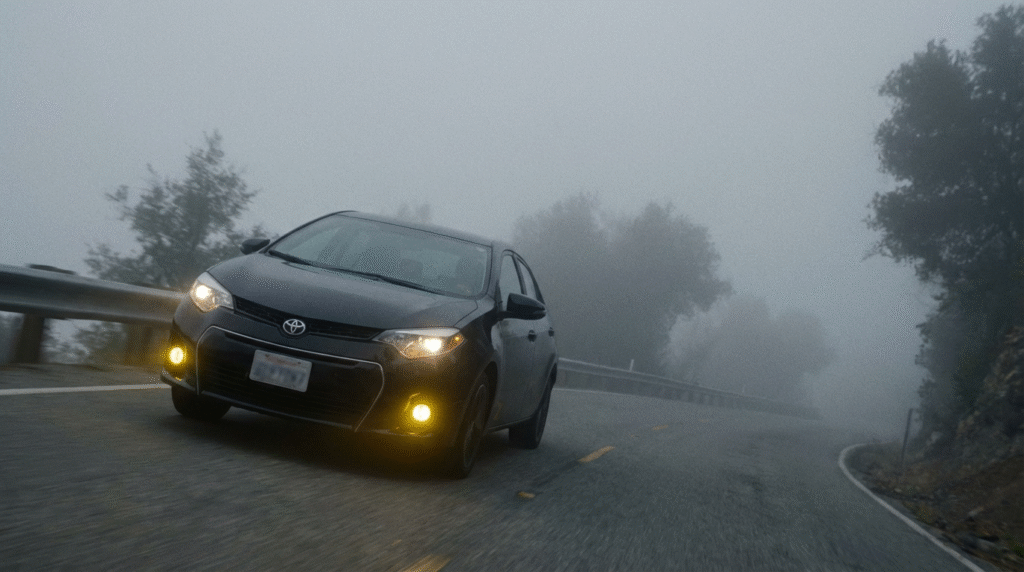
There are three main types of fog lights in the aftermarket: halogen, LED, and HID. For most daily drivers, LED is the strongest choice when the optics and thermal design are done right. Halogen still makes sense for OE-style repairs and lower upfront cost. HID is bright, and it typically requires more hardware and a slower warm-up than LED or halogen, so it performs best when the system is properly engineered to manage glare.
Here is the simple breakdown:
- Halogen: Proven, affordable, and easy to replace, but shorter-lived and less efficient
- LED: Instant full output, low power draw, long service life, and compact packaging, but only when heat control and optics are executed correctly
- HID: Strong intensity and range, and a solid option when the system is properly engineered for auxiliary lamp use
For most upgrade shoppers, LED is the practical answer. For many OE-style repairs, halogen still does the job well. If you are shopping for high-quality small round LED fog lights, pay more attention to beam shape, sealing, and mount strength than housing style alone. A high-quality 30W LED fog light is only a good buy when the wattage is backed by proper optics and thermal management, not just output claims.
Signs Your Fog Lights Are Failing
Fog lights usually show signs of decline before they quit entirely. Watch for these warning signs:
- Dim output or uneven left-to-right brightness
- Flickering during bumps or after startup
- Reduced ability to see objects at a safe distance
- Yellowed or discolored lenses
- Weak reflector performance
- Peeling internal surfaces
- Condensation inside the housing
- Melting, warped plastic, or a burning odor
When those symptoms appear, the problem is usually bigger than the bulb. Moisture intrusion, reflector deterioration, overheated connectors, and degraded seals can all reduce useful output long before a complete failure occurs.
CarParts.com’s 9-Step Validation Process
At CarParts.com, applicable fog lights go through a 9-step validation process designed to check the failure points that matter most in real-world use. The goal is not simply to confirm that a lamp turns on. The process is built to screen for sealing integrity, optical performance, electronic stability, vibration resistance, and real-world fitment before the part ever reaches the vehicle.
The process covers nine checkpoints:
- Lighting function test to verify that all illumination features operate correctly
- Air-tightness test to confirm sealing integrity under pressure
- Waterproof test using 360-degree high-pressure water spray for one hour while the lamp is active
- Real-world driving vibration test at vehicle mounting points for one hour at 750 rpm
- Endurance burn test for eight hours at 13.5 volts, followed by internal inspection
- Underwater test to confirm zero air or water leakage
- Photometric validation using an LMT goniophotometer for regulatory reference
- Electronic signal verification to confirm stable output and communication behavior
- Vehicle fitment confirmation by engineers to verify proper installation and full on-road function
This process matters because fog lights sit low on the vehicle, where they take on more spray, more debris impact, and more thermal cycling than most drivers ever realize. A fog light that passes through this kind of validation is far better positioned to resist moisture intrusion, hold its beam pattern, stay securely mounted, and deliver dependable performance over time. It also gives DIYers the fitment confidence they want, since factory-aligned design and real vehicle verification reduce installation frustration and the risk of returns.
What Are the Best Fog Light Brands From CarParts.com?
For shoppers comparing fog light brands on CarParts.com, Replacement and JC Whitney stand out for different reasons, though both are built to the same engineering and quality standards. The right pick comes down to fitment and style rather than a difference in build quality.
Replacement is a strong fit for OE-style repair. The brand’s fog lights are built as direct-fit parts with plug-and-play wiring, and product pages highlight drop-in installation, reliable visibility, and factory-style replacement use. Replacement is the right call when your priority is restoring stock-like fit, stable performance, and a repair that stays straightforward from installation through long-term use.
JC Whitney stands out for its broader variety. The lineup includes multiple fog-light configurations such as round, projector-style, and kit-based options across different price points. That makes JC Whitney a strong pick for shoppers who want more flexibility in style, housing design, or package format while still staying within the direct-fit aftermarket category.
The best decision comes down to your specific needs. Choose Replacement when your priority is OE-style restoration with minimal installation hassle. Choose JC Whitney when you want broader style and kit variety without stepping down into bargain-built unknowns.
High-quality fog lights are a safety system, not a commodity. When the optics are controlled, the seals hold, and the fit is right, you get more useful visibility, fewer repeat repairs, and better value over the life of the part.
Keep Reading: Related Posts



Any information provided on this Website is for informational purposes only and is not intended to replace consultation with a professional mechanic. The accuracy and timeliness of the information may change from the time of publication.