Manual and automatic transmissions are both solid choices, but neither is universally better. Automatics usually fit modern commuting and traffic best, while manuals reward drivers who want direct control and are willing to live with clutch wear and technique. Typically, a person who opts for a manual transmission vehicle when they can choose either way will do so because they enjoy shifting gears.
Is Manual Better Than Automatic?
A manual is better only when your priorities favor control and involvement over convenience. For most daily drivers, an automatic is easier to live with and delivers similar or better efficiency on many newer vehicles.
If you are deciding automatic transmission versus manual, start with these practical filters:
- Choose manual if you want hands-on control, you drive lots of hills or two-lane roads, and you are comfortable paying attention to clutch feel and shift quality.
- Choose automatic if you deal with stop-and-go, share the car with other drivers, or want the widest selection of trims and powertrains.
- Choose an automatic with a manual mode if you want occasional gear control without committing to three pedals.
The manual vs automatic pros and cons change with commute type, driver skill, and how much wear-and-tear risk you are willing to own.
Difference Between an Automatic and Manual Transmission
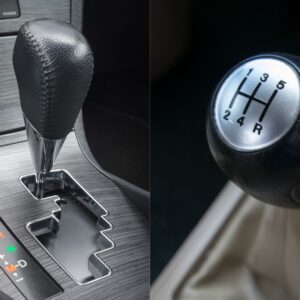
The big difference is who manages gear changes and how the engine is coupled to the gearbox. Manuals use a driver-operated clutch and shifter; traditional automatics use internal clutches, hydraulics, and electronics to control gear changes through planetary gearsets.
For DIY owners, manual gearbox vs automatic comes down to what fails and what you can diagnose quickly.
Manual highlights:
- Wear points: clutch parts, hydraulic master or slave cylinders, synchronizers, shifter linkage
- Red flags: slipping under load, hard reverse engagement, gear grind, popping out of gear. On many manuals, reverse is unsynchronized, so you may need to briefly re-engage the clutch or select another gear first if the teeth do not line up cleanly.
- Manual transmissions often need less frequent fluid service than automatics, but a leak can still cause a stealthy and expensive failure. Many also have no dipstick, so checking and adding fluid can be harder.
Automatic highlights:
- Wear points: clutch packs, solenoids, valve body, torque converter clutch, cooling system
- Red flags: delayed engagement, shift flare, harsh shifts, shudder at steady cruise, overheating. If an automatic transmission is used to pull heavy loads, it will usually need more frequent service intervals.
- A large number of automatic transmissions have no dipstick, so special procedures and tools may be required just to check the fluid level.
- Some transmissions claim to have lifetime fluid, but that does not mean the fluid will never need changing.
Note: Automatic can mean a torque-converter automatic, a CVT, or a dual-clutch, and their failure modes and service needs are not identical.
In day-to-day use, driving manual vs automatic changes workload at low speed. Manuals demand coordination; automatics free up attention for traffic management. If you are used to driving a manual, choosing the appropriate gear becomes second nature.
Warning: Riding the clutch or holding a hill with clutch slip will shorten clutch life fast. Use the brake, the parking brake, or hill-hold assist if equipped.

Pro Tips are nuggets of information direct from ASE-certified automobile technicians working with CarParts.com, which may include unique, personal insights based on their years of experience working in the automotive industry. These can help you make more informed decisions about your car.
Pro Tip: If you are driving a pickup with a manual transmission, avoid resting the weight of your hand on the gear shifter because that can contribute to premature wear in the shift linkage or related components.
Manual vs Automatic Fuel Economy
The mpg gap is usually small and model-specific, not a guaranteed win for either side. If you ask is automatic better than manual for mpg, the answer is often yes on modern cars with many gears and aggressive lockup strategies, but you have to verify it per model.
Use this quick comparison process:
- Look up both powertrain versions in the EPA fuel economy database.
- Compare combined mpg first, then check city versus highway based on your route.
- Treat a 1 mpg gap as minor unless you drive high annual miles.
- Newer automatic transmissions may have six to ten forward gears, which can help fuel economy.
Fuel efficiency swings more from driving style than from transmission type when ratings are close. Smooth throttle and fewer hard stops cut fuel consumption, and that usually matters more than shifting method. For more on the fuel economy debate, compare the exact powertrain and model year rather than relying on old assumptions.
Example: Two versions of the same car can post similar gas mileage on paper, but a manual driven with lots of clutch slip can end up worse than the automatic.
Costs and Ownership Reality
The cheapest choice is usually the one with the clearest maintenance history, not the one with the lowest sale price. A manual car or automatic car decision should be made with predictable wear items and hard-to-price risks in mind.
Where costs typically differ:
- Manuals can be cheaper to buy used, but a clutch job is a normal ownership expense and can run into the low-thousands depending on the vehicle and labor time. That said, many manual-transmission vehicles can go a long time without needing a new clutch if they are driven properly.
- Automatics often cost more to repair or replace, and diagnosis can be more involved because electronics and hydraulics overlap.
- Insurance rarely changes much based on transmission alone, since insurers weigh the driver, the model, and the location more heavily.
Tip: A manual that feels fine for ten minutes can still be due for a clutch. Prove it on a test drive before you treat the price as savings.
Automatic vs Manual Transmission Reliability
Reliability depends more on design, heat, service history, and driving habits than on the label. Manuals are simpler internally but rely on a wearable clutch; automatics can last a long time when serviced and kept cool, but they get expensive when neglected.
Quick checks that prevent parts swapping:
- Manual
- High-gear roll-on: rising rpm without matching acceleration suggests slipping clutch.
- Noise change with clutch pedal: can hint at release bearing or input shaft issues.
- Automatic
- Look for fresh leaks at cooler lines, pan seams, and axle seals.
- Scan for transmission codes and pending faults, not just engine codes. Many symptoms of a bad automatic transmission overlap with fluid, valve body, or converter issues.
| Symptom on a test drive | Likely cause | Quick check | Next step |
| Manual grinds into reverse | Clutch not fully releasing | Shift into first, then try reverse | Check clutch hydraulics and adjustment |
| Manual slips under load | Worn clutch or oil contamination | High-gear roll-on test | Inspect for leaks at bellhousing |
| Automatic delays engagement | Low fluid or leak-down | Verify level per OEM procedure | Scan codes and inspect for leaks |
| Automatic shudders at cruise | Torque converter clutch issue | Note if it changes with light throttle | Check service history and scan for TCC faults |
Warning: Skip brake-torque and stall tests. They can overheat an automatic quickly and turn a maybe problem into a definite failure.
Safety and Theft
Transmission choice is not a substitute for good tires, good brakes, and a driver who is comfortable with the controls. For car accident rate manual vs automatic debates, the best takeaway is that transmission type is a minor factor compared with driver behavior and the vehicle’s safety systems.
Practical points:
- If a manual increases stress, stalls, or hill-start mistakes, an automatic can be safer for that driver. There is more of a learning curve with manual transmissions.
- A manual may discourage an unprepared thief in some cases, but there is no strong public dataset proving a consistent theft advantage.
- A manual can sometimes be bump-started, but many modern cars still need enough battery power to run engine controls, so do not count on it.
Used-Car Test Drive Checklist That Works
Most transmission deal-breakers show up with a calm, structured drive and a quick scan. Do not buy the car that only feels good at one temperature or one throttle position.
- Start cold, listen, and press the clutch pedal or shift into drive to see if new noises appear.
- Drive gently until warm and confirm shift behavior stays consistent.
- Test typical scenarios: a manual downshift into second, or an automatic steady cruise and moderate acceleration shift.
- Park, check underneath for leaks, and scan for codes.
Example scenario: The manual feels engaging but slips slightly on a high-gear roll-on, which points to a predictable clutch job. The automatic shifts smoothly but shows delayed engagement after idling, which can be harder to price. Pick the car with the problem you can diagnose and budget confidently.
Keep Reading: Related Posts




Any information provided on this Website is for informational purposes only and is not intended to replace consultation with a professional mechanic. The accuracy and timeliness of the information may change from the time of publication.