A bad mass air flow sensor usually shows up as rough running, misfiring, poor acceleration, stalling, and reduced fuel economy. You’ll often see a check engine light too. The sensor measures the air entering your engine, and faulty readings throw off your fuel mixture.
Quick Answers
Here’s the short version before we dig into the details.
- Common warning signs: Check engine light, rough idle, misfires, hesitation, stalling, and poor fuel economy.
- What it does: The mass air flow sensor measures air entering the engine so your computer can add the right fuel.
- How serious is this issue: You can sometimes drive short-term, but address it quickly to protect your catalytic converter.
- Why it fails: Dirt, oil contamination, wiring faults, age, and airflow leaks are frequent culprits.
- What to do first: Scan for trouble codes, then inspect the sensor and its connector.
- Repair or replace: Try cleaning first, and replace the sensor if cleaning doesn’t fix it.
What Does the Mass Air Flow Sensor Do?
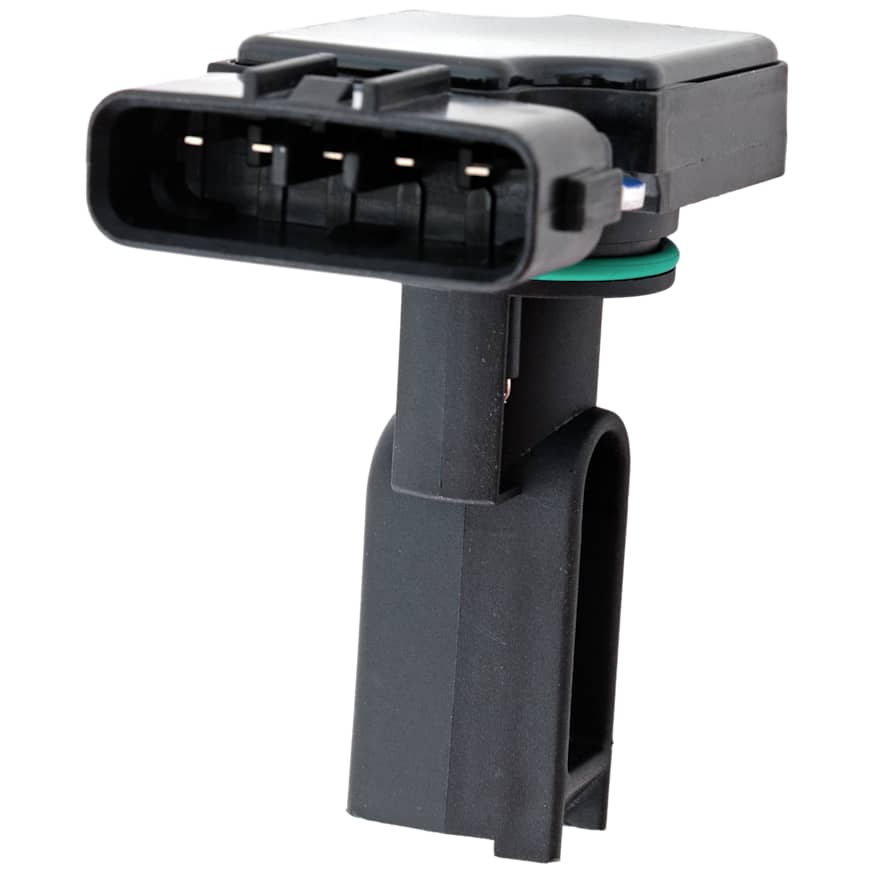
The mass air flow sensor measures how much air enters your engine. Your powertrain control module, or PCM, uses that reading to calculate fuel delivery. More air means more fuel, so accurate readings keep the mixture balanced.
The sensor sits between the air filter and the throttle body. Most designs use a heated hot wire or hot film element. Airflow cools the element, and the PCM reads that change to measure incoming air.
Not every car uses one. Some models run a Speed Density System instead. That setup leans on the manifold absolute pressure sensor and other inputs to calculate fuel.

What Are the Symptoms of a Bad Mass Air Flow Sensor?
A failing sensor sends bad data to your PCM, and your engine reacts in ways you can feel and hear. Here are the most common signs, starting with the ones you’ll notice first.
Illuminated Check Engine Light
A bad sensor often triggers the check engine light first. The PCM stores a trouble code when the signal looks wrong. Common mass air flow codes include P0100 through P0103. Air-fuel imbalance and misfire codes can also point to the sensor.
Rough Running and Misfiring
Without an accurate signal, the PCM can’t fuel the engine correctly. Your engine may run rich with too much fuel or lean with too little. Either way, combustion turns incomplete. The result is an engine that runs rough and misfires.
Poor Acceleration, Hesitation, and Stalling
A faulty sensor can starve your engine of fuel. When that happens, you’ll feel weak acceleration and hesitation. Your car may also stall at idle or when you slow down. These symptoms often get worse under load, like towing or climbing hills.
Reduced Fuel Economy
A bad sensor throws off your engine’s fuel calculations. That imbalance can push fuel consumption up. If your mileage drops with no change in driving habits, the sensor is worth checking.
What Causes a Mass Air Flow Sensor to Fail?
Most sensor problems trace back to contamination. Over time, dirt, dust, oil, and moisture coat the sensing element. That buildup blocks accurate readings and skews your fuel mixture.
Other causes show up regularly too. Oil from an over-oiled aftermarket air filter can film the element. Loose or corroded wiring disrupts the signal. Heat, vibration, and age also wear the sensor down.
Airflow leaks matter as well. A loose or cracked hose between the sensor and throttle body lets in unmeasured air, often called false air. False air makes the PCM miscalculate fuel. A clogged engine air filter can distort readings too.
Can You Drive With a Bad Mass Air Flow Sensor?
You can sometimes drive briefly with a bad sensor, but you shouldn’t wait long. A faulty sensor can damage your catalytic converter and raise emissions. It can also strain your oxygen sensor as the fuel mixture drifts.
Some cars won’t run at all when the sensor fails. Others run poorly and feel unsafe to drive. Fixing it early saves you from bigger repair bills later.

How to Diagnose a Bad Mass Air Flow Sensor
A wide range of problems can mimic a bad MAF sensor, so it’s a good idea to test a suspect sensor before you rush out and buy a new one.
Before getting started, however, you’ll want to have the vehicle’s repair information handy. Manuals, such as those from Chilton, are good, but a subscription to a repair database (e.g, ALLDATA or Mitchel 1 DIY) is even better. You can find more information on accessing quality repair information in our article on repair manuals.
Note: The following are general guidelines for educational and entertainment purposes only. Consult your vehicle’s factory information for specific repair instructions and recommended safety procedures.
Step 1. Check for Diagnostic Trouble Codes (DTCs)
If the check engine light is on, you’ll want to retrieve the corresponding diagnostic trouble codes using a scan tool or code reader. These days, you can even get an inexpensive code reader for your smartphone.
Is there a MAF-related DTC stored in the PCM’s memory? Then there may be a problem with the MAF sensor or its circuit. As was mentioned, air/fuel ratio and misfire codes may also point to a problem with the MAF sensor (though, there are many other possibilities, as well).
Keep in mind: Sometimes, a bad MAF sensor won’t set a code, especially on older vehicles with a type of self-diagnostics called OBD-1.
Step 2. Perform a Visual Inspection
Next, you can move on to performing a visual inspection. You’ll want to look for issues, such as damaged wires and poor connections. Make sure that the MAF sensor’s electrical connector is clean and tight.
Repair any issues found during the visual inspection, clear the DTCs, and see whether the problem returns.
Step 3. Test the MAF Sensor
Testing a MAF sensor can be tricky. Hot wire sensors output an analog voltage signal, while hot film sensors create a square wave digital frequency pattern.
It’s important to know what type of sensor you have—and you should always consult the factory repair information before testing.
Check the MAF Sensor Data with a Scan Tool
You can check the operation of both hot wire and hot film MAF sensors with a scan tool. A fancy scanner isn’t necessary for this step—you can use a basic tool, as long as it displays OBD live data.
The data parameter you want to view is usually labeled airflow rate and is measured in grams per second (g/s).
Here’s how it’s done:
- Find the airflow data parameter ID (PID) on your scan tool.
- Turn the engine on, bring it up to operating temperature, and leave the vehicle in park. Let the engine idle while you monitor the PID.
- At idle, the approximate air flow rate (in g/s) should loosely mirror the size of the engine (measured in liters). For example, if you have a 1.8L engine, the reading should be close to 1.8 g/s.
As you’ll see in the image below, which is of a Honda 1.8L engine with a healthy MAF sensor, there’s a reading of 2.27 g/s at idle.

Note: The idle airflow/engine displacement correlation is an imprecise, rule-of-thumb measurement that can vary by vehicle. Some automakers include the MAF sensor specifications in the factory repair information. It’s a good idea to consult a repair manual or repair database for this information.
- For this test to be useful, you should also monitor the air flow PID at wide open throttle (WOT).
- Have an assistant drive while you monitor the air flow PID on the scan tool (or use the tool’s recording capability if equipped). It’s best to view the air flow PID as a graph if your scan tool has that capability.
- Have your assistant operate the vehicle at WOT.
Note: The transmission may need to be put into a lower gear to create a sufficient load on the engine.
- At WOT, the MAF sensor reading should be approximately 40 times the engine displacement. For example, if your vehicle has a 1.8L engine, the MAF reading should be approximately 72 g/s (1.8 x 40 = 72).
- If the engine has variable valve timing (VVT), the MAF sensor reading should be approximately 50 times the engine displacement. So, if our 1.8L engine has VVT, the reading should be closer to 90 g/s (1.8 x 50 = 90).
- Should you find the readings to be far below these values, chances are, the MAF is either dirty or faulty.
- You can test the MAF further using the following approaches.
Checking the Output of a Digital Frequency (Hot Film) MAF Sensor
Hot film MAF sensors output a digital waveform pattern that looks like little square humps. The frequency of the humps increases as air flow through the MAF increases.
To check the output of a hot film style MAF sensor, you’ll need either a digital multimeter with a frequency (Hz) setting, an OEM-level (i.e., expensive) scan tool, or an oscilloscope. The scope is the best choice since it allows you to see minor glitches in the MAF output signal.
Our sample vehicle for this test is a 1998 Chevy Astro with a 4.3L engine and a known good MAF sensor. Chevy’s specifications for the MAF sensor (with the van at operating temperature) are approximately 2285 Hz at 4.6 g/s. This value has some wiggle room and doesn’t need to be exact.
Using a Scan Tool
First, we can check the data on an OEM-level scan tool that offers manufacturer-specific live data. As we can see in the photo, our values (2512 Hz at 5.77 g/s) are close to the manufacturer’s specification (remember, there’s a little wiggle room).

You should also monitor the value while driving (with help from an assistant or recording function, of course). Typically, at WOT, the value should exceed 7 kHz.
Using an Oscilloscope
Also, you can check the MAF’s frequency output using either a digital multimeter DMM with a frequency setting or an oscilloscope. A scope is the best option since it allows you to see the MAF signal directly.
To set up the scope, you’ll need a back probe test lead to connect to the MAF signal wire (see photo). You’ll want to attach the positive (red) lead to the MAF sensor’s signal wire, and the negative (black) lead to a good ground. Consult a repair manual or repair database to determine which wire is the MAF signal wire.

Next, turn on your scope and adjust the settings as needed. Then, start the engine and monitor the results at idle.
Judging from the waveform pattern in the image below, our Astro van’s MAF appears healthy. The sensor’s signal has humps that are nice and even. Plus, the frequency of those humps (2.42K Hz) is within specification.

Snap the throttle open by hand (or have an assistant operate the accelerator pedal). If the MAF sensor is working properly, the signal’s humps should still stay nice and even, but their frequency should increase.
Checking the Output of an Analog Voltage (Hot Wire) MAF Sensor
Hot wire sensors produce an analog voltage signal that starts near zero volts. The sensor’s output voltage steadily climbs to around 5 volts as air flow through the MAF sensor increases.
To check a hot wire MAF sensor’s output, you’ll need either a regular DMM, an OEM-level scan tool, or an oscilloscope.
Our sample vehicle is a 2007 Honda Civic with a 1.8L engine and a known good MAF sensor. Because Honda does not list the MAF specifications for this car, we’ll have to use rule-of-thumb guidelines during testing.
Using a Scan Tool
The typical reading for an analog MAF sensor is around 1 volt at idle. As you can see in the image below, the sensor in our Honda is reading 1.31 volts at idle, which is just fine.

The MAF sensor signal voltage should steadily increase as the amount of air entering the engine increases. You can verify this by monitoring the value while driving (with help from an assistant or recording function, of course). Typically, at WOT, the value should be nearly 5 volts.
Using a Digital Multimeter
Good news: You can test a hot wire MAF using a traditional DMM. To set up the DMM, you’ll need a back probe test lead to connect to the MAF signal wire (see photo). You’ll want to attach the positive (red) lead to the MAF sensor’s signal wire, and the negative (black) lead to a good ground.
Consult a repair manual or repair database to determine which wire is the MAF signal wire.

Next, start the engine and monitor the results at idle. Judging from the readings in the image below, the Civic’s MAF output at idle appears fine. The reading is close to 1 volt at idle.

Open the throttle by hand (or have an assistant operate the accelerator pedal). The voltage should steadily increase as airflow increases.
Is it Really a Bad MAF Sensor?
In some instances, what seems like a bad MAF is actually a problem somewhere in the sensor’s circuit. So, if your test results point to a bad MAF, but replacing the sensor doesn’t cure the problem, you’ll need to dig a little deeper.
Consult a repair manual or a repair database for the factory wiring diagram. Then use a DMM to ensure the supply voltage and ground portions of the MAF circuit are intact. You may also need to check for continuity between the MAF sensor and the PCM.
Although somewhat rare, it’s also possible for the PCM to misinterpret the MAF signal. The dealer may have a technical service bulletin (TSB) suggesting a software update to fix the problem.
Should You Clean or Replace the Mass Air Flow Sensor?
Try cleaning first, since a dirty sensor is a common and cheap fix. Use a dedicated mass air flow cleaner sold in an aerosol can. Spray the sensing element gently, let it dry fully, then reinstall it.

When cleaning the MAF sensor, you should always follow the instructions listed on the product you purchased. In general, however, the process involves the following:
Warning: Do not use MAF cleaner on Karman-Vortex style MAF sensors. This type of sensor uses either an ultrasonic receiver or a pressure sensor to detect vortexes in the airflow through the sensor.
Step-by-Step Instructions for Cleaning the MAF Sensor:
1. Put on your safety glasses.

2. Locate the MAF sensor (positioned between the air filter assembly and throttle body).

3. Disconnect the MAF sensor electrical connector.

4. Use a screwdriver to loosen the clamps on the air intake duct.

5. Remove the MAF sensor by pulling it out of the air intake duct.
6. Place a clean towel under the MAF sensor.

7. Attach the straw to the aerosol can. Then spray the recommended amount of cleaner (as listed on the product instructions) onto the sensing element inside of the MAF housing.
Note: Do not allow the straw to contact the MAF sensing element.
8. Allow the MAF sensor to dry thoroughly.
9. Reinstall the MAF sensor into the air intake duct.
10. Use a screwdriver to tighten down the clamps on the air intake duct.
11. Reconnect the MAF electrical connector.
Tip: Never touch the sensing element with the spray straw or a rag, since the wire or film is fragile.
Replace the sensor when cleaning doesn’t restore normal performance. Removal and installation follow the same simple steps. If you’re weighing your options, our guide to the best mass air flow sensor brands compares application, quality, and cost. Aftermarket sensors match factory specs and offer great value.
FAQs About a Bad Mass Air Flow Sensor
Here are quick answers to common questions drivers ask.
You can drive short-term in many cases, but don’t push it. A failing sensor risks catalytic converter damage and poor drivability.
You can drive short-term in many cases, but don’t push it. A failing sensor risks catalytic converter damage and poor drivability.
A bad mass air flow sensor often sets codes like P0100 through P0103. Older OBD-1 vehicles may not store a code, though.
Yes, a bad mass air flow sensor can cause misfires. Wrong airflow data leads to an incorrect fuel mixture and incomplete combustion.
Ignoring a bad sensor can damage your catalytic converter over time. You’ll also face poor fuel economy and rough performance.
When Should You Call in a Mechanic?
Call a professional if replacing the sensor doesn’t fix the problem. Sometimes the real fault sits in the wiring or the PCM. A technician can check circuit voltage, ground, and continuity for you.
A functioning mass air flow sensor keeps your engine running smoothly and efficiently. When yours needs cleaning or replacing, a quality replacement mass air flow sensor is easy to find at CarParts.com. Shop online from home, pick from trusted aftermarket brands, and get your part delivered fast.
Products Mentioned in this Guide
 Mass Air Flow Sensor
 MAP Sensor
Keep Reading: Related Posts


Any information provided on this Website is for informational purposes only and is not intended to replace consultation with a professional mechanic. The accuracy and timeliness of the information may change from the time of publication.