A liftgate lock actuator is a small electric motor and gear assembly that locks and unlocks your vehicle’s rear hatch when you press the key fob, the interior switch, or the dashboard release. It sits inside the liftgate panel and drives the latch mechanism that secures the tailgate to the body. When it fails, you lose electric control of the rear door, although the manual lock cylinder usually still works as a backup.
Key Takeaways
- A liftgate lock actuator handles electric locking and unlocking of the rear hatch through a compact motor and gear set. It’s practically the same as a door lock actuator.
- Common failure signs include clicking sounds, intermittent response, and a latch that ignores the key fob
- Replacement parts typically run $60 to $280, with total job cost falling between $140 and $600
- DIY replacement is moderate in difficulty and can save $140 to $320 in labor
- Trucks and SUVs usually cost less to service than vehicles with complex powered liftgate systems
How a Liftgate Lock Actuator Works
The actuator is mounted inside the rear hatch, behind the interior trim panel. When you press the lock or unlock button on your key fob or dashboard, the body control module commands the actuator circuit, often by switching power or ground. A small DC motor inside the unit spins a set of plastic gears that move a lever or rod. That lever engages or releases the latch pawl, which holds the striker on the body of the vehicle.
Liftgate Safety Interlocks and Related Electrical Faults
On many Ford, GM, Toyota, Hyundai, and Kia applications, the control system prevents the liftgate from unlatching or opening while the transmission is in Drive or Reverse. This safety interlock helps prevent inadvertent liftgate opening while driving. If there is an issue with the transmission range sensor or neutral safety switch, the wiring, or the liftgate control module, the lock actuator might not work even after it is replaced. Refer to the wiring diagram below.
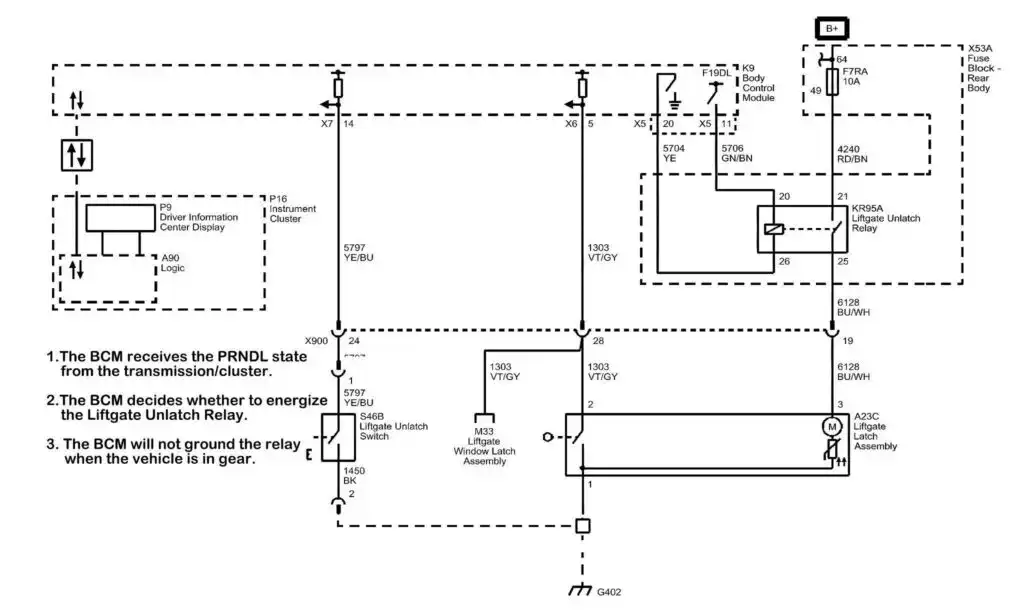
Earlier models may have the actuator wired through the neutral safety switch to achieve the same result. In these systems, the actuator ground is interrupted unless the vehicle is in Neutral or Park.
The same assembly often includes a position sensor that tells your vehicle whether the latch is open, closed, or moving. In newer models, it may also tie into the central locking system, the rear wiper interlock, and the interior dome light. That’s why a liftgate actuator failure sometimes affects other functions, such as the courtesy lights or alarm system.
Common Signs Your Liftgate Lock Actuator Is Failing
A failing actuator rarely dies all at once. Most owners notice gradual symptoms before the latch quits entirely. However, as with any other electrical component, it can also fail suddenly.
Won’t Lock or Unlock Electrically
The key fob, remote, and interior switch stop controlling the hatch. A manual key cylinder or emergency release may still work if equipped, but the electric system is dead. This is the clearest sign that the actuator has lost power, burned out internally, or has another electrical issue. Disconnect the actuator connector and load-test its power and ground circuits with a test lamp that draws at least 1 amp, following the vehicle’s service information. You can also apply fused power and ground directly to a conventional two-wire actuator to see whether it operates independently. If it does, the actuator is not at fault. Do not apply battery voltage to signal wires or module-controlled circuits.
Clicking or Grinding Noises
Rapid clicking, buzzing, or grinding during a lock attempt usually means the motor is still trying, but the gears are stripped or the mechanism is binding. The motor keeps cycling without engaging the latch.
Intermittent Response
The hatch locks on the third try, or unlocks only after several presses. This usually points to worn brushes inside the motor or a loose electrical connection that will get worse over time.
Stuck in One Position
The latch refuses to change state no matter what you try. The internal drive mechanism may have seized. However, if the faulty latch is rusty, damaged, or binding, the actuator will not be able to move it, and replacing the actuator will not fix the problem.
What Causes a Liftgate Lock Actuator To Fail?
Most failures come down to wear. The plastic gears inside the unit cycle thousands of times over the life of your vehicle, and they eventually crack or strip. Moisture is the second big factor. Rear hatches see a lot of weather, and water that finds its way past worn seals corrodes the motor windings and the electrical connector.
Collision damage is another possible cause. The liftgate lock actuator and latch assembly are mounted inside the rear hatch, where a rear-end impact can crack the housing, distort the liftgate, or knock the latch and striker out of alignment. If the hatch starts acting up after a rear-end collision, the damage could be related.

Replacement Cost Breakdown
Total cost typically lands between $200 and $500 for a complete job, and full estimates can run from $140 on the low end to $600 for premium work at a dealership.
Parts
Aftermarket actuators run $60 to $180 for most vehicles, with premium or vehicle-specific units reaching $280. OEM parts cost roughly 40 to 60 percent more than equivalent aftermarket options but carry the manufacturer’s warranty. Many aftermarket brands offer 1 to 3 year warranties of their own, which closes the gap on long-term value.
Labor
Labor falls between $80 and $320 depending on vehicle complexity and shop rate. Independent shops in suburban areas typically charge $70 to $120 per hour. Dealerships and urban shops run $150 to $200 per hour. Most jobs take 1 to 2 hours of flat-rate time, plus an extra 30 to 60 minutes if the latch assembly, wiring harness, or liftgate lock actuator connector also needs replacement.
OEM vs. Aftermarket
Quality aftermarket units that specify OEM-equivalent construction and sealed connectors perform reliably for most drivers. OEM makes more sense when your vehicle is still under factory warranty or when the liftgate uses a proprietary multi-function module that aftermarket suppliers haven’t matched.
Can You Replace It Yourself?
This is a moderately challenging DIY job. The basic steps include removing the interior trim panel, peeling back the liftgate padding, unplugging the electrical connector, removing two to four fasteners, installing the new unit, and reconnecting the wiring. Most people with basic mechanical skills and a socket set can handle it in under two hours.
Torque values, fastener locations, and connector designs vary widely between makes and models, so always consult your vehicle’s service manual before starting. If you aren’t comfortable with electrical connectors or panel removal, have a qualified mechanic do the work. A misaligned latch or pinched wiring harness can leave the hatch stuck shut, which is a real headache to recover from.
FAQ
Most last 8 to 12 years or 100,000 to 150,000 miles, although heavy use and exposure to moisture shorten that significantly.
Yes, as long as the hatch stays closed. Use the manual key cylinder to lock it, and avoid relying on the electric system until it’s repaired.
It can. A motor that keeps trying to cycle, or a connector that’s shorting out, may draw current even when the vehicle is off. If your battery is dying overnight after the hatch started acting up, get it inspected.
Sometimes. Some aftermarket units sell the actuator only, while others include the full latch. Check the listing carefully against your vehicle’s part number before ordering.
It’s primarily a security and convenience issue. The hatch can still be locked manually, so it isn’t a roadworthiness problem. Still, if the latch behavior feels inconsistent when the hatch is closed and locked, have it inspected to confirm that the latch is fully engaged.
Get Your Hatch Back in Working Order
A failing rear latch isn’t a job you have to put off, and parts are widely available for most vehicles on the road today. Whether you replace it yourself or hand it off to a shop, sourcing the part first lets you compare prices and avoid markup. Browse CarParts.com to find a direct-fit liftgate lock actuator for your vehicle’s year, make, and model. Enjoy fast shipping and clear fitment.
Keep Reading: Related Posts




Any information provided on this Website is for informational purposes only and is not intended to replace consultation with a professional mechanic. The accuracy and timeliness of the information may change from the time of publication.