The most common symptoms of a bad exhaust manifold gasket are a ticking or hissing noise, a burning smell with light smoke, and worse fuel economy. These signs point to exhaust gases leaking from the seal between the manifold and the cylinder head. You’ll want to sort it out quickly, since a bad enough leak can turn into a fire hazard.
Quick Answers
Here’s the short version if you’re trying to confirm a diagnosis fast.
- Warning signs: Hissing or tapping sounds, a burning smell, light smoke, and poor fuel economy.
- What it does: The gasket seals the joint between the exhaust manifold and the cylinder head.
- How serious is it: It’s best not to drive on it, and a big leak can become a fire hazard.
- Why it fails: Age and heat cycling, impact damage, corrosion, or damage during other repairs.
- First step: Listen for a cold-start tick and look for soot around the manifold joint.
- Repair or replace: Replace the gasket, which can run anywhere from $40 to $1,700 depending on the vehicle.
What Is an Exhaust Manifold Gasket?
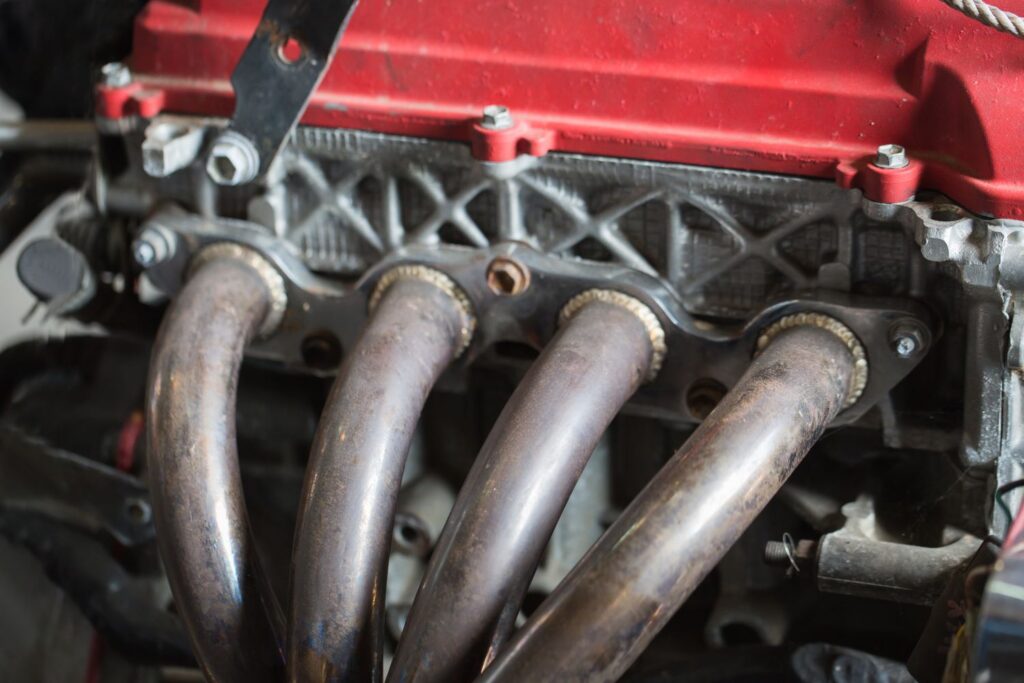
The exhaust manifold gasket is the sealing mechanism between the exhaust manifold and the engine’s cylinder head. It’s a vital part of the exhaust system and also indirectly contributes to emission control.
V8 engines from the 70s through the 80s that had cast iron manifolds and cast iron cylinder heads didn’t come with exhaust manifold gaskets. Each cast iron manifold was machined during the manufacturing process to fit so precisely against the cast iron cylinder head so that no gasket was necessary.
But once that manifold was removed during service, an exhaust manifold gasket was necessary when the exhaust manifold was being reinstalled due to the shape-changing characteristics of cast iron that has been heated to several hundred degrees and allowed to cool over and over.
Modern engines will have some kind of exhaust manifold gasket today. Because heads are aluminum and exhaust manifolds are steel, the gasket will either be steel, or, in some cases, it may be some kind of composite asbestos or aramid type material heavily coated with slippery graphite to handle the “scrubbing” effect of the aluminum head and the steel manifold expanding and contracting at different rates.
Note that there is also the gasket between the exhaust manifold and the header pipe or catalytic converter, which is more likely to fail than the gasket between the manifold and the cylinder head.
What Are the Symptoms of a Bad Exhaust Manifold Gasket?

The symptoms of a bad exhaust manifold gasket usually show up as noise, smell, and a small dip in fuel economy. A leaking exhaust gasket can impact exhaust emissions, and if the leak is bad enough, it can even become a fire hazard. That risk goes up if the rocker arm (valve) covers are seeping oil that trickles down across the point of the leak. See related valve cover gasket symptoms if you suspect that’s happening.
Hissing or tapping sounds
Hissing or tapping sounds are some of the most common symptoms of a bad exhaust manifold gasket. You may also smell exhaust fumes if you happen to be running the A/C on anything other than “max” or “recirc.”
If you hear hissing, clicking or tapping sounds when the engine is started cold that then fade away as the engine heats up, these may indicate an exhaust leak from a cracked cast iron exhaust manifold if your engine has one. But on the more common steel exhaust manifolds today, if they are cracked, they don’t typically close during heat expansion as a crack in cast iron does.
Poor Fuel Economy
Oxygen sensors don’t sense fuel, they sense oxygen. Since the engine’s exhaust has pressure waves pulsing through it, any breach in the exhaust system from a failed gasket, loose fasteners, or a cracked manifold, can draw varying amounts of oxygen into the exhaust stream to be picked up by the O2 sensors and misinterpreted as a lean air/fuel situation.
This will cause the engine controller (PCM/ECM) to add some fuel that isn’t needed, which will have an effect on fuel economy but won’t typically affect engine performance in a noticeable way.
If an exhaust leak is serious enough, it can reduce exhaust gas recirculation flow to the point that codes are stored for that part of the emissions system. But a leak this serious will typically be noisy enough that the exhaust leak itself will most likely become the focus the repair. A careful exhaust manifold leak check confirms where the gases are escaping.
Burning smell and smoke
If you can smell burning metal or plastic from the direction of the engine, you might have a bad exhaust manifold gasket. There are usually wires and plastic parts near the gasket that may burn or melt when exposed to high temperatures. Again, there’s the risk of a fire hazard with a significant exhaust leak, particularly if the exhaust leak is directed at anything flammable.

The exhaust gasses produced by the combustion process are very hot. If the gasses leak out of the exhaust manifold gasket, they might reach the heat-sensitive parts. These parts might melt or even burn, producing a distinct smell and possibly even some smoke. Needless to say, you will need to replace any melted or burned parts as well as the gasket itself.
What Causes an Exhaust Manifold Gasket to Fail?
Most exhaust manifold gaskets last many heat cycles, so failure isn’t especially common. When it does happen, a few causes stand out. A collision can apply enough shock to fracture the gasket, and a steel seal that loses its corrosion protection can rust and fail. Loose or broken manifold bolts and studs also open gaps that let exhaust escape. Some repairs even require removing the gasket to reach other parts, and it can get nicked in the process.
Can a Bad Exhaust Manifold Gasket Cause Misfire Codes?
A leaking exhaust manifold gasket doesn’t directly cause a cylinder to lose compression, so it isn’t a true source of misfire on its own. Removing the manifold entirely wouldn’t change any cylinder’s compression. If you’re seeing misfire codes alongside gasket symptoms, the misfire usually traces back to ignition or timing, not the gasket.
A leak can still skew oxygen sensor readings and trigger a check engine light for a lean condition. So it’s worth confirming whether you’re chasing an exhaust leak, a blown head gasket, or a separate ignition problem before you start replacing parts.
How Long Does the Exhaust Manifold Gasket Last?
Most manufacturers design their exhaust manifold gaskets to run for numerous heat cycles, which translates to many years. However, the gaskets can degrade faster and fail earlier depending on various factors.
For example, a collision with an obstacle or another vehicle can apply enough shock to fracture the gasket, allowing exhaust gasses to leak out of the ensuing crack. If the seal is made of steel and it loses its corrosion protection to damage or extended exposure, it can corrode and fail.
Some repair and maintenance jobs require removal of the exhaust manifold gasket to access other engine parts for inspection and repair. While mechanics usually take care in uninstalling the gasket, they can inadvertently damage it anyway.
Can You Drive With A Bad Exhaust Manifold Gasket?
It’s best to avoid driving your car until you have repaired or replaced its faulty exhaust manifold gasket. The reduction in fuel efficiency can make you drop by the gas station more often to fill your fuel tank. And if your vehicle is slated for an emissions test, it’s going to fail. If you keep driving with a leaky gasket, the exhaust valves might fail in the long run and require replacement themselves. The fire risk from hot gases reaching flammable parts is the bigger reason not to put it off.
How Do You Diagnose a Bad Exhaust Manifold Gasket?
You can confirm most leaks with a simple see, listen, and smell check before taking anything apart.
- Look for black soot or carbon buildup around the manifold-to-head joint. Dark streaks there point to escaping gases.
- Listen at a cold start for a ticking or puffing sound. A whistle can mean gases escaping through the gasket layers.
- Smell for exhaust fumes under the hood or in the cabin. Fumes inside the car are a clear warning sign.
- Check the studs and bolts for anything loose, broken, or missing, since that often lets the manifold warp.
Let the engine cool fully before you touch anything, and work in a well-ventilated space. If listening doesn’t confirm it, a shop can run a leak-down or smoke test to pinpoint the source.
Should You Repair or Replace the Gasket?
A faulty exhaust manifold gasket gets replaced rather than patched. If loose bolts caused an early leak, retightening them to the correct torque can sometimes save the seal before it blows out completely.
On engines with individual gaskets per cylinder, replacing the full set is smart even if only one looks bad. Mixing old and new gaskets can seal unevenly and invite the next leak. A replacement for a bad exhaust manifold gasket can set you back anywhere between $40 and $1,700.
Depending on the setup, the job may mean removing sensors or even the turbocharger, so it isn’t always a beginner DIY. When you do buy the seal, a quality aftermarket exhaust manifold gasket made from reliable materials performs well under heat and pressure.
Frequently Asked Questions
The first symptoms of a bad exhaust manifold gasket are usually a ticking or hissing noise at cold start and a faint exhaust smell. A small drop in fuel economy often follows as oxygen sensor readings drift.
You shouldn’t keep driving with a bad exhaust manifold gasket. A worsening leak can damage exhaust valves over time and, in bad cases, create a fire hazard near flammable parts.
Replacing an exhaust manifold gasket can cost anywhere from $40 to $1,700. The wide range comes from how much labor is involved and whether sensors or a turbocharger have to be removed first.
A bad exhaust manifold gasket can cause a check engine light. A leak lets extra oxygen into the exhaust, so the oxygen sensor may read lean and set a related code.
An exhaust manifold gasket leak doesn’t directly cause misfire codes, since it doesn’t change cylinder compression. Misfires that show up with a leak usually trace back to ignition or timing issues instead.
A bad exhaust manifold gasket usually sounds like a ticking, tapping, or puffing noise, loudest at cold start. Some leaks produce a whistle as gases escape through the gasket layers.
Exhaust fumes in the cabin are a reason to stop driving and get the leak checked. Those fumes can contain carbon monoxide, which is dangerous to breathe in an enclosed space.
Ignoring an exhaust manifold gasket leak lets it grow louder and worse. Over time it can damage exhaust valves, harm nearby sensors and wiring, and raise the chance of a fire near flammable parts.
Keep Your Exhaust Sealed and Quiet
A tight exhaust manifold gasket protects your fuel economy, your emissions, and the parts sitting near all that heat. Once you’ve confirmed the leak, a fresh exhaust manifold gasket gets your engine sealed up and running quietly again. You can match a quality replacement exhaust manifold to your vehicle with the built-in selector at CarParts.com and have it on the way in just a couple of business days.
Keep Reading: Related Posts







Any information provided on this Website is for informational purposes only and is not intended to replace consultation with a professional mechanic. The accuracy and timeliness of the information may change from the time of publication.