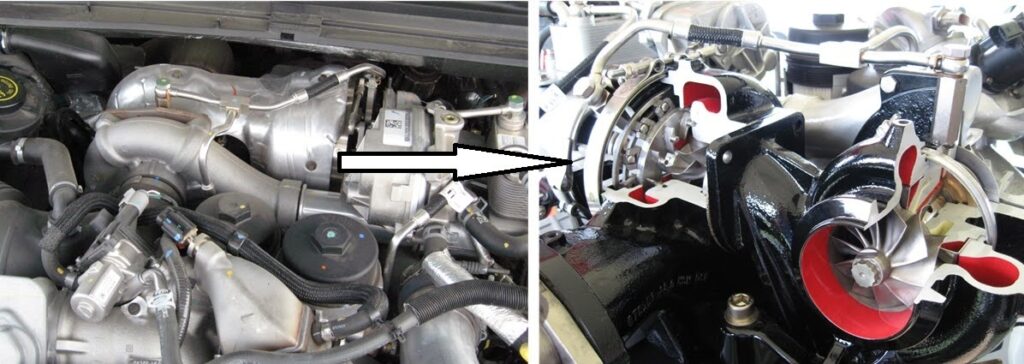
The turbo, or turbocharger, can typically be found near the engine of the vehicle. It’s often attached to the exhaust manifold, bolted on to keep it steady and secure. It’s worth mentioning that the exact location of a vehicle’s turbo varies, depending on the make and model. If you’re unsure, it’s a good idea to consult your vehicle owner’s manual to find its exact placement.
Rather than depending on atmospheric pressure for air induction, a turbocharged or supercharged engine has air “force fed” to the manifold, increasing volumetric efficiency from less than 100% to more than 100%.
When the forced air charge is cooled on the way to the manifold, the benefits of turbocharging are increased even more.
Tips to Access the Turbo
Accessing a vehicle’s turbocharger isn’t easy by any means. Sometimes it’s tough even for experienced mechanics. Still, there will come times when you’ll need to inspect it for signs of damage, but usually, you can do this without removing the turbocharger. You just need to disconnect the air inlet feed so you can see the turbo blades, look for signs of oil leaking from the shaft seals, or to feel the shaft on the turbo with your finger to see if it’s loose.
If you do need to access the turbo, make sure to take necessary precautions:
- Always disconnect the car battery before fiddling with anything in the engine.
- Drain all engine oil before attempting to access the turbo and get an oil change in case you replace it.
- Make sure to disconnect and clean any oil lines, replacing any that become inoperative.
- Don’t forget to unbolt and remove the turbo before attempting to access it.
When in doubt, bring your vehicle to a mechanic. There’s no harm in having a professional inspect or replace your turbocharger for you.

What Makes the Turbo So Important?
The turbo allows vehicles to produce more power and torque by compressing air into the engine’s cylinders. Not only does this boost fuel efficiency, but it also reduces emissions while significantly boosting performance.
Turbocharging technology also allows smaller engines to achieve the same performance levels as larger engines, meaning less engine space, more weight savings, and improved engine packaging.
Keep Reading: Related Posts







Any information provided on this Website is for informational purposes only and is not intended to replace consultation with a professional mechanic. The accuracy and timeliness of the information may change from the time of publication.