Wheel alignment and wheel balancing are two different services, but many people often get them confused. In a nutshell, wheel alignment consists of adjusting the angles of the wheels to the vehicle manufacturer’s specifications so the tires meet the road properly.
In other words, alignment is not simply making every wheel perfectly straight. The correct settings depend on the vehicle’s drivetrain, suspension design, and factory specifications. For example, on some front-wheel-drive vehicles, a technician may set the front toe slightly out because drive torque can cause the front wheels to toe in while moving. On a rear-wheel-drive vehicle, the front toe is often set slightly in because the rear wheels are pushed by the rear axle, and the front wheels tend to toe out a bit under load.
The purpose of these adjustments is maximum tire life and a vehicle that tracks straight and true when driving along a straight and level road. Wheel balancing, on the other hand, allows the tires and wheels to spin without causing vibrations. This is accomplished by checking for any heavy spots on the wheel-tire combination and compensating for them by placing a measured wheel weight on the opposite side of the wheel from where the heavy spot is.
The symptoms of a car that is out of alignment are:
- Uneven or rapid tire wear
- Pulling or drifting away from a straight line
- Wandering on a straight level road
- Spokes of the steering wheel off to one side while driving on a straight and level road.
The symptoms of a wheel that is out of balance are:
- Vibration in the steering wheel at certain highway speeds.
- Vibration in the seat or floorboard at certain highway speeds.
- Scalloped or cupped wear pattern on the tires

Wheel Alignment
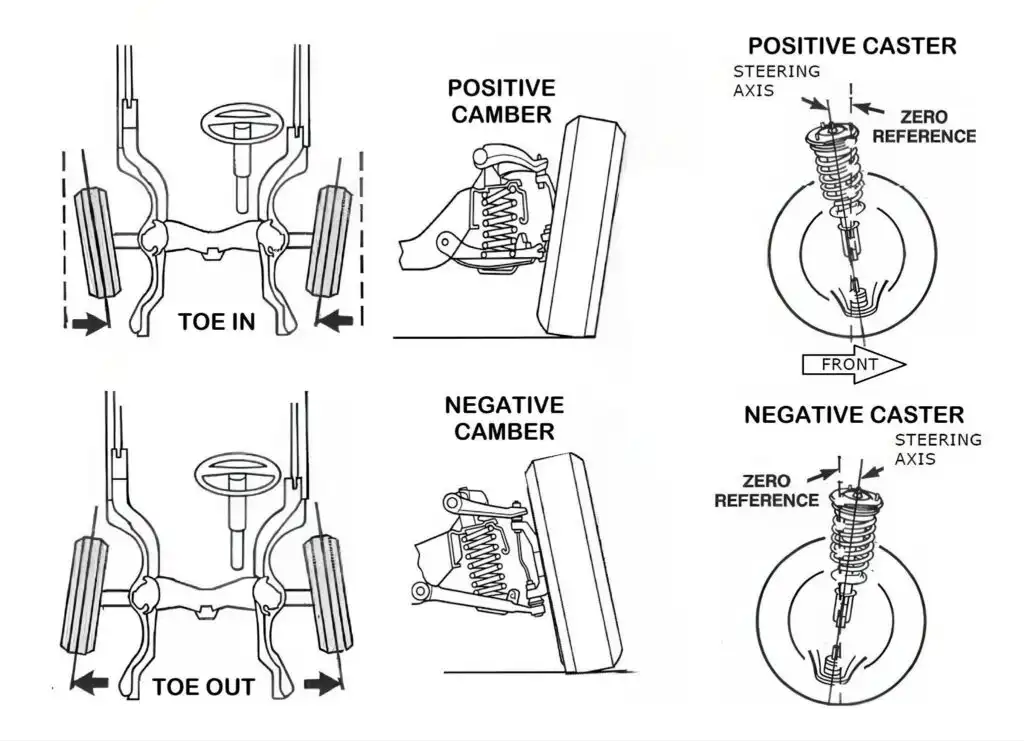
The three alignment angles for the steering end of the vehicle are camber, caster, and toe. Camber refers to the tire leaning in or out. Caster refers to steering axis tilt. Toe refers to each wheel’s angle related to the opposite wheel.
Rear wheel alignment, where adjustable, usually consists of toe and camber adjustments rather than caster adjustments because rear wheels typically do not steer.
Toe (The Tire Killer)
Toe is the most critical alignment angle regarding tire life. Even a slight toe-in or toe-out error creates a constant scuffing action as the tire is dragged sideways down the road.
- Toe-in: Typically causes wear on the outer edges of both tires. It often creates a “sawtooth” or “feathered” wear pattern that you can feel by rubbing your hand across the tread.
- Toe-out: Typically causes wear on the inner edges of both tires, also resulting in feathering.
Camber
Camber causes wear when the tilt is aggressive enough to concentrate the vehicle’s weight on one side of the tread.
- Positive camber: The top of the tire tilts outward, putting excessive pressure and wear on the outer shoulder.
- Negative camber: The top of the tire tilts inward, leading to accelerated wear on the inner shoulder.
- Note: Unlike toe, camber wear is usually smooth and doesn’t always show the “feathering” characteristic.
Caster
Caster is the forward or backward tilt of the steering axis.
- Because the tire still sits flat on the road while traveling in a straight line, caster does not cause tire wear. Its main job is to provide self-centering for the steering wheel and directional stability.
How to Check If You Need an Alignment
To find out if you need an alignment, first check each tire and look for uneven wear patterns. The problem with this method, however, is that if you can see a wear pattern like the ones listed below, it may be too late to save that tire. This is why it is a good idea to have your alignment checked periodically.
At each tire, take a coin and insert it in the tread at the inside, center and outside.


- If the tread is deeper on the edges than in the center, the tire is over inflated.
- If the tread is deeper in the center than the edges, the tire is under inflated.
- If the tread is deeper on one side than the other, have your wheel alignment checked soon.
Run your hand back and forth across the tread, being careful not to cut yourself on any debris or exposed steel belt wire. If the tread is smooth in one direction, but jagged in the other you have what is called a “saw-tooth” wear pattern which is caused by a toe-in problem. Have the alignment checked as soon as possible as this condition causes rapid tire wear.

The first two conditions do not call for a wheel alignment but the second two do. If these wear patterns are pronounced, you should replace the tires or move them to the rear before aligning the car. Ask your alignment specialist to be sure.
Another indication of an out-of-alignment condition is a car that continuously drifts or pulls to one side of the road when you let go of the wheel. A car that is hard to keep in a straight line without constant steering corrections is also a candidate. These conditions may or may not also contribute to premature tire wear.

Pro Tips are nuggets of information direct from ASE-certified automobile technicians working with CarParts.com, which may include unique, personal insights based on their years of experience working in the automotive industry. These can help you make more informed decisions about your car.
Pro Tip: Rule of thumb: Even if the angles are within spec, the vehicle will tend to pull toward the wheel with the most negative caster and the most positive camber adjustment.
A wheel alignment cannot be done on a car with loose or worn front end parts. The technician will first check for worn parts and inform you of any problems before beginning the alignment.
The best type of wheel alignment is a four wheel alignment. Many cars today have adjustable rear alignment settings, but even for cars without adjustments in the rear, a four wheel alignment will allow the technician to identify any rear tracking problems and compensate for them with adjustments to the front.
After the wheel alignment is finished, you should drive the car on a straight and level road and check that the car goes straight and that the steering wheel is in the proper position with the spokes level. If you notice a problem,take the car back and have the technician drive it and fine-tune the alignment settings.
Wheel Balance
Out-of-balance tires will cause a car to vibrate at certain speeds, usually between 50 and 70 mph. A tire is out of balance when one section of the tire is heavier than the others. One ounce of imbalance on a front tire is enough to cause a noticeable vibration in the steering wheel at about 60 mph. To balance a wheel, the technician will mount it on a balancing machine which spins the wheel to locate the heavier part. He will then compensate for the heavy part by attaching a lead weight on the opposite side. Many people are pleasantly surprised at how smooth their car drives after balancing all four wheels.

Most high quality tires will hold their balance fairly well and go out of balance very gradually. If you notice a vibration that wasn’t there the day before, it is possible that one of the lead balancing weights fell off. If you feel the vibration mostly in the steering wheel, the problem is most likely in a front wheel. If the vibration is mostly in the seat, the problem is probably in the rear.
For those of you who are very sensitive about vibrations and your shop can’t seem to get that last bit of vibration out, check to see if you have locking wheel lugs. Some locking lugs are as much as 1.5 ounces heavier than the other lug nuts which translates to about 1/2 ounce at the wheel rim. Try putting a 1/2 ounce weight opposite the locking lug and see if it helps.
Where to Shop for Replacement Parts for Your Vehicle
There are cases when the wheel alignment and balance are off simply because of worn steering components. Thankfully, CarParts.com significantly speeds up the process of finding replacement parts that fit your vehicle thanks to the tools on our website.
Shopping for parts online is more convenient thanks to our built-in vehicle selector that lets you sort our catalog by year, make, and model. This makes it easier for you to check whether the part you’re ordering matches your vehicle’s specifications.
We offer steering components at different price points since we know that not everyone can or wants to splurge on auto parts. This should give you the option to choose from brands that match your budget. Aside from competitive pricing, we also offer a lifetime replacement guarantee and accept 60-day returns for qualified purchases.
Shop now, and get the best deals today!
Keep Reading: Related Posts




Any information provided on this Website is for informational purposes only and is not intended to replace consultation with a professional mechanic. The accuracy and timeliness of the information may change from the time of publication.