Most drivers facing engine failure ask the same question. Should you buy a new engine, or rebuild what you have? Whether engine rebuild kits are worth it depends less on the kits themselves and more on three factors you need to evaluate before ordering anything: the condition of your block, the total cost to complete the job, and how long you plan to keep the vehicle.
Are Engine Rebuild Kits Worth the Investment?
The short answer is yes, under the right conditions. Rebuild kits typically cost one-third to one-half of a full engine replacement. A complete V8 engine swap can easily exceed $5,000 once labor is included. That gap makes kits worth a hard look.
For more background on why engine rebuilds are done and what they cost, see the CarParts.com guide to rebuilding an engine.
The value equation works best when:
- The engine block is structurally sound (no cracks, no warped deck surface)
- The vehicle has no major issues beyond the engine
- Aftermarket parts are widely available for your application
- You plan to keep the vehicle for at least two to three more years
If the block is cracked or the head is severely damaged, the rebuild may not be worth pursuing. For high-mileage vehicles that will be sold soon, the return on investment also shrinks considerably.
Inspect the Engine Before Ordering a Kit
Even if you do not see an obvious problem with the head or block, it is best to strip the engine down and send the block, crankshaft, and cylinder head or heads to a reputable machine shop for inspection. If the cylinders are tapered or out of round, the shop may need to bore and hone them for matching oversize pistons and rings. A crankshaft kit can include bearings, but the correct bearing size should be selected only after the journals are measured. Do not forget the cam bearings if the engine uses replaceable ones.
Did the engine have low oil pressure? If so, you need to determine why before reassembly. Worn bearings, excessive clearances, a damaged pump, blocked passages, or another fault can cause the same symptom. Timing components are also an important part of a properly completed rebuild, so confirm whether the kit includes them or whether they must be purchased separately.
Have the cylinder head or heads checked for cracks, warpage, valve-guide wear, and valve-seat condition. If the machine shop is performing valve work, take the valve stem seals from the gasket set so the shop can install them during reassembly when appropriate.
The average total engine rebuild cost often runs from about $2,500 to $4,500, depending on the make, model, year, engine design, and extent of the damage. Labor is usually the largest line item, and the job can require 20 or more hours of shop time. Compare that figure against the cost of a used, crate, or remanufactured engine for your vehicle before deciding.
What a Rebuild Kit Actually Contains
Kits are not all identical. Buying the wrong tier wastes money or leaves you short during assembly.
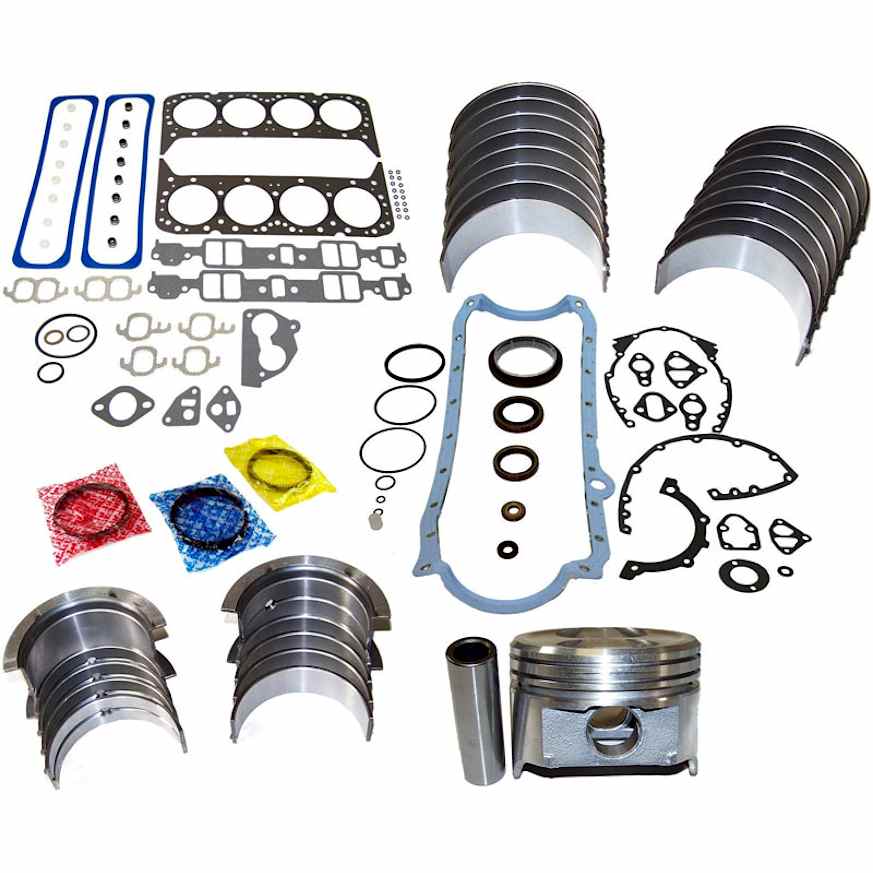
A complete rebuild kit typically includes pistons, piston rings, main and rod bearings, and a full engine gasket set to seal combustion chambers, coolant passages, and oil paths. Higher-tier master kits add timing chain components, a new oil pump, a water pump, and sometimes cam bearings.
The three main kit categories are:
- Re-ring kit: Typically replaces rings, bearings, and gaskets without including pistons. Use this only when the pistons are still serviceable and the cylinder bores are not tapered or out of round beyond specification. On some applications, this work can be completed with the engine in the vehicle, but access and repair procedures vary. If worn rings might be the root problem, review the signs of bad piston rings before deciding on a kit tier.
- Inframe kit: Adds new pistons to the re-ring contents. It is less time-consuming than a full out-of-frame overhaul but includes more components than a re-ring.
- Master or deluxe kit: The most comprehensive option. It may include pistons, rings, bearings, gaskets, cam bearings, and other overhaul parts. Performance-oriented versions may use forged pistons, multi-layer steel gaskets, or upgraded bearings, but those parts are not standard in every master kit. Some kits include the timing components, while others require you to buy them separately.
Note: Some retailers label a re-ring kit as “pistonless.” Both terms mean the same thing. Confirm piston inclusion before you buy.
OEM vs. Aftermarket Engine Rebuild Kits: Which One to Choose
The biggest advantage of an OEM rebuild kit is fitment certainty. Every component was spec’d for your engine. Most OEM kits also carry a 6-to-12-month warranty. The trade-off is a steep price premium.
Aftermarket kits close the quality gap more than most buyers expect. Aftermarket rebuild kits cost less, but that does not make them lower quality. In many cases, aftermarket components match or exceed OEM standards. Engine manufacturers outsource production to third-party suppliers anyway.
The practical rule: for common domestic and Japanese engines, a reputable aftermarket kit performs reliably. For diesel engines, commercial trucks, or tight-tolerance applications, OEM kits reduce risk.
Skip this: Avoid kits priced far below the market average for your engine. Unusually low kit prices signal substandard materials or incorrect tolerances. The cheapest option rarely stays cheapest once the engine is reassembled.
Fitment and Compatibility Checks Before You Buy
Fitment errors are among the most common and costly buyer mistakes. A kit that looks correct may not account for mid-cycle engine changes.
Before placing any order, verify:
- Engine family and displacement (e.g., 5.0L Coyote vs. 4.6L Modular)
- Model year and any production date cutoffs for engine revisions
- Whether the engine has been bored oversize previously
- VIN-specific details for vehicles with multiple engine options in the same model year
Mismatched kits lead to costly errors. Always confirm engine model, displacement, year, and VIN-specific fitment before purchasing.
Tip: If the engine has had prior machine work, measure the bore diameter with a caliper before ordering. Many suppliers offer standard, 0.010-over, 0.020-over, and 0.030-over piston sizes.
The True Cost of Rebuilding an Engine: Parts, Labor, and Machine Work
The kit price is only one part of the total expense. It is usually the smaller portion.
Quality rebuild kits run $800 to $1,500. Shops charge 20 to 40 labor hours depending on complexity. Machining costs alone can reach $600 to $1,000 or more.
Beyond those figures, budget for:
- Block cleaning and inspection
- Cylinder honing or boring if the walls are scored
- Crankshaft grinding if journals are worn
- Head resurfacing or full reconditioning. If you suspect a blown head gasket is part of the problem, have the head checked at the machine shop before ordering a kit.
- Replacement head gasket set and assembly lubricants
- Replacement hardware (bolts, plugs, studs)
Hidden damage found during teardown can double the initial quote. A cracked block or warped head can turn a straightforward engine overhaul into a far more expensive repair.
Warning: Never finalize a budget before a machine shop inspects the bare block. Quotes based on assumptions before teardown are almost always wrong.
Rebuild Kit vs. Crate Engine vs. Remanufactured Engine
Understanding the alternatives prevents defaulting to a rebuild when another option fits better.
A crate engine is a complete, pre-assembled unit ready for installation. It comes in stock replacement, high-performance, and custom configurations.
A remanufactured engine is torn down, cleaned, machined to spec, and reassembled with new parts. Quality varies significantly between suppliers. Some simply clean used cores rather than fully remanufacturing them.
The comparison at a glance:
- Rebuild kit: Lowest parts cost, highest time investment, full customization, no labor warranty
- Remanufactured engine: Mid-range cost, factory-like quality from reputable suppliers, usually warrantied
- Crate engine: Highest upfront cost for new units, minimal downtime, clear warranty
When a Used Engine May Be a Better Option
A used engine from a reputable recycler may be the better option when it comes with documented mileage, test results, and meaningful warranty coverage. Prices for common domestic V8 engines vary widely by region, exact engine code, mileage, included accessories, and whether the unit has been inspected or tested. Some extended warranties include limited labor reimbursement, but buyers should read the exclusions, approval requirements, and reimbursement limits before assuming installation labor is covered.
A rebuild gives you control over every internal component, but the timeline can stretch from weeks to months depending on machine-shop availability and back-ordered parts. A crate or remanufactured engine can reduce downtime, although installation time still depends on vehicle access, parts transfer, programming, and supporting repairs.
Buy carefully: If your engine is rare, late-model, heavily modular, or badly damaged, a used, crate, or remanufactured option may cost less overall. Factor in the labor and machine work a difficult rebuild demands. For issues that can appear after major engine work, see the guide to problems after engine replacement.
Where to Buy Engine Rebuild Kits Online
Buying online delivers real savings, but fitment risk rises when buyers move too fast.
CarParts.com carries engine rebuild kits across a wide range of domestic and import applications. Kits include full gasket sets, piston ring sets, expansion plug kits, and bearing sets. Their parts search filters by year, make, model, and engine. Prices start around $156 and scale up by kit tier and application.
When shopping online for engine components:
- Use the vehicle fitment tool on every product page
- Cross-reference the part number against your engine’s casting or stamping number
- Check the return policy before buying, since installed parts are typically non-returnable
- Order the full kit from one supplier to ensure matched tolerances across all components
Bundling all parts from a single source reduces compatibility issues and eliminates mismatched tolerances.
Tip: If your engine needs an oversize piston, contact the supplier before ordering. Not all listings specify available oversizes in the product title.

Installation: What Most Buyers Underestimate
Rebuild kits simplify sourcing. They do not simplify assembly. The job demands precision tools and correct procedures throughout.
Every component must be prepped and installed carefully. Every fastener must be torqued to spec. An error of just a few thousandths of an inch can cause early catastrophic failure.
Required tools for a complete engine rebuild:
- Torque wrench (at least two: one for small fasteners, one for head bolts and main caps)
- Bore gauge and micrometer set
- Piston ring compressor
- Ridge reamer (for cylinders with wear ridges)
- Plastigage (for bearing clearance verification)
- Assembly lubricant rated for engine break-in. The oil pump must receive adequate lubrication from the first startup after reassembly.
A full rebuild typically requires 20 to 40 hours for experienced mechanics. First-time rebuilders should expect significantly more time.
Warning: Do not skip Plastigage bearing clearance checks. Incorrect bearing crush causes failure regardless of kit quality. The check takes under 30 minutes and can save the entire rebuild.
When Skipping the Rebuild Kit Makes More Sense
Not every worn engine justifies a kit purchase. Knowing when to walk away saves money and time.
Walk away from a rebuild if:
- The vehicle is in poor overall condition beyond the engine. A rebuilt motor will not fix worn suspension, a failing transmission, or a deteriorating body.
- The rebuild cost approaches or exceeds the vehicle’s market value
- The engine has extreme mileage and multiple other systems are failing simultaneously
- The block has a confirmed crack or needs boring beyond available oversize ranges
- Used replacement engines for that application are plentiful and cheap with verified compression
For a $3,000 vehicle that needs a $3,500 rebuild, the math rarely works. The exception is when preserving the original engine has a specific purpose or value, such as maintaining a numbers-matching classic or keeping a specialized work vehicle in service. Once teardown and machine-shop measurements confirm that rebuilding is the right choice, compare direct-fit engine rebuild kits and verify every included size before placing the order.
Keep Reading: Related Posts





Any information provided on this Website is for informational purposes only and is not intended to replace consultation with a professional mechanic. The accuracy and timeliness of the information may change from the time of publication.