A driveshaft constant velocity (CV) joint looks like an easy part to buy online, because front and rear versions for the same SUV can look nearly identical in a listing photo. The trouble usually shows up on the garage floor, when the new joint won’t slide onto the shaft or its bolt holes miss the flange.
So skip the usual first question of which joint costs least. Ask this instead: What exactly needs to go in the cart for this job? A joint that looks close enough can stall the repair if the boot, clamp, or bolts aren’t in the box. It can also fall short when the real wear sits in the shaft spline or the joint at the other end.
One vehicle can use several different driveshaft CV joints. Front and rear shafts can each take a different design, and so can the transfer case end and the axle end. Engine or transmission changes can split them further.
The Job in One Sentence
The job is to put a smooth, sealed, correctly sized flex point back into the driveshaft so that torque reaches the axle without clunk or vibration.
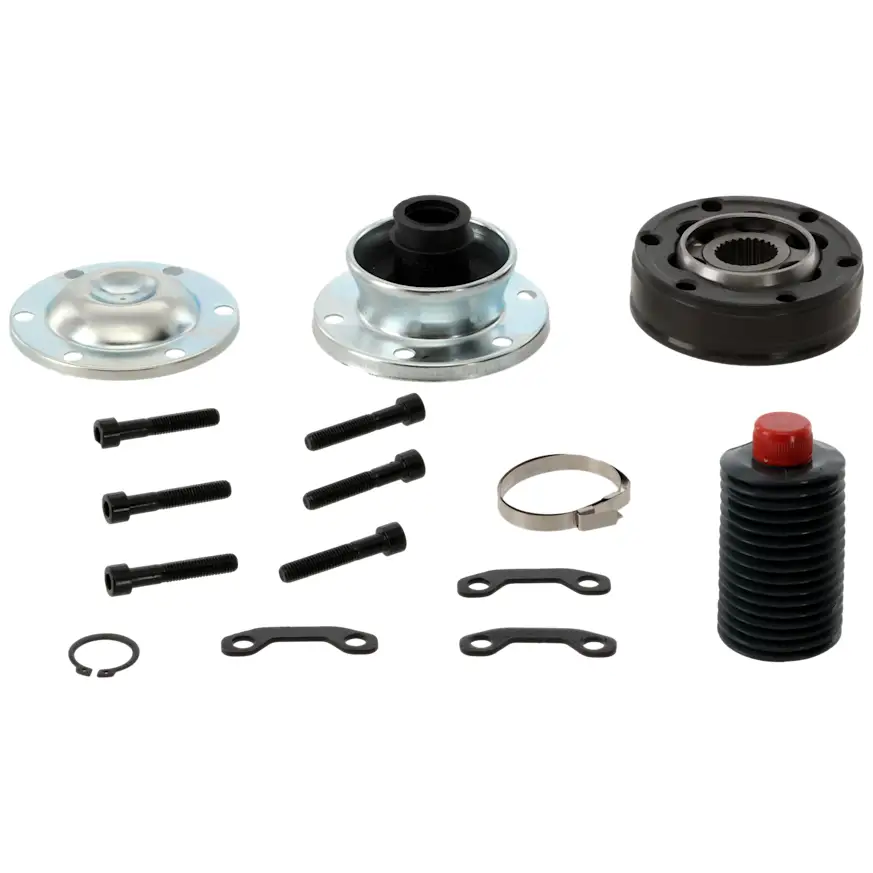
In all-wheel drive (AWD) and four-wheel drive (4WD) vehicles, plus some rear-wheel drive (RWD) cars, the driveshaft CV joint lets the shaft swing through angle changes as the suspension moves. The joint typically bolts to a flange at the transfer case, transmission, or differential and rides on the shaft’s splined end, where a snap ring holds it and a boot seals in the grease.
That’s why a correct order covers more than the joint. It only lasts when the boot keeps dirt out and the flange bolts clamp it squarely. Sellers offer it as a bare joint (often with grease, a boot clamp, and a snap ring), as a joint with a boot kit, or built into a complete driveshaft assembly. The condition of the shaft decides which one fits your job.
Choose Your Cart Size
Pick the cart size by how much of the driveshaft is worn and how long you plan to keep your vehicle.
1. Minimum Viable Repair
This lane fixes one worn joint on a shaft that’s otherwise healthy.
Choose it if:
- One joint has play or a torn boot, and the shaft tube is straight with no dents.
- The joint at the other end of the shaft still moves smoothly.
Typical cart:
- One driveshaft CV joint for the correct shaft and end
- A CV boot kit with clamps, if the joint ships without a boot
- New flange bolts, if your application calls for them or the old ones are rusty
2. Smart Same-Access Refresh
This lane uses the fact that the shaft is already on the bench.
Choose it if:
- The joint or universal joint (U-joint) at the opposite end feels notchy or dry.
- A transfer case output seal or differential pinion seal weeps where the shaft bolts up.
- Your two-piece shaft has a center support bearing with cracked or sagging rubber.
Typical cart:
- The driveshaft CV joint plus its boot kit and bolts
- A second CV joint or U-joint for the other end of the same shaft
- A center support bearing, if the shaft uses one
- The leaking seal and the fluid to top it off
3. High-Mileage / Do-It-Once Reset
This lane replaces the shaft as a unit instead of rebuilding it piece by piece.
Choose it if:
- The vehicle has high mileage and every driveshaft component is original.
- The shaft spline shows wear, or the tube carries dents or heavy rust.
- The vehicle tows or sees off-road use, or you’ve already rebuilt this shaft once.
Typical cart:
- A complete front or rear driveshaft assembly with new joints installed
- New flange bolts or retaining hardware for both ends
- Output and pinion seals, plus the fluid for each
Most vehicle owners with one failed joint and a sound shaft belong in the first lane. The third lane’s for older vehicles with worn splines or several tired joints.
What Is Commonly Ordered Together on This Job
A driveshaft CV joint order usually needs a boot, fresh hardware, and any seal that leaks at the shaft’s ends.
Boot Kits and Clamps
The boot keeps the joint’s grease in and road grit out, so a torn or hardened boot ruins a new joint fast. Many bare joints include a clamp and grease but no boot. Vehicle owners often assume “includes boot clamp” means the boot comes too. Read the contents line, and add a boot kit with both clamps if it’s missing.
Flange Bolts and Retaining Hardware
Some applications call for new flange bolts at every removal, and old ones often come out rusted or rounded. Many joints ship without bolts, so check the contents line before you assume they’re in the box.

Seals at the Shaft Ends
The transfer case output seal and the differential pinion seal sit right behind the flanges you’ll unbolt. Unfortunately, vehicle owners tend to ignore a light weep until it soaks the new boot. If you replace either seal, add the matching gear oil or transfer case fluid to the order.
Same-Shaft Wear Items
The other end of the shaft might use a U-joint, a second CV joint, or a rubber flex disc. Two-piece shafts add a center support bearing. These parts aged alongside the failed joint, and the shaft has to come out to reach any of them.
Complete Driveshaft vs. Bare Joint
A complete driveshaft assembly arrives with joints already fitted, and it usually comes balanced as a unit. A bare joint costs less but depends on a healthy spline and a straight tube. Buyers who order a bare joint for a shaft with a worn spline often end up ordering the full assembly a week later.
What People Forget Until the Vehicle Is Already Apart
These questions catch the misses that leave a driveshaft sitting on the bench.
- Does the joint come with a boot, or only grease, a clamp, and a snap ring?
- Is this the front shaft or the rear shaft?
- Does the failed joint sit at the transfer case end or the axle end?
- Can the old flange bolts go back in, or does your application call for new ones?
- Do you own the 12-point or Torx-style bit these bolts need?
- Does the shaft’s spline look clean and tight, or worn and shiny?
- Did you order fluid to top off after a seal replacement?
- What shape are the U-joint and center support bearing on the same shaft?
When Replacing Only the Driveshaft CV Joint Is False Economy
The joint-only order makes sense in plenty of cases. If the boot tore recently and the joint still turns smoothly, or the shaft is young and straight, a single joint plus a boot kit is the right call.
But a joint-only order turns expensive when the shaft has to come out again within a few months. It’s also shortsighted when the rest of the shaft shares the same age and mileage. Removing the driveshaft takes most of the labor, while the joint swap itself goes quickly once the shaft is on the bench. If the U-joint at the other end already feels notchy, you’ll pull the same shaft again when you need to repair it.
A worn spline changes the math too. A new joint on a worn spline can still clunk on takeoff, so the money spent on the joint might not be enough. True, you’ll pay more up front for a complete driveshaft assembly, but you’ll no longer have to guess about the spline, joints, or balance.
The Fitment Splits That Break Driveshaft CV Joint Orders
Most wrong driveshaft CV joint orders come from picking the wrong shaft, the wrong end, or the wrong size.
Front Shaft vs. Rear Shaft
A 4WD or AWD vehicle often uses different joints on its front and rear driveshafts. Listings name the position, and a front joint won’t swap into a rear shaft just because the photos match.
Transfer Case End vs. Axle End
One shaft can carry two different joints. The transfer case or transmission end often uses a plunging joint, while the axle end uses a fixed joint or a U-joint, depending on application. Listings might label these as inner and outer or by component name, so match this wording to your vehicle’s shaft.
Bolt-Hole Count and Outer Diameter
Flange joints vary by bolt-hole count, bolt circle, and outer diameter. A joint that’s a few millimeters off in any of these won’t seat on the flange.
Spline Count and Shaft Diameter
The joint’s inner race has to match the shaft’s spline count and diameter. A close-looking joint with the wrong spline won’t slide on, and a forced fit damages both parts.
Drivetrain and Transmission
Full-time AWD, part-time 4WD, and automatic or manual transmission choices can change shaft length and joint type. Read the drivetrain and transmission notes on the listing along with the model name.
Engine, Body Style, and Production Date
Engine options and wheelbase differences can change the driveshaft on the same model. Some models also switched joint designs partway through a model year. Check the catalog closely for details like production dates and input your vehicle identification number (VIN) if needed.
Bare Joint vs. Complete Driveshaft
Some original driveshafts use joints that the manufacturer never meant to service separately. In these cases, the catalog might only list a complete driveshaft for your ride, and the full assembly is the correct fit for that vehicle.
Delivery-Day Inspection Checklist
Check the new driveshaft CV joint against the listing, and against the old joint if it’s already off, before you unbolt anything else.
- Confirm the box label lists the same position as your order, front or rear.
- Count the bolt holes and compare their spacing and the outer diameter to the old joint or flange.
- Count the inner race splines and compare them to the shaft or old joint.
- Find every item the listing promised, such as grease, a boot, clamps, or bolts.
- Flex the joint through its range by hand and feel for binding or grit.
- Inspect the boot for cuts and the joint body for dents or shipping damage.
Your One-Job Order Sheet for a Driveshaft CV Joint
Work through these seven steps before checkout, and you’ll order the right driveshaft CV joint the first time.
1. Lock In the Full Vehicle Build
Match engine, transmission, and drivetrain, and enter the VIN or production date if the catalog asks.
2. Name the Shaft and the End
Write down front or rear, then transfer case end or axle end.
3. Set the Repair Scope
Decide between one joint, a same-shaft refresh, or a complete driveshaft.
4. Read the Contents Line
See whether the boot, clamps, and bolts come in the box, then add whatever’s missing.
5. Compare the Old Joint
If the old joint is already off, count its bolt holes and splines and measure its outer diameter.
6. Add Seals and Fluid
Include any weeping output or pinion seal and the fluid that goes with it.
7. Match Your Ownership Plan
Keep it lean for a young shaft you’ll sell soon, or go bigger for a high-mileage vehicle you plan to keep.
The Smart Way To Shop Driveshaft CV Joints
Shop driveshaft CV joints by shaft, end, and repair scope instead of by photo. Remember that two joints can look identical on screen and still differ in spline count, bolt pattern, or plunge travel.
A cheap joint that ships without a boot or bolts leaves you waiting on a second delivery with the shaft on the floor. Meanwhile, a correct order costs a little more planning, and it lets you bolt the shaft back in and drive.
Your vehicle’s drivetrain and ownership outlook decide which lane fits. Confirm the fitment details, and you’ll finish the job in one pass.
Keep Reading: Related Posts



Any information provided on this Website is for informational purposes only and is not intended to replace consultation with a professional mechanic. The accuracy and timeliness of the information may change from the time of publication.