Fuel tank straps are one of those parts that look deceptively simple until the wrong set shows up and the job stalls. Two straps that are close in length but wrong in geometry, a set that doesn’t include the mounting hardware, or a bare strap when the application needs a hanger assembly can send the job sideways fast. The question to start with is not “which one is cheapest” but “what exactly needs to go in the cart to finish this repair.”
Fuel tank straps come in enough variations, including length, mounting style, material finish, quantity per set, hardware included or not, and with or without a skid plate or insulator, that shoppers regularly order a set that looks right in the listing thumbnail and turns out to be wrong at the vehicle. This category rewards a few minutes of cart logic before checkout.
The Job in One Sentence
The job is to restore secure, vibration-free tank retention so the fuel system stays protected and stationary under the vehicle.
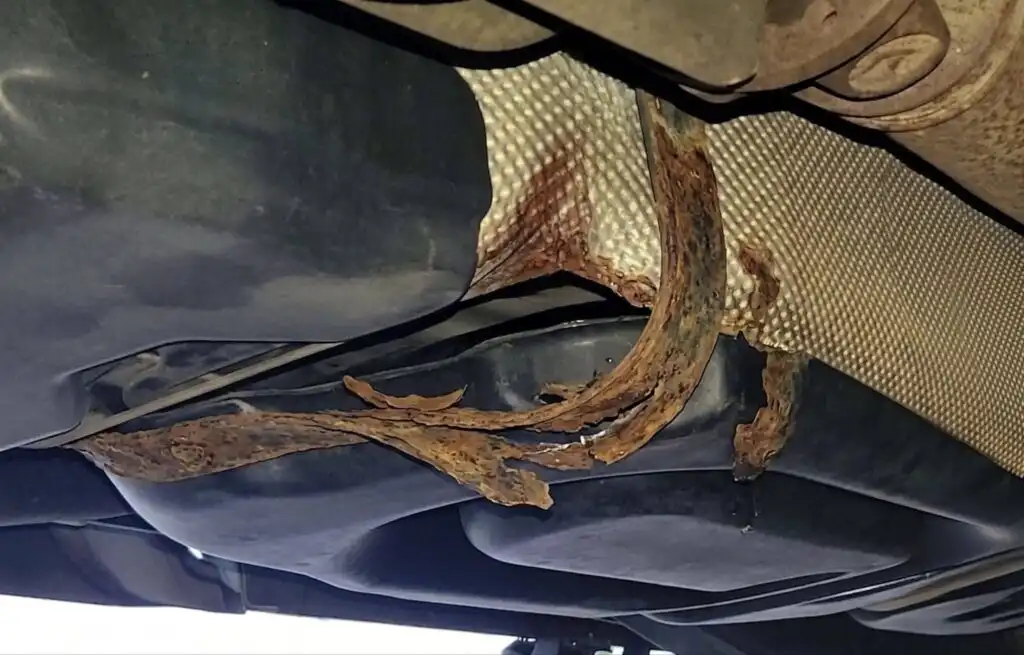
Fuel tank straps cradle the fuel tank against the chassis and withstand road vibration, debris contact, and heat cycling. When they rust through, crack, or lose their mounting integrity, the tank can shift, putting stress on fuel lines, the filler neck, and the fuel pump assembly. The repair is about restoring a secure system, not just swapping metal bands.
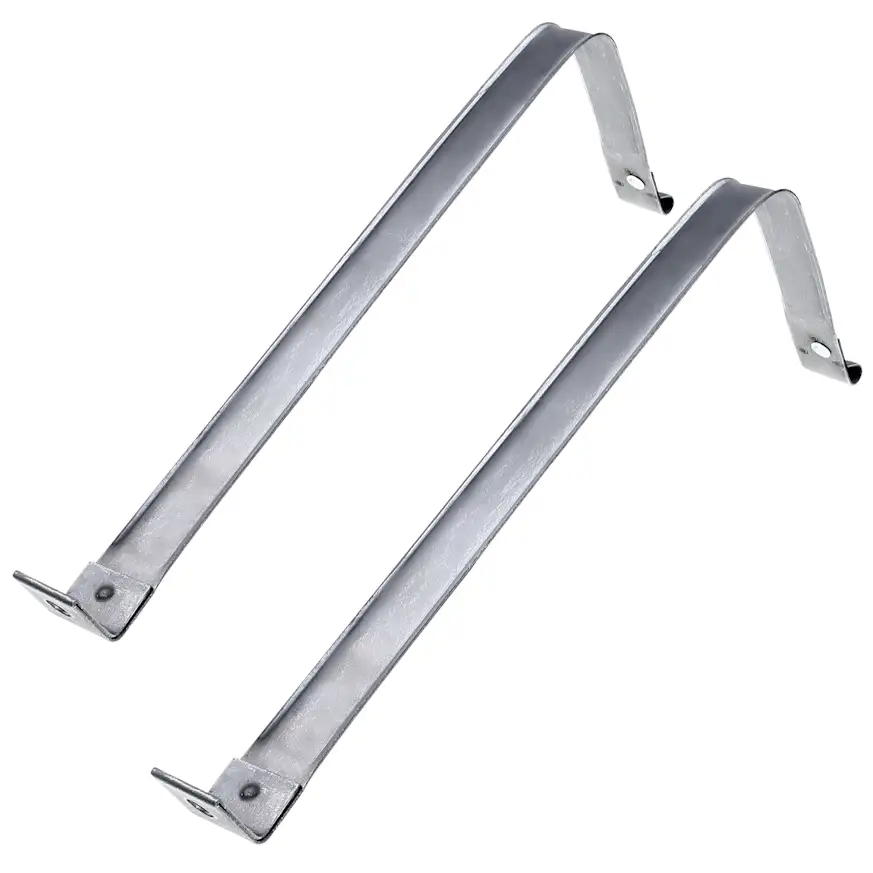
How to Safely Reduce Fuel Tank Weight Before Removal
Dropping a fuel tank that is more than one-quarter full can be dangerous because of the added weight. A gallon of gasoline weighs roughly 6 lbs. or about 2.7 kg, meaning the gasoline in a half-full 26-gallon tank weighs nearly 80 lbs., not including the weight of the tank itself.
Use a siphon pump designed for gasoline, or run the fuel level down before starting. Work outdoors or in a well-ventilated area, keep ignition sources away, and transfer fuel only into an approved container with enough capacity for the amount being removed.
If the manufacturer’s service information provides a pump-assisted transfer procedure, follow it exactly. Depending on the vehicle, the procedure may involve disconnecting a fuel line at the filter or another designated point, connecting a fuel-rated hose to an approved container, and commanding the pump with a scan tool or the specified relay-jumper method. Do not improvise this procedure.
Pay close attention to fuel flow. If the procedure permits a clear fuel-rated hose, stop the pump when the flow becomes foamy or the pump begins to cavitate so the pump is not damaged.
Why Universal Fuel Tank Straps Are a Poor Long-Term Fix
Universal, cut-to-length strap kits may work only as a temporary emergency measure. They generally cannot reproduce the vehicle-specific geometry, attachment points, and tension required for a secure long-term repair. Use straps listed for the vehicle’s exact tank configuration whenever possible. Vehicle-specific replacements are typically available from aftermarket suppliers.
Straps are most often sold as a set of two, though some applications require three. Some listings include a protective skid plate or rubber insulator. Others are bare straps only. Knowing what the original setup used and whether the replacement matches that is the first real decision in this order.
Choose Your Cart Size
1. Minimum Viable Repair
The straps are the only failure. Hardware is reusable. The tank and surrounding components are in good shape.
Choose it if:
- One or both straps are visibly cracked, snapped, or badly corroded but everything else checks out
- The vehicle is relatively low mileage or newer
- The mounting bolts and hardware came out cleanly and are not stripped or rusted
Typical cart:
- Fuel tank strap set (correct quantity for application)
- Replacement mounting hardware if not included in the strap set
2. Smart Same-Access Refresh
The tank is already down or close to it, so adjacent wear items are worth a look.
Choose it if:
- The straps failed due to general underbody corrosion, suggesting nearby components are in similar shape
- The fuel filter is accessible or overdue
- The rubber insulators or cushioning pads between the strap and tank are brittle or missing
Typical cart:
- Fuel tank strap set
- Mounting hardware
- Fuel filter (if accessible from this position)
- Rubber strap insulators or cushioning pads if sold separately for the application
3. High-Mileage / Do-It-Once Reset
Older vehicle, heavy rust belt exposure, or a fuel system that hasn’t been touched in years.
Choose it if:
- The vehicle has significant mileage, and the straps are original equipment
- There’s evidence of fuel smell, soft fuel lines, or a stiff filler neck hose
- The tank itself shows surface rust, or the mounting points on the frame are corroded
Typical cart:
- Fuel tank strap set
- Mounting hardware
- Fuel filler neck hose
- Fuel lines or hose clamps if visibly cracked
- Fuel filter
- Tank rubber insulators
What Is Commonly Ordered Together on This Job
Hardware and Fasteners
Many strap sets include mounting bolts, nuts, and washers, but not all do. Check the listing carefully. Corroded hardware is the most common reason a straightforward strap swap turns into a hardware store run. Order a replacement bolt kit if there’s any doubt.
Rubber Insulators and Cushioning Pads
Some applications use rubber pads or foam insulators between the strap and the tank body. These degrade with heat and age. If the listing doesn’t include them and the originals are cracked or missing, they need to be sourced separately.
Fuel Filler Neck Hose
With the tank lowered, the filler neck hose is right there. If it’s been on the vehicle for years and shows any cracking or stiffness, replacing it now costs almost nothing in extra labor.
Fuel Filter
Depending on the application and filter location, dropping the tank gives good access. High-mileage vehicles where the filter hasn’t been touched in years should get a new one while access is open.
Skid Plate
Some OE setups include a protective skid plate that mounts alongside or in conjunction with the straps. If the original had one and the replacement listing doesn’t include it, that’s a separate line item to address.

What People Forget Until the Vehicle Is Already Apart
These are the things that cause mid-repair problems:
- Not confirming the quantity, since some applications need three straps, not two
- Assuming hardware is included, as it often isn’t in bare-strap listings
- Forgetting the rubber insulator pads between the strap and the tank
- Not checking whether the listing is strap-only or includes a hanger bracket assembly
- Ordering by strap length alone without checking the mounting-hole geometry
- Skipping the filler neck hose inspection until the tank is already lowered
- Not having penetrating oil on hand for severely rusted mounting bolts
- Failing to confirm whether a skid plate is part of the OE assembly
When Replacing Only the Fuel Tank Strap Is False Economy
If one strap is snapped due to a single impact and the rest of the underbody looks solid, replacing only the straps is completely reasonable. The job is short, access is straightforward, and there’s no compelling reason to chase adjacent parts.
The logic shifts when the failure mode is generalized rust. Straps that have corroded through didn’t corrode in isolation. The mounting points, the filler neck hose, the fuel lines, and the hardware are all living in the same environment. Replacing the straps and leaving the adjacent components clearly degraded means the next repair is already scheduled. For an overview of common fuel pump symptoms to watch for while you’re under the vehicle, see our dedicated guide.
The other false economy is replacing only one strap on a two-strap application. If one has failed from corrosion or fatigue, the other is likely not far behind. Replacing both at once is almost always the right call.
The Fitment Splits That Break Fuel Tank Strap Orders
Strap Length and Geometry
This is the most common wrong-part trap. Strap length varies significantly by make, model, tank size, and tank position, such as front-mounted vs. rear-mounted. Two visually similar straps may have completely different mounting hole locations or end profiles. Always verify length against the application, not just a rough visual match.
Quantity Per Application
Most passenger cars use two straps. Larger trucks, SUVs, and vehicles with extended-range tanks may require three. Ordering a set of two for a three-strap application leaves the job incomplete.
With or Without Skid Plate or Insulator
Some listings are bare straps. Others include a protective skid plate or integrated insulator. The OE setup may include one, and ordering without it leaves the tank less protected than factory spec.
Material Compatibility and Insulators
Do not install bare steel straps directly against an aluminum tank without the specified rubber insulators. Moisture trapped between dissimilar metals can accelerate galvanic corrosion and damage the strap or tank.
Hanger Assembly vs. Bare Strap
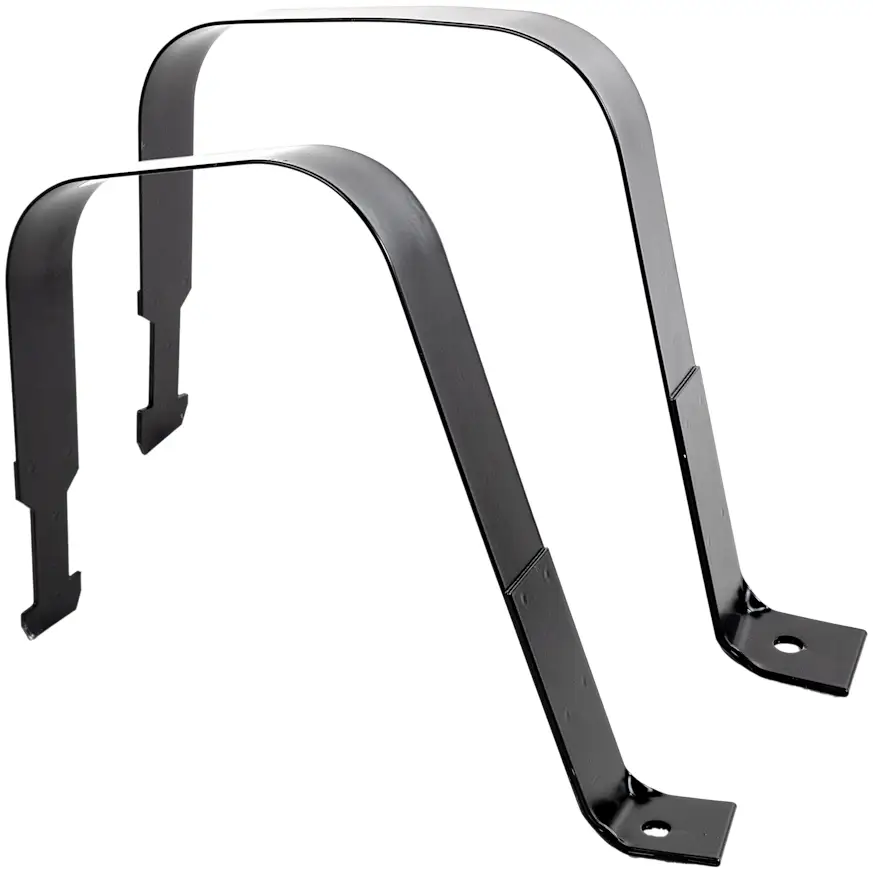
Some vehicles use a strap integrated with a mounting bracket or hanger assembly. A bare strap will not substitute correctly. If the original has a formed bracket or attachment point built in, the replacement needs to match that configuration.
Tank Size Variants
Do not rely on the vehicle’s year, make, and model alone. A single truck model year can offer several fuel tank capacities, such as 26-, 34-, or 36-gallon options. Some model years or trim levels offered optional larger fuel tanks, and different capacities on the same platform may use straps with different lengths. The owner’s manual may list the available capacities without identifying which one is installed. Confirm the specific tank using the original window sticker or build sheet, a VIN-based parts catalog, or physical tank dimensions before ordering straps. Confirming the actual tank size before ordering prevents this mismatch.
Position: Front vs. Rear
On multi-strap setups, front and rear straps are sometimes different lengths or shapes. Some applications sell them as matched sets; others sell them individually, labeled by position. Ordering two of the same strap when the application needs a front and a rear variant is a real ordering mistake.
Delivery-Day Inspection Checklist
Before dropping the tank, check the new straps against the originals:
- Strap length on each piece matches the original
- Mounting hole location and spacing match
- End profiles and bend geometry are consistent with OE
- Hardware is included, or a separate hardware order is ready
- Rubber insulators or cushioning pads are present if required
- Skid plate or hanger bracket matches the original configuration if applicable
- Material finish is appropriate for the application such as steel, galvanized, or satin-coat
- No damage from shipping, including bent profiles or deformed mounting tabs
Your One-Job Order Sheet for a Fuel Tank Strap
Confirm the vehicle: year, make, model, engine, and tank size if there’s an optional larger tank for that platform
Confirm the quantity: two straps or three; do not assume
Confirm what the listing includes: bare strap, set with hardware, or assembly with hanger bracket and skid plate
Add consumables: mounting hardware if not included, rubber insulators, and penetrating oil for rusted hardware
Check the same-access items: filler neck hose and fuel filter while access is open, especially on high-mileage vehicles
Choose the right ownership logic: isolated replacement if the vehicle is in good shape, or a broader fuel system refresh if the underbody shows general corrosion
The Smart Way to Shop Fuel Tank Straps
The order that looks cheapest at checkout is rarely the order that finishes the job cleanly. A strap set that doesn’t include hardware, or one listed for a 26-gallon tank when the vehicle has the 35-gallon option, costs more time than money once the vehicle is on jack stands.
Shopping for fuel tank straps correctly means filtering by exact application, reading the listing for what is and is not included, and thinking through the one or two adjacent items that make sense given the vehicle’s age and condition. The strap set is the headline part. The complete order is what actually gets the job done once.
Keep Reading: Related Posts





Any information provided on this Website is for informational purposes only and is not intended to replace consultation with a professional mechanic. The accuracy and timeliness of the information may change from the time of publication.