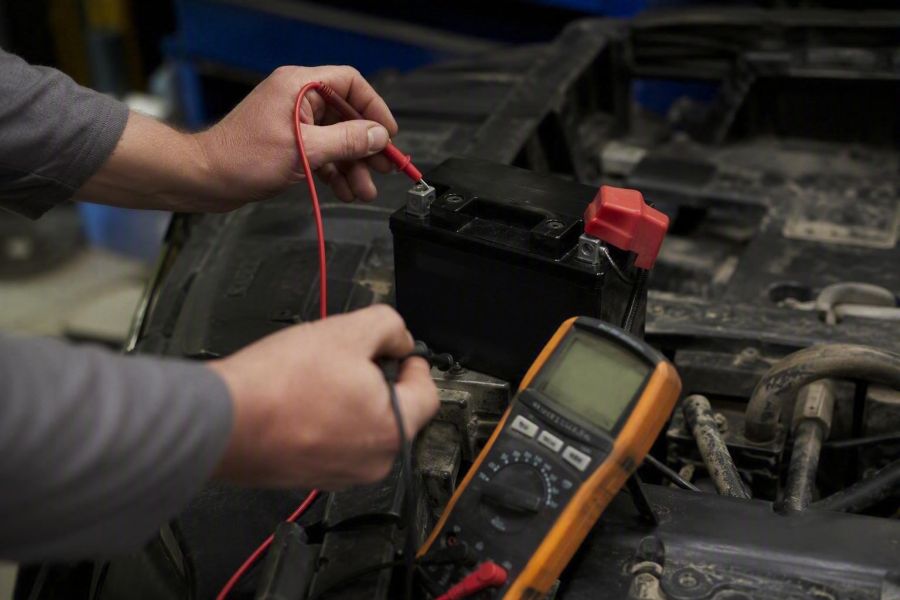
Set a digital multimeter to DC volts, touch the red probe to the positive terminal and the black probe to the negative, and read the number with the machine shut off. A healthy 12-volt powersports battery rests between 12.6 and 12.8 volts. Under 12.4 volts it needs a charge, and under 11.8 volts it’s probably finished. This resting number is only the first of three readings. The full version of how to test a powersports battery with a multimeter adds voltage while the engine cranks and while it runs, which separates a tired battery from a charging system that isn’t keeping up.
Key Takeaways
- A fully charged 12-volt battery rests at 12.6 to 12.8 volts once it’s been off the charger.
- Under 12.4 volts, charge it. Under 11.8 volts, plan on replacing it.
- Voltage that sags under roughly 9.6 volts during cranking means the battery can’t hold up under load.
- At about 4,000 rpm, a working charging system should pull the reading to 13.5 or higher.
- Lithium packs and 6-volt batteries use different numbers, so check the manufacturer’s chart.
What You Need Before You Start
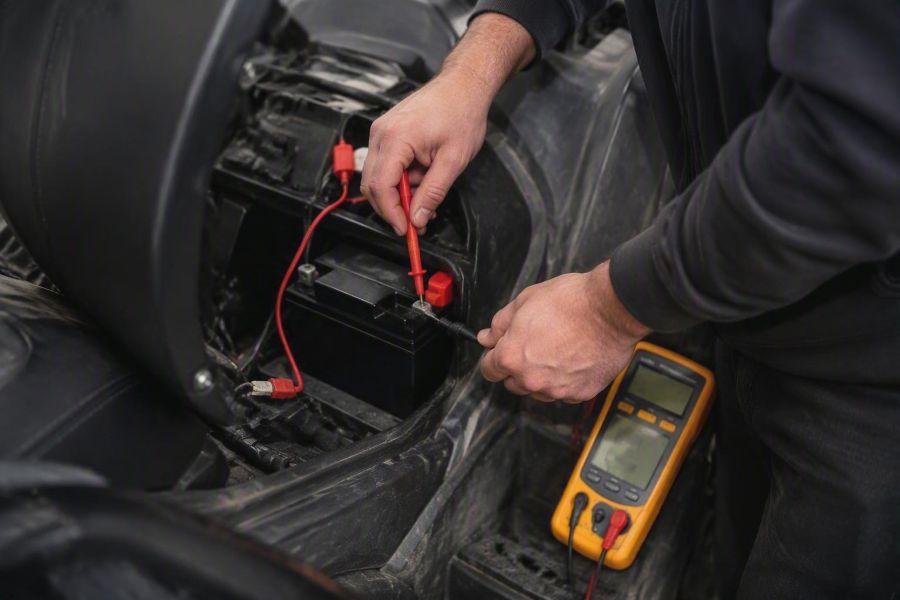
A digital multimeter, hand tools to pull a seat or side panel, and gloves cover it. The tool list for how to check a motorcycle battery is the same one you’ll use for a quad, a side-by-side, a sled, or a ski. Auto-ranging meters need the knob on V. Manual meters need the DC scale set to 20, since these batteries nominally run 12 volts.
Work with the engine off and the key out, and keep the probes from touching each other or bridging both terminals. If the case looks swollen, cracked, or wet with acid, skip the test and replace it.
Ruling Out the Easy Stuff
Half of what looks like a battery problem isn’t the issue. Check the kill switch, the sidestand and clutch interlocks on a bike, the seat belt interlock on a side-by-side, and the tether lanyard on a ski. Loose or corroded terminals mimic a flat battery, so clean and tighten them first. A strong crank that still won’t fire points away from the battery, toward a fuel delivery problem or a fouled spark plug.
Reading Resting Voltage
Setting Up the Meter
Black lead into the COM port, red lead into the port marked V. Turn the meter to DC volts, or to the 20 scale if it isn’t auto-ranging. Touch black to the negative post and red to the positive post.
What the Number Means
At roughly 80 degrees, 12.73 volts or better is a full charge. About 12.6 lands near 90 percent, 12.5 near 80 percent, 12.3 near 70 percent, and 12.06 sits at half. Under 12.0 volts it’s discharged, and under 11.8 volts it’s likely damaged rather than just flat.
Timing matters as much as the number. A battery straight off a charger carries a surface charge that reads high, so let it rest 30 minutes or run the headlight for 30 seconds, then read it again. Check once more after 12 hours off the charger for a real verdict. One that shows 12.7 fresh off the tender and 12.2 the next morning is losing its grip.
The Two Tests Most Riders Skip
Cranking Voltage
Leave the probes on the terminals and have someone hit the starter while you watch the meter. Voltage dips during cranking, and that’s normal. In a lead-acid or AGM battery it shouldn’t fall under about 9.6 volts across 10 seconds. A reading that plunges into the single digits and recovers slowly means the battery measures fine at rest and still can’t do the job.
Keep hands, sleeves, and leads clear of the drive line, fan, and exhaust while the engine turns.
Charging Voltage
With the engine running, put the probes back on the terminals. At idle you won’t see much change. Bring the revs to around 4,000 and the reading should climb into the 13.5 to 14.5 range for most machines. A number stuck near resting voltage points at the stator, the regulator, or the wiring between them. Over about 15 volts, the regulator is overcharging and cooking the battery. Either result is worth an inspection before you buy another battery.

Testing by Machine Type
Most testing motorcycle battery advice stops at the street bike, but the same meter and the same numbers cover everything in the garage. Only access, accessory load, and usage change.
ATVs and UTVs
Batteries hide under the seat, behind a front rack panel, or under the cargo bed. Side-by-sides carry the heaviest accessory loads in powersports, since winches, light bars, stereos, and cab heaters all pull current. Take a reading before and after an accessory installation, and look for a key-off draw if the machine keeps going flat in the driveway.
Personal Watercraft
Ski batteries sit in the hull, where moisture and vibration go to work on the terminals. Most are sealed absorbed glass mat (AGM). Pull the seat, look for corrosion, and read the battery a few weeks before the first launch instead of on the morning of it.
Snowmobiles
Cold takes a bite out of cranking power, so test a sled twice: once warm in the garage and once at the temperature you ride in. One that passes at 60 degrees and fails at 10 is telling you something.
Dirt Bikes and Scooters
Small-displacement machines often run lithium iron phosphate packs, and these don’t follow the lead-acid chart. A healthy lithium pack rests near 13.0 to 13.3 volts, so a reading in the 12s can mean it’s low rather than fine. Some packs sleep after a deep discharge and need a lithium-specific charger to wake up.
When It Isn’t the Battery
A battery that keeps dying is usually a symptom. Parasitic draw from an alarm, a GPS unit, or accessory wiring flattens a small battery in days, and corroded cables or a weak stator produce the same complaint. Find the cause before you buy a replacement.
FAQs
Under 11.8 volts at rest, most lead-acid and AGM batteries are past saving. Charge it, then retest 12 hours later. Replace it if the reading slides back down.
Yes. All three readings happen with the battery in place. You only need to pull it for a bench load test or when the terminals sit too deep to reach safely.
Voltage shows the state of charge, not the current the battery can deliver. A sulfated battery holds a good resting number and still collapses when the starter loads it, which is what the cranking test catches.
Once at the start of the season, once mid-season, and again before storage. Machines that sit for months do better with a maintenance charger.
The procedure is the same, but the numbers aren’t. Lithium packs rest higher and fall off sharply at the end of their charge, so use the battery maker’s chart.
A multimeter turns a guess into a five-minute answer, whether your machine is a quad, a ski, a sled, or a bike. Once you know what you’re actually replacing, the fix is a battery, a terminal kit, or a charging part instead of a weekend of guessing. Find batteries, chargers, and electrical parts built to fit every machine you own here at the JC Whitney Performance Hub.
Keep Reading: Related Posts







Any information provided on this Website is for informational purposes only and is not intended to replace consultation with a professional mechanic. The accuracy and timeliness of the information may change from the time of publication.