Picture a crisp October morning with the sled on the trailer and the first snow a few weeks out. You press the start button and get a weak click from a lithium battery that sat all summer. Before you blame the battery, look at how it was charged, because charging habits decide how long lithium lasts. Knowing how to charge a lithium powersports battery without damaging it saves money and keeps rides on schedule.
This guide covers every machine in your garage, including ATVs, UTVs, dirt bikes, motorcycles, scooters, PWCs, and sleds. You’ll get the right voltage, charger features, temperature limits, and fixes for batteries that refuse to charge. Most online advice targets e-bikes and solar banks, so we adapted it to 12-volt starting batteries powersports machines use.
Why Lithium Charges Differently Than Lead-Acid
Most powersports lithium batteries use lithium iron phosphate chemistry, often shortened to LiFePO4. It weighs far less than lead-acid and holds a charge longer, but it follows different charging rules. Lead-acid needs occasional high-voltage pulses to break up sulfate crystals, while lithium never sulfates at all.
Every lithium battery also carries a battery management system, or BMS. This circuit board blocks overcharge, over-discharge, overheating, and overcurrent, and it balances the cells inside. The BMS protects the pack from most abuse. A charger that sends desulfation pulses above 15 volts can still damage cells or trip the BMS.
How to Charge a Lithium Powersports Battery Without Damaging It, Step by Step
Good charging starts before the charger touches a terminal. Run through these quick checks, then follow the steps below.
Inspect the Battery and the Temperature
Look over the case for cracks, swelling, or heat damage. If you find any, replace the battery instead of charging it. Clean terminals and snug cables matter too, because poor connections create resistance and sparks. Charge in a dry, ventilated spot away from heaters and direct sun.
Temperature matters just as much. Many makers set the safe charging window from 32°F to about 104°F, and a few allow up to 113°F. Charging below freezing can cause lithium plating inside the cells, which permanently cuts capacity. After a hard ride, let the battery cool indoors for a few minutes before you charge it.
The Charging Steps
This order protects the battery, the charger, and your hands from sparks.
- Switch off the ignition, then disconnect the negative cable, or use a quick-connect harness if your machine has one.
- Set the charger to its lithium or LiFePO4 mode, and confirm it’s rated for 12 volts.
- Clip the red clamp to positive and the black clamp to negative while the charger is unplugged.
- Plug in the charger and watch the indicator lights for the first few minutes.
- Touch the case now and then, and stop charging if the battery gets hot.
- Unplug the charger from the wall when it reports full, then remove the black clamp and the red clamp.
- Reconnect the negative cable last, and tighten it snugly.
Most lithium packs can handle an overnight charge thanks to the BMS. Even so, unplug once the charger reports full, because that reduces needless stress on the cells. A healthy charge shows stable voltage, little heat, and a strong start afterward.
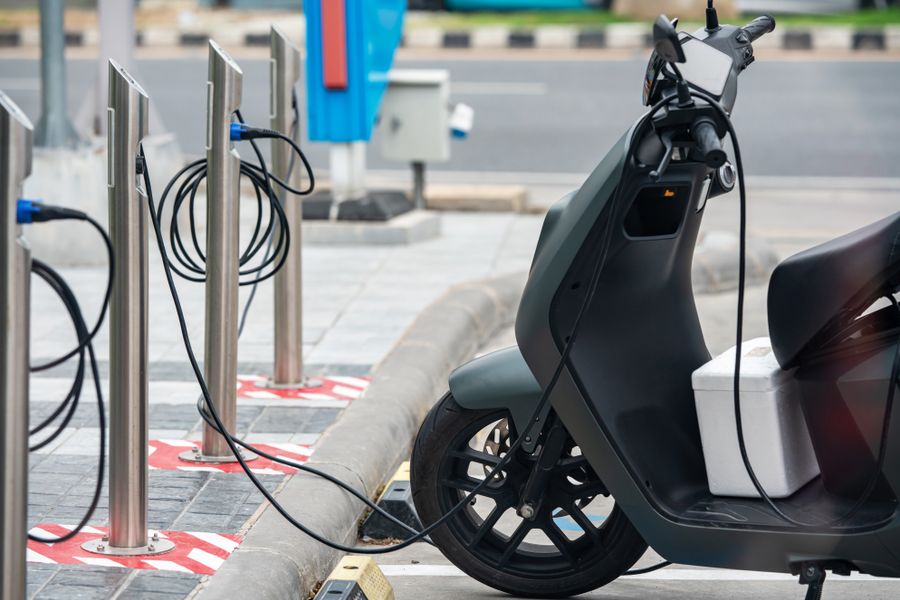
Choosing a Charger That Won’t Harm Lithium
The charger is where most damage starts. Lithium wants a smooth, controlled profile, and an old lead-acid unit often gets that wrong.
Chargers built for lithium motorcycle batteries usually add useful extras, such as temperature compensation or a BMS reset. Multi-chemistry smart chargers work well too, but you must select the lithium setting every time. Many of them include a desulfation mode for lead-acid, and you shouldn’t use it on lithium. Skip older lead-acid units and unregulated chargers entirely.
Use this checklist when you shop for a charger.
- A dedicated lithium or LiFePO4 mode, not just an AGM setting.
- Constant current and constant voltage charging with automatic cutoff.
- No desulfation or repair cycle, or a way to switch it off.
- An amp rating that suits your battery, from 1 amp for small packs to 10 amps for large ones.
- A winter mode if you charge in a cold garage.
- A quick-connect harness so you can skip the clamps.
Popular lithium-compatible smart chargers run about $30 for a 1-amp model and near $100 for a 10-amp model. Prices shift by brand and retailer, so treat these as ballparks. If you ride an electric model with a high-voltage pack, use the maker’s charger and match its voltage exactly.
Voltage Readings, Charge Rates, and Charge Time
A multimeter turns guesswork into data. Check voltage after the battery rests for an hour, because readings right after riding or charging run high.
| Resting voltage (12-volt LiFePO4) | What it usually means |
| 13.2 to 13.4 volts | Fully charged and healthy |
| 13.0 to 13.2 volts | Normal operating range |
| 12.4 to 12.8 volts | Low, so charge soon |
| Below 12.0 volts | Deeply discharged, so charge right away |
| Below 10 volts | BMS protection or possible damage |
Some makers set a stricter line. EarthX, for example, calls anything under 13.28 volts discharged for its packs, so check your maker’s chart. Don’t make a habit of running a lithium battery flat, since repeated deep discharges speed up wear.
Charging voltage sits higher than resting voltage. A LiFePO4 pack needs about 14.2 to 14.6 volts while charging, and 14.4 is a common target. A lithium-compatible charger handles this for you, so you only need these numbers to verify a setting.
Charge rate matters too. Check the label for the maximum charging amps, and never exceed that number. A gentle rule of thumb is 0.2 to 0.5 times the amp-hour rating. A 10Ah battery, for example, charges well at 2 to 5 amps.
To estimate time, divide the battery’s amp-hours by the charger’s amps. A 10Ah battery on a 2-amp charger needs about five hours from empty. A 5-amp charger cuts that to roughly two. Most batteries are only partly drained, so real charge times run shorter.
Charging Notes for Each Powersports Vehicle
Every machine stresses its battery differently, so tailor your routine to the way you ride.
ATVs and UTVs
Winches, light bars, audio systems, and GPS units often pull power even when the key is off. That parasitic draw can empty a lithium pack in days and trip the BMS. A battery isolator or disconnect switch stops the drain, and a lithium-compatible charger tops off the battery between trips. A heavy winch pull can also spike current and trip the BMS, so match the battery to your accessories.
Dirt Bikes, Motorcycles, and Scooters
These machines use small batteries, so a 1 to 2 amp lithium-compatible charger is usually plenty. Dirt bikes sit between rides. Scooters take short trips that rarely recharge the pack, and alarms drain parked bikes.
Check voltage monthly in those cases. If your bike has a factory charging socket, use it, since the electrical system is built around it.
Personal Watercraft
Moisture is the enemy on the water. Rinse and dry the machine, wipe the terminals, and keep connectors sealed before you charge. Many riders install a quick-connect charger lead, so they never unhook cables inside a wet hull. At season’s end, pull the battery, charge it indoors, and store it off the floor in a dry spot.
Snowmobiles
Cold is the biggest variable here. Lithium batteries still discharge in freezing weather. Many BMS units refuse a charge when the cells sit near or below 32°F.
Bring the battery indoors and let it warm up first, or choose a cold-rated pack with a built-in heater. Some chargers add an automatic winter mode below 40°F, which helps in a chilly garage.

What to Do When a Lithium Battery Won’t Charge
A dead-looking battery isn’t always dead. Often the BMS has simply disconnected the cells to protect them.
Deep discharge, extreme temperatures, or overcurrent can all trigger protection or sleep mode. In sleep mode, the terminals show very low voltage. A smart charger can’t detect the battery and may refuse to start.
Many makers publish a wake-up method. Examples include a reset button, a charger with BMS reset, or a brief jump starter boost. Follow your maker’s method, then switch to the lithium charging mode and charge normally.
Don’t wait around, though. Cells held below about 2.5 volts each can also suffer permanent damage, so test a revived battery carefully. If the case swells, runs hot, or refuses charge after a reset, replace it.
Charging and Storing Lithium Between Rides
Lithium self-discharges slowly, about 2 percent a month, versus roughly 30 percent for lead-acid. That’s why many riders can park a machine for months without a charger.
Some riders wonder about leaving a lithium pack on a trickle charger all winter. A fixed-float lead-acid unit isn’t the answer. Lithium doesn’t need constant top-offs, and some chargers never settle into maintenance mode.
A true lithium maintainer works fine. Some brands carry multi-chemistry models that offer a lithium protocol for unattended storage. Low-draw machines often need no charger at all.
Storage charge level depends on the pack. Starter-style batteries go into storage fully charged. Check their voltage every few weeks.
Some makers, especially for larger packs, prefer 50 to 60 percent for long layups. Either way, store it cool and dry, and disconnect the negative cable to remove parasitic draw.
New batteries often ship partly charged too. Shorai says its batteries arrive near 30 percent, so top off a new one before the first ride.
Fitment and Installation Checks Before You Upgrade
Charging problems often start with a mismatched battery. Before you order, confirm voltage, case size, terminal polarity, and cold cranking amps. Use your owner’s manual and the vehicle selector.
Lithium powersports batteries commonly cost about $70 for small packs and $150 or more for larger sizes. Prices shift.
Test your charging system as well, because an aging regulator can overcharge lithium. With the engine above idle, a healthy system typically reads roughly 13.8 to 14.5 volts at the battery. Check your service manual for the exact spec. Secure the hold-down, keep terminals tight, and skip the pressure washer near the battery.
Quick Answers About Charging Lithium Powersports Batteries
These are the questions riders ask most often.
Can I use a regular car battery charger on a lithium powersports battery?
Only if it has a true lithium mode and no desulfation cycle. Otherwise it can overcharge the pack or trip the BMS.
Do lithium batteries need a special charger?
Yes. Choose a charger with a lithium or LiFePO4 profile at the right voltage for the fullest charge.
How long does it take to charge a lithium powersports battery?
Divide amp-hours by charger amps. A 10Ah battery on a 5-amp charger needs about two hours from empty.
Should I charge after every ride?
Usually not, since the stock charging system handles regular riding. Charge when voltage drops, after short cold trips, or before storage.
Can my machine’s stock charging system handle lithium?
Usually yes, because many lithium makers design for stock systems. A failing regulator is the main risk, so test it.
Equip Your Garage for the Next Ride
Your thirst for adventure doesn’t have an off-season, and neither should your battery. When you’re ready to shop, the JC Whitney Performance Hub at CarParts.com has battery chargers and quick-connect harnesses. You’ll also find jump starters, terminals, hold-downs, and cables for ATVs, UTVs, bikes, scooters, PWCs, and sleds. Use the vehicle selector to confirm fitment, and equip the whole garage, from tow rig to trail machine.
Keep Reading: Related Posts




Any information provided on this Website is for informational purposes only and is not intended to replace consultation with a professional mechanic. The accuracy and timeliness of the information may change from the time of publication.