You might already know that you need a cruise control switch. The harder part is choosing the version that actually matches your vehicle’s steering wheel, its wiring, and the way it was built.
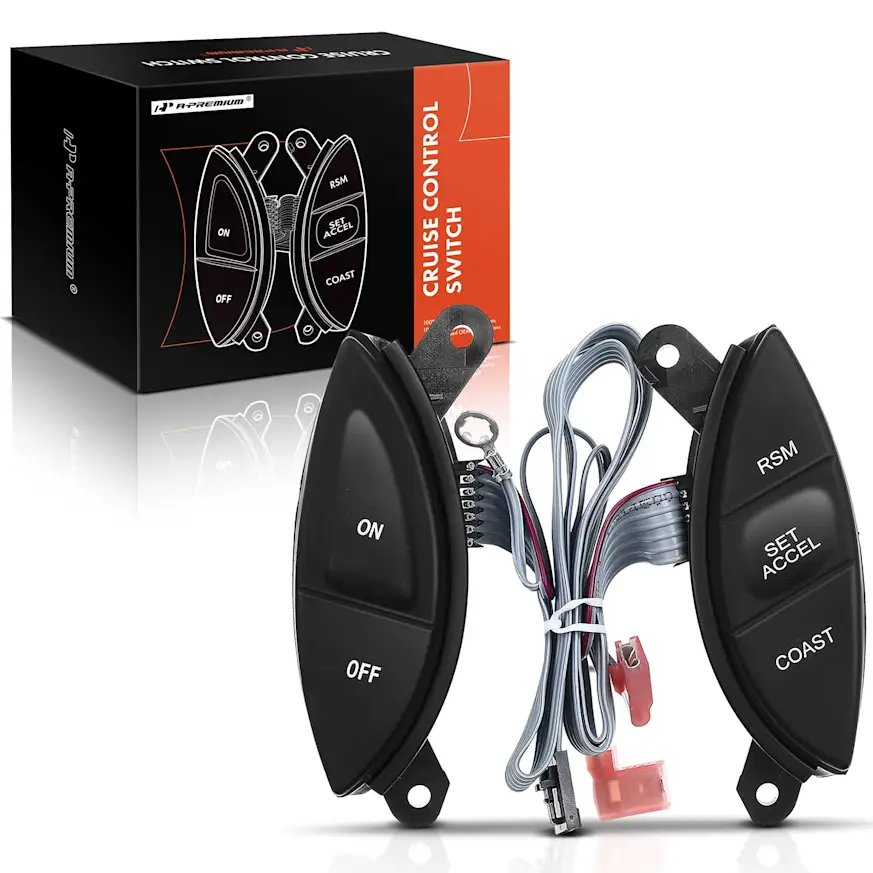
Cruise control switches are one of those categories where the listings look almost interchangeable at thumbnail size. One product photo shows a small black button pad that sits in the face of the steering wheel. Another shows a long stalk that mounts to the steering column. A third shows two button pads joined together by a wiring harness. All of them are correctly labeled as a cruise control switch, and all of them can be the wrong choice for your vehicle.
The differences that matter aren’t always obvious in the image. They live in the switch style, the side of the wheel the pad occupies, the connector on the end of the wire, and whether the listing covers one button pad or a matched set. This is a check you want to run before the order ships, not after you have the trim panel off and a connector that doesn’t seat.
How Do You Choose the Right Cruise Control Switch?
To choose the right cruise control switch, confirm your vehicle’s year, make, model, and trim first, since switch shape and button layout often change with trim and steering wheel design. Next, determine whether your vehicle uses a steering-wheel-mounted button pad or a column-mounted stalk switch, and whether the failed switch is on the left or right side of the wheel. Then check whether the listing covers a bare switch, a switch with a wiring pigtail attached, or a paired left-and-right set. Compare the connector shape and button count against the switch you’re replacing, and confirm what’s included before adding it to cart.
Start With the Vehicle, Not the Product Image
Start with the vehicle, not the thumbnail. Two switches can look nearly identical in a photo and still use different button counts, different mounting clips, or a connector that doesn’t match your ride’s harness.
Use the vehicle selector before you compare anything else. Cruise control switches are strongly trim-dependent, because the switch shares real estate on the steering wheel with audio, phone, and display controls that not every trim level received.
Confirm these details:
- Year, make, and model: Steering wheel designs change mid-generation more often than shoppers expect.
- Trim or submodel: A base trim and a higher trim for the same model year can use completely different switch pads.
- Steering wheel type: A leather-wrapped wheel with integrated controls and a base urethane wheel often take different parts.
- Side or position: Determine whether you need the left pad, the right pad, or a column-mounted switch.
- Feature level: Note whether your vehicle’s steering wheel also carries audio, cruise resume, phone, or menu buttons on the same pad.
- Production date, where listed: Some applications split part coverage partway through a model year.
Getting the vehicle data right narrows the field faster than scrolling. It also filters the listings that fit a similar-looking wheel for a different trim.
Identify the Version Your Repair Actually Needs
Two cruise control switches can share the same name and still solve different ordering problems. The category splits several ways, and the split you care about depends on how your vehicle is built and what actually failed.
Look at which of these describes the part you need:
- Steering-wheel button pad: A flush-mounted switch that sits in the face or spoke of the wheel. Some listings identify this explicitly as a steering wheel cruise control switch.
- Column-mounted stalk switch: A lever-style switch that mounts to the steering column instead of the wheel, common in vehicles that never used wheel-mounted buttons.
- Single switch versus paired set: Some listings cover one button pad. Others cover a left-and-right pair joined by a wiring harness, which matters if only one side failed and you don’t want to pay for two.
- Bare switch versus switch with pigtail: Some products arrive with a short wiring lead and connector already attached. Others are the switch body alone.
- Cruise-only versus multifunction pad: If your vehicle’s wheel combines cruise control with audio or display buttons on one pad, a cruise-only switch won’t fill the opening or restore the other functions.
- Direct-fit designation: Several listings in this category carry an explicit direct-fit product attribute, which tells you the part is built to drop into the factory location without modification.
Naming the version you need before you sort by price prevents the most common outcome in this category, which is a part that mounts but doesn’t plug in, or a part that plugs in but leaves an empty hole in the wheel.
Compare the Details That Make the Switch Fit
Use the product image as a starting point, not as the whole match. Photos in this category are genuinely useful, because much of what decides fitment is visible. Just don’t stop at the overall silhouette.
If you can see or remove the original switch, compare these points against the listing photos and product details:
- Connector shape and pin count: The plug on the harness end is the single most common mismatch. Count the pins and note whether the connector is flat, square, or rounded.
- Button count and layout: Match the number of buttons and their arrangement, not just the presence of a cruise symbol.
- Button legends: Check for on, off, set, resume, cancel, and coast markings, and confirm the printed symbols match what you have now.
- Pad outline and curvature: The switch has to follow the contour of your specific steering wheel spoke.
- Mounting tabs and clip locations: These decide whether the switch seats and locks in place.
- Wire lead length: On listings that include a pigtail, a shorter or longer lead than the original can complicate routing.
- Bezel or trim finish: Many switches in this category are specified in a black finish, so verify the color matches your interior trim.
- Stalk length and pivot direction, for column switches: A column stalk has to clear the wheel and any surrounding trim.
Two or three of these checks usually settle the decision. The connector and the button layout do most of the work.

Check What Comes in the Box
A listing can be correct for your vehicle and still be incomplete for your repair. Fitment and completeness are separate questions, and this category has real variation in what ships.
Read the product details for these items:
- Whether a wiring pigtail or connector is attached to the switch
- Whether mounting clips, screws, or retainers are included
- Whether the listing covers one switch or a left-and-right pair
- Whether a bezel or trim surround is part of the product or reused from your vehicle
- Whether any harness adapter is supplied
If the original switch is cracked at the mounting tabs, or if the wiring lead is chafed rather than the switch itself, this changes which version you’ll need. And if the listing you’ve chosen doesn’t include a clip or retainer that you need, plan on sourcing this separately rather than assuming it’s in the box.
Compare Brands After You Confirm Fitment
Brand matters, but it shouldn’t be the first filter. A Motorcraft, A-Premium, Replacement, or Autotecnica cruise control switch still has to match the steering wheel style, side, button layout, and connector before it belongs in your cart.
Once fitment is settled, brand becomes a useful confidence filter. The options in this category tend to occupy different positions. Motorcraft lists its cruise control switches under an OE Replacement series, which appeals to shoppers who want the configuration their vehicle left the factory with. A-Premium and Replacement both carry a direct fit product designation, and A-Premium specifies a plastic switch construction. Coverage terms are stated per product and vary between brands, so it’s worth reading them rather than assuming they match.
The better question isn’t which cruise control switch brand is best. It’s which brand offers the correct switch style, side, and connector for your vehicle and repair. A recognizable name on a switch with the wrong plug still ends up in a return box.
Choose the Right Ownership Lane
The right cruise control switch isn’t always the most expensive one. It’s the one that matches how long you need the repair to hold and how much of the switch assembly actually failed.
- Replace only the failed switch: Best if one button pad stopped responding, the wiring and connector are intact, and the vehicle is a shorter-term keeper. A single bare switch in the correct side and layout does the job. Don’t pay for a paired set or an attached harness you won’t use.
- OE-style replacement for a daily driver: Best if you want the switch to look, feel, and function like the original, especially on a wheel where the pad is visible every time you drive. An OE Replacement series part or a direct fit switch in the matching finish fits here. Don’t underbuy on the button layout to save a few dollars, because a cruise-only pad on a multifunction wheel isn’t a fix.
- Matched-pair or harness-included replacement: Best if both sides of the wheel are showing worn or unresponsive buttons, if the wiring lead is damaged, or if you’d rather not disassemble the wheel twice. A paired set joined by a harness, or a switch with a pigtail already attached, addresses the whole assembly in one order. Skip this lane if only one side failed and the wiring checks out.
Make the Final Add-to-Cart Check
Before you add the cruise control switch to cart, make sure the listing matches your vehicle, the switch style, the side, the button layout, and the details you can verify against the switch you’re removing.
- Year, make, model, and trim confirmed in the vehicle selector
- Steering wheel design or column-switch style identified
- Left, right, or column position confirmed
- Button count and legends matched to the original
- Connector shape and pin count verified
- Single switch or paired set decided
- Pigtail, clips, and retainers checked against what shipped
- Finish or color matched to the interior trim
- Brand selected after the fitment and version checks, not before
- Product notes and details read in full
Your Best Starting Point
Filter by vehicle first. Add its year, make, model, and trim so the results reflect the steering wheel your vehicle actually has, then narrow by switch style before you compare anything else.
From there, work down the list of things you can verify. Identify whether you need a wheel-mounted pad or a column stalk. Confirm the side. Match the button layout and the connector against the original switch. Read the product details to see whether a pigtail, clips, or a second switch is part of what ships. Then use brand as the last filter rather than the first.
The best cruise control switch order isn’t the one that looks close enough or carries a familiar name. It’s the one that matches the steering wheel, side, connector, and button functions you need working when you get back on the highway.
Keep Reading: Related Posts




Any information provided on this Website is for informational purposes only and is not intended to replace consultation with a professional mechanic. The accuracy and timeliness of the information may change from the time of publication.