Refrigerant doesn’t just vanish. If your car’s AC is blowing warm air after a long winter or a season sitting idle, a low charge is one of the first things to rule out. Getting refrigerant back into the system starts with connecting the charging hose correctly. Get that wrong, and nothing else you do will matter.
How to Connect a Refrigerant Hose to a Car AC System
The connection point is the low-pressure service port, also called the low-side port. It sits on the larger-diameter AC line between the accumulator and the compressor. On most vehicles, it’s marked with an “L” or capped in blue.
Here’s the full process:
- Turn off the engine and let things cool down for a few minutes.
- Locate the low-pressure service port and wipe the area clean with a lint-free rag.
- Unscrew the port cap counterclockwise and put it somewhere you won’t lose it.
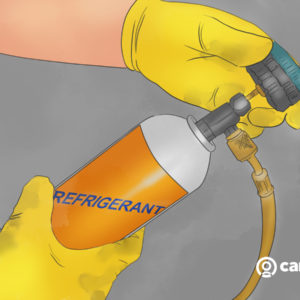
- Pull back the collar on the quick-connect fitting at the end of your charging hose.
- Push the fitting firmly over the port until it clicks into place.
- Tug lightly on the hose to confirm it’s seated. If it pulls free easily, it hasn’t latched.
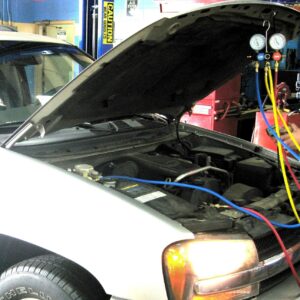
- Attach the other end of the hose to your refrigerant can or manifold gauge set per the tool’s instructions.
- Start the engine and set the AC to maximum cooling with the fan on high before opening any valves.
Warning: Never connect to the high-pressure side using a consumer recharge kit. That port sits between the AC compressor and condenser, and adding refrigerant there from a small can risks a dangerous pressure buildup.
What Refrigerant Type Does Your Car Use?
This is where a lot of DIYers make an expensive mistake. Using the wrong refrigerant or an incompatible hose can contaminate the system and require a full flush to fix.
R134a vs. R1234yf
R134a is standard in most vehicles built between 1994 and 2014. It uses a half-inch ACME-threaded can tap and a larger quick-connect low-side coupler. R1234yf is required in most 2015-and-newer vehicles. Its service port uses a smaller quick coupler with a left-hand thread on the can connection. The fittings are intentionally different sizes, so a hose designed for one refrigerant won’t seat correctly on the other system’s port.
Check your owner’s manual or the underhood sticker near the AC components before buying anything. Skipping that step is how a simple recharging your AC turns into a shop visit.
What to Look for When Buying an AC Charging Hose
Not every hose on the market is built to the same standard. These are the specs worth checking:
- Hose length: 24 inches works for most engine bays. Go longer if the low-side port sits near hot components or in a tight spot.
- Gauge quality: Look for a color-coded gauge with clear pressure ranges. A dial scaled to 160 or 200 PSI gives you more useful resolution than one that tops out at 100 PSI.
- Coupler construction: Metal couplers hold up better than all-plastic versions over time. Make sure the collar slides smoothly before committing.
- Pressure rating: Look for hose wall ratings of 600 PSI or higher for automotive AC service work.

Trigger Kits vs. Manifold Gauge Sets
Consumer recharge hoses with trigger dispensers are built for a quick top-off using a single can. They work well for that job. But if you’re diagnosing AC performance or adding refrigerant more than once, a manifold gauge set with separate blue and red hoses gives you full pressure readings on both sides of the system.
Aftermarket hoses and gauge sets from brands like UAC and 4-Seasons are engineered to the same pressure ratings as OEM parts and often cost significantly less.
How Do You Know the Connection Is Working?
Once the engine is running and the AC is on full blast, watch the gauge on your charging hose. The reading only means something when the compressor clutch is engaged. You’ll know it’s working because the center of the compressor pulley will be spinning.
For most vehicles running R134a, healthy low-side pressure falls between 25 and 45 PSI. Hotter ambient temperatures push the target toward the higher end of that range. For R1234yf systems, follow the pressure chart included with your gauge set, since operating pressures differ from R134a. It also helps to understand how AC systems work before diagnosing any pressure readings.
Tip: Read the pressure a few seconds after the compressor engages, not while it’s cycling off. The reading climbs sharply when the compressor stops and drops when it kicks back in. A mid-cycle reading will throw off your estimate.
How to Disconnect a Refrigerant Hose Safely
With the AC still running, pull back the collar on the quick-connect fitting and pull the hose straight off the port. Don’t twist it. The port has a built-in Schrader valve that closes as the hose releases, which limits refrigerant loss. A small hiss at disconnect is completely normal.
Replace the port cap immediately after pulling the hose off. Leaving the port open lets moisture into the system. Moisture in the refrigerant circuit reacts with compressor oil and produces acids that degrade components over time. A failing AC accumulator is one common result of moisture contamination — it’s the component designed to protect the system from exactly that. If you want to know more about how it works, signs of a bad accumulator.
Does It Make Sense to Buy a Replacement AC Refrigerant Hose Online?
Absolutely. Aftermarket AC refrigerant hoses are engineered to match OEM pressure ratings, diameter specs, and routing geometry, often at a fraction of dealership prices. The key is confirming fitment before ordering. AC hoses have pre-formed bends designed to match a specific engine bay layout. A hose that’s the right diameter but the wrong length or angle won’t seat cleanly at the fittings, and that creates leak points.
Make sure the listing specifies whether the hose is for the suction side or discharge side. They’re not interchangeable. The discharge hose runs significantly hotter and carries higher pressure, so it’s built with thicker walls. If warm air is a recurring issue even after a recharge, it may be worth checking whether a bad AC compressor is the real culprit before adding more refrigerant.
CarParts.com carries vehicle-specific AC refrigerant hoses from trusted aftermarket brands, with fitment filters that narrow results to your exact year, make, model, and engine.
Keep Reading: Related Posts




Any information provided on this Website is for informational purposes only and is not intended to replace consultation with a professional mechanic. The accuracy and timeliness of the information may change from the time of publication.