Need car parts? Select your vehicle
Reading Time: 2 minutes

Summary

  • The A/C fuse is usually in the engine bay fuse box, often near the battery. In some vehicles, it’s in a secondary fuse box behind the steering column or beside the passenger footrest.

  • Many vehicles have more than one A/C-related fuse, such as those for the condenser fan, clutch, or blower motor. The owner’s manual and the specific issue help identify which fuse to check.

  • To access the fuse, open the underhood junction box or remove interior trim as needed, then refer to any cover diagram. Turn the vehicle off, disconnect the battery, use pliers for small fuses, and tighten bolt-in fuses securely.

Q: Where is the A/C Fuse Typically Located in a Car?

A: On most vehicles, the A/C fuse is located inside the vehicle’s engine bay fuse box. Engine bay fuse boxes can vary depending on the vehicle. Usually, it’s located near the battery of cars like the 2003 Toyota Corolla. That said, the A/C fuse in some vehicles like the 2004 Ford F-150 can be found in the secondary fuse box, which is located either behind the driver’s steering column or beside the passenger footrest. 

, P0442 Code: Evaporative Emission Control System Leak Detected (Small Leak)

Pro Tips are nuggets of information direct from ASE-certified automobile technicians working with CarParts.com, which may include unique, personal insights based on their years of experience working in the automotive industry. These can help you make more informed decisions about your car.

Pro Tip: To find the A/C fuse, you’ll need the owner’s manual, because it isn’t in the same place on every vehicle. Usually it’ll be in the underhood fuse panel (junction box). Some junction boxes have a label on the underside of their cover with a diagram and a legend telling you which fuse is which. You also need to know which A/C fuse you are looking for.
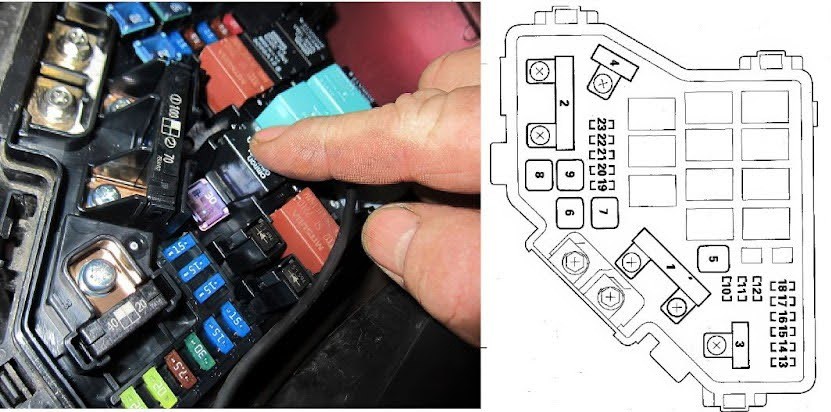
fuses on a 2007 Honda CRX
The term “A/C fuse” can be misleading since there can be more than one. This 2007 Honda CRX has several A/C related fuses. It has two A/C condenser fan fuses, an A/C clutch fuse, and a blower motor fuse. You need to know which one you need to look for. Does the A/C not work at all? Does the blower not work? Does the A/C not work well when sitting in traffic? Knowing what you’re trying to fix will determine which fuse you’re looking for. Many modern vehicles are set up this way. | Image Source: Richard McCuistian
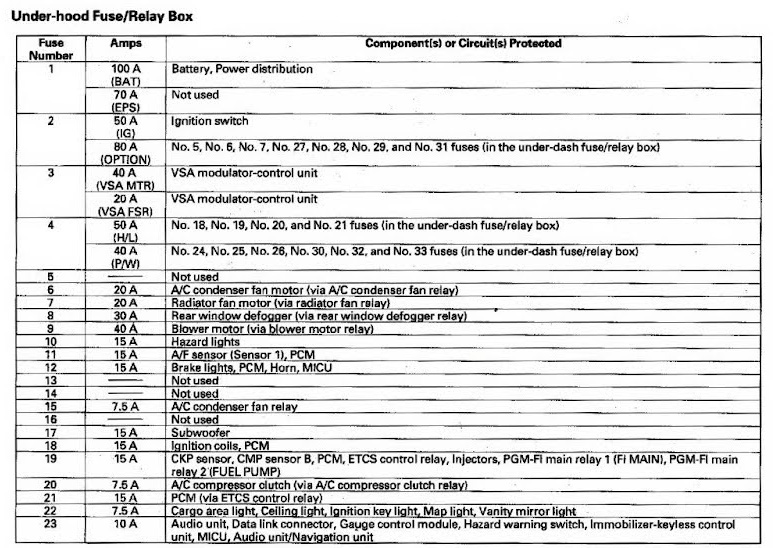
fuse relay box chart
Under-hood fuse/relay box chart showing fuse numbers, amperages, and protected circuits (including A/C condenser fan, blower motor, and compressor clutch) to help locate the correct A/C fuse. | Image Source: Richard McCuistian

Tips on How to Access the A/C Fuse

The fuse box is typically visible as soon as you pop the hood. This box is covered by plastic trim, requiring you to flip the cover like a lid. The fuse box usually has a hinge that locks it in place. 

If the A/C fuse is located in the secondary fuse box, you’ll need to remove a plastic trim to see it. In a 2004 Ford F-150, this involves removing plastic trim near the passenger footrest with a screwdriver. 

Once you’ve opened the fuse box, you’ll notice dozens of different fuses with varying numbers and labels. To identify your vehicle’s A/C fuse, you’ll need to check its owner’s manual. The manual should list the A/C fuse’s number and location in the fuse box. 

See also  Where Is the Fuse Box Located?

Remember that you must ensure your vehicle is turned off before touching the fuses. You should also first disconnect the battery. If the A/C fuse inside your vehicle is small, then you might need a needle-nose plier, as pulling out the fuse by hand can be difficult. 

Some large fuses are fastened using screws or bolts. Ensure that you properly tighten the new fuse to the correct torque specification. Otherwise, it might not make proper contact.

About The Authors
Written By Automotive and Tech Writers

The CarParts.com Research Team is composed of experienced automotive and tech writers working with (ASE)-certified automobile technicians and automotive journalists to bring up-to-date, helpful information to car owners in the US. Guided by CarParts.com's thorough editorial process, our team strives to produce guides and resources DIYers and casual car owners can trust.

Reviewed By Technical Reviewer at CarParts.com

Richard McCuistian has worked for nearly 50 years in the automotive field as a professional technician, an instructor, and a freelance automotive writer for Motor Age, ACtion magazine, Power Stroke Registry, and others. Richard is ASE certified for more than 30 years in 10 categories, including L1 Advanced Engine Performance and Light Vehicle Diesel.

Any information provided on this Website is for informational purposes only and is not intended to replace consultation with a professional mechanic. The accuracy and timeliness of the information may change from the time of publication.

File Under : Electrical System , Auto Repair , DIY Tagged With :
CarParts Euro
Subscribe
Notify of
guest
0 Comments
Oldest
Newest Most Voted
Inline Feedbacks
View all comments
expand_more
CarParts.com Fix-It-Forum BE PART OF OUR COMMUNITY: Share your knowledge & help fellow drivers Join Now