Yes, grille guards are generally permitted in many U.S. states, but the exact rules vary by jurisdiction. Federal law does not impose a blanket ban on owner-installed grille guards on used vehicles, but it also does not create nationwide approval. Manufacturers, distributors, dealers, and repair businesses may not install aftermarket equipment in a way that knowingly makes federally required safety equipment inoperative. State and local laws then determine what owner modifications are allowed on public roads, with common restrictions involving required lighting, license plate visibility, and vehicle dimensions or protrusions.
The catch is that “legal” depends on how the guard is built, how far it sticks out, and how it interacts with safety equipment like airbags and crash sensors. A few jurisdictions add stricter rules, and a poorly fitted guard can turn a legal accessory into a ticket or a failed inspection. So before you bolt one on, the real question isn’t just whether they’re allowed. It’s whether your specific setup meets your state’s requirements and your vehicle’s design.
Key Takeaways
- Federal law does not give grille guards blanket nationwide approval. State and local rules govern owner-installed modifications, while commercial installers also have federal safety obligations.
- Common legal limits can cover lighting obstruction, license plate visibility, sharp edges, and how far the guard protrudes.
- Vehicle-specific fit matters: a guard must work with airbag sensors and crumple zones in modern trucks.
- Some states and municipalities apply tighter rules, so check the laws that apply where you drive before buying.
- Choosing a model designed for your vehicle’s year, make, model, and sensor package can reduce fitment and safety-system conflicts, but it does not by itself guarantee legal compliance or warranty coverage.
What the Law Actually Says
Federal law does not categorically prohibit a vehicle owner from installing a grille guard on a used private passenger truck or SUV in the U.S. NHTSA regulates motor vehicles and motor vehicle equipment, and federal law prohibits manufacturers, distributors, dealers, and repair businesses from knowingly making federally required safety equipment inoperative when installing aftermarket equipment. That “make inoperative” provision generally does not apply to an owner modifying their own used vehicle, although state law still can.
State rules fill in the gaps, and they tend to focus on safety and visibility rather than the guard itself. The common themes look like this:
Lighting and Visibility
Your headlights, turn signals, and marker lights have to stay fully visible and functional. A guard that covers part of a headlight or blocks a turn signal can fail inspection or draw a citation. Quality guards route around these lights by design, and many include cutouts or mounting points that keep everything exposed.
License Plate Placement
Most states require your front license plate (where one is mandated) to remain readable and unobstructed. If a guard hides the plate, you’ll need a relocation bracket to mount it somewhere visible. This is one of the most common reasons drivers run into trouble, and it’s an easy fix.
Protrusion and Sharp Edges
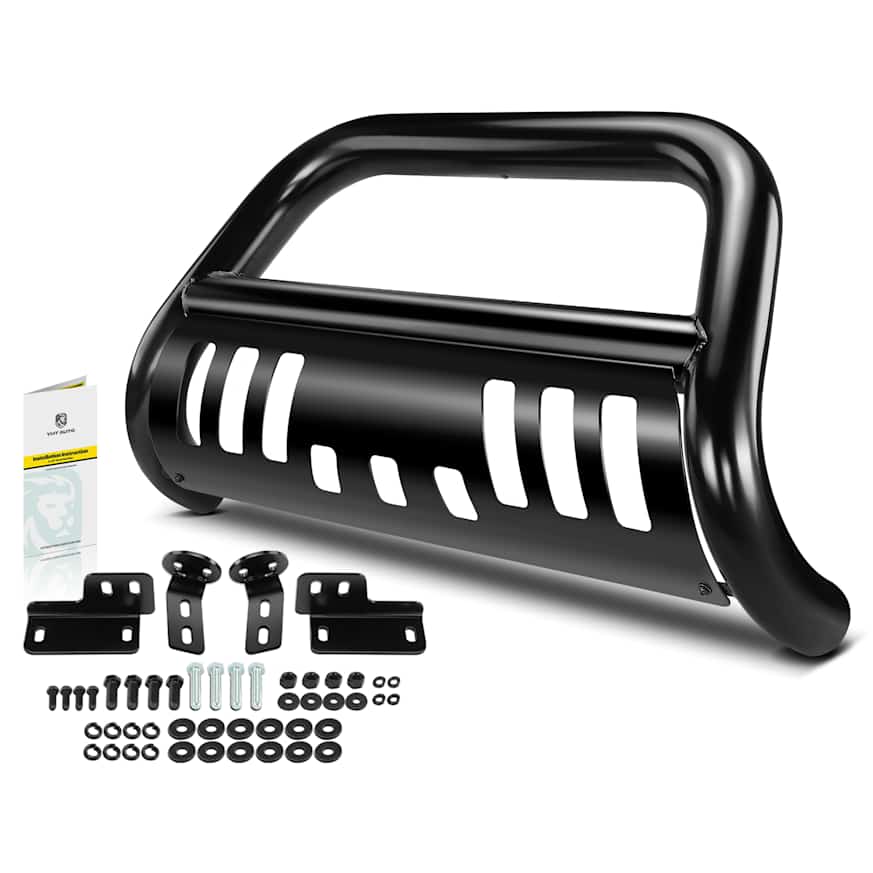
Some states limit how far accessories can extend beyond the front bumper, and a few restrict sharp or pointed protrusions that could increase injury risk in a collision. Modern guards from established brands use rounded tubing and finished edges, which keeps them on the right side of these rules. The guards shown across major retailers and manufacturers use welded or bolt-on one-piece and three-piece steel construction designed to sit flush with the truck’s front end rather than jut out aggressively.
Commercial Vehicle Rules
If your truck operates as a commercial motor vehicle, additional federal, state, or fleet equipment rules may apply depending on its classification and use. Fleet and work-truck operators should confirm the requirements that apply to their vehicles before installing a front-end accessory.
Where the Gray Areas Are
State and local requirements vary, and some jurisdictions regulate front-end modifications through broader equipment, dimension, lighting, or pedestrian-safety rules. Because these vary and change, the safe move is to read your state’s vehicle code or call your local DMV before purchasing. Don’t assume that a guard legal in one state is automatically fine across a border. You can also review common examples of potentially illegal vehicle modifications before modifying the front end.
Insurance treatment depends on the policy and the circumstances. If a modification contributes to an incident or affects the vehicle’s value, an insurer may ask about it. Keeping documentation for the guard and installation can help.
How Fit Affects Legality and Safety
Modern trucks rely on front-mounted sensors, crumple zones, and airbag timing that depend on a predictable front-end structure. A guard designed for your vehicle’s exact year, make, model, and equipment package is more likely to use the intended mounting points and provide the necessary sensor or camera clearances. Vehicle-specific fit alone does not prove SRS or ADAS compatibility, so verify the guard manufacturer’s documentation and the vehicle maker’s guidance. A universal or mismatched guard can interfere with sensor readings or change how the front end behaves in a crash, which is both a safety concern and, in some cases, a compliance one.
That’s why fitment tools matter. Manufacturer catalogs list guards by application, often down to specific trim and model-year ranges, and many include camera or sensor cutouts for trucks equipped with front cameras. Picking a guard built for your vehicle reduces fitment risk, but you still need to verify local legality and compatibility with the truck’s SRS and ADAS hardware.
Safety Notes
A grille guard adds front-end protection, but it isn’t a substitute for safe driving, and a heavier front end can subtly change handling and braking feel. If you notice any change in steering, braking response, or alignment after installation, get the setup inspected. Mounting hardware should be torqued to spec and rechecked after the first few hundred miles, since a loose guard is both a safety hazard and a potential violation.
Airbag and ADAS Compatibility
Grille guards may affect supplemental restraint systems (SRS), which is one of the biggest safety concerns. Modern trucks rely on calibrated crash structures and sensors to determine airbag deployment. Depending on its design and mounting method, a rigid grille guard can change the crash pulse or load path reaching those sensors, potentially changing the deployment threshold or timing or contributing to an unintended deployment under some conditions.
Some manufacturers engineer vehicle-specific mounting systems intended to preserve SRS performance. The idea is similar to seat covers designed around seat-mounted airbags: the accessory must be engineered so it does not interfere with the safety system. Do not assume that a guard is “airbag compliant” just because it fits the truck. Check the guard manufacturer’s documentation and the vehicle manufacturer’s guidance for the exact application.
Also, newer trucks are packed with advanced driver-assistance systems (ADAS) in the grille and bumper area. Before buying a grille guard, verify that it will not obstruct or degrade adaptive cruise control, automatic emergency braking, forward-facing or 360-degree cameras, or parking sensors. Some vehicles require model-specific cutouts, relocation hardware, or recalibration.
Brush Guard and Replacement Bumper Tradeoffs
Brush guards often mount at the front bumper or frame using vehicle-specific brackets. While they can protect against limbs, brush, or minor debris, some light-duty guards can bend backward in a harder animal strike and damage the hood, grille, or radiator. A replacement bumper designed for heavier-duty use may offer more substantial front-end protection, but it also adds weight and must still be compatible with the vehicle’s SRS and ADAS equipment.
Added Weight and Suspension Effects
A heavy steel grille guard can weigh roughly 75 to 150 pounds or more, depending on the design, while full replacement bumpers can exceed 200 pounds. Added weight ahead of the front axle can reduce front ride height, alter alignment geometry, increase tire wear if alignment changes, and slightly affect fuel economy. Owners should consider whether the added load calls for heavier-duty front springs or another load-rated suspension solution. A spacer-style leveling kit can raise ride height, but it does not increase the factory spring’s load capacity.
Always check the manufacturer’s spec sheet for SRS and airbag compatibility, confirm compatibility with front camera and radar packages, and ensure the installation instructions do not require relocating the front license plate or factory tow hooks in a way that violates applicable state or local rules.
Grille Guard vs. Bull Bar vs. Brush Guard
These terms get mixed up, and the differences can matter for both protection and compliance. A full truck grille guard wraps the front end and often shields the grille and headlights. A bull bar is a lower, simpler bar that protects the lower front. A brush guard generally refers to additional guard sections that extend protection across the grille and, on some designs, the headlight area; terminology varies by manufacturer. Retailers typically separate these into distinct categories, along with related parts like bull bar mounting kits, grille air deflectors, and radiator guards. Knowing which style you’re buying helps you match it to your needs and your local rules. If you’re weighing your options, our guide on the pros and cons of bull bars breaks down what each style does best.
FAQ
In California, whether a grille guard is legal depends on how the installation interacts with applicable vehicle-equipment rules. Required lighting must remain functional, and Vehicle Code section 5201 requires license plates to stay clearly visible and legible. Check the current California Vehicle Code and any local requirements for your setup before buying.
It can fail an inspection where a state or jurisdiction checks this equipment if it blocks required lights, hides the license plate, or otherwise violates local equipment rules. Inspection programs vary by state, so there is no single nationwide pass-or-fail rule.
It can. NHTSA has warned that some grille-guard designs and mounting methods can change the crash impulse reaching airbag sensors and alter deployment timing or thresholds. Use a vehicle-specific guard only when its manufacturer documents compatibility with your vehicle’s SRS, and follow the vehicle manufacturer’s guidance.
Installing one generally doesn’t void your factory warranty on its own, but damage caused by improper installation might not be covered. Under federal warranty law, a manufacturer generally cannot void the entire warranty simply because you used an aftermarket part, but it can deny coverage for damage it can show was caused by the part or its installation. Use a guard rated for your model and follow the torque specs.
Yes. If the guard covers the plate’s factory spot, add a relocation bracket so the plate stays visible and readable, which keeps you compliant in plate-required states.
Ready To Gear Up?
If you’ve confirmed your local rules and your vehicle’s fitment, the next step is choosing a guard built for your exact truck. CarParts.com carries grille guards, bull bars, brush guards, and the mounting kits that go with them, organized so you can match the right part to your vehicle’s year, make, and model. Shop our selection here at CarParts.com and choose front-end protection that fits your truck, then verify that the installation meets your state and local rules.
Keep Reading: Related Posts




Any information provided on this Website is for informational purposes only and is not intended to replace consultation with a professional mechanic. The accuracy and timeliness of the information may change from the time of publication.