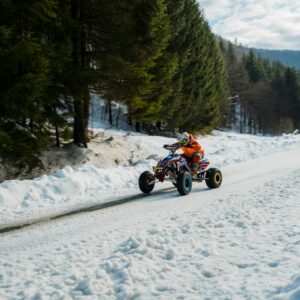
Two riders reach the same trailhead, one on a quad and one in a side-by-side. Both check their tires before heading out. The quad rider settles near 3 psi, while the side-by-side driver airs up to about 14.
Neither made a mistake, because weight, load, and horsepower set different baselines for each machine. Terrain adjusts those baselines from there, and that’s the real ATV vs UTV tires question. This guide shows how it plays out on trails, in mud and sand, and on the job.
How ATV vs UTV Tires Differ Before Terrain Enters the Picture
A UTV often outweighs an ATV by 1,000 pounds or more. It also hauls passengers and cargo through a belt-driven transmission. That mass shows up in tire size, construction, and load rating.
Size and the Sidewall Code
ATV tires commonly stand 22 to 28 inches tall, and UTV tires start near 25 and climb past 35. Many ATVs run narrower fronts and wider rears, such as 25×8-12 and 25×10-12. Check whether your side-by-side uses matching sizes or a staggered pair.
Decoding the sidewall takes seconds. The first number is height in inches, the second is width, and the last is rim diameter. An R marks a radial, while a plain hyphen or a D marks bias ply.
Ply Rating, Radial, and Bias
Ply rating no longer counts layers. It measures strength and load capacity, so 8-ply carries more and resists punctures better than 4-ply. ATV tires usually run 2 to 6 ply, and UTV tires run 6 to 12. Treat the ply rating on a side-by-side tire as a load rating first.
Radials flex more and spread a wider contact patch. That gives a smoother ride and longer tread life. Bias tires have stiffer sidewalls that suit rocks and heavy hauling.
Trail Riding: Round Tread and Predictable Handling
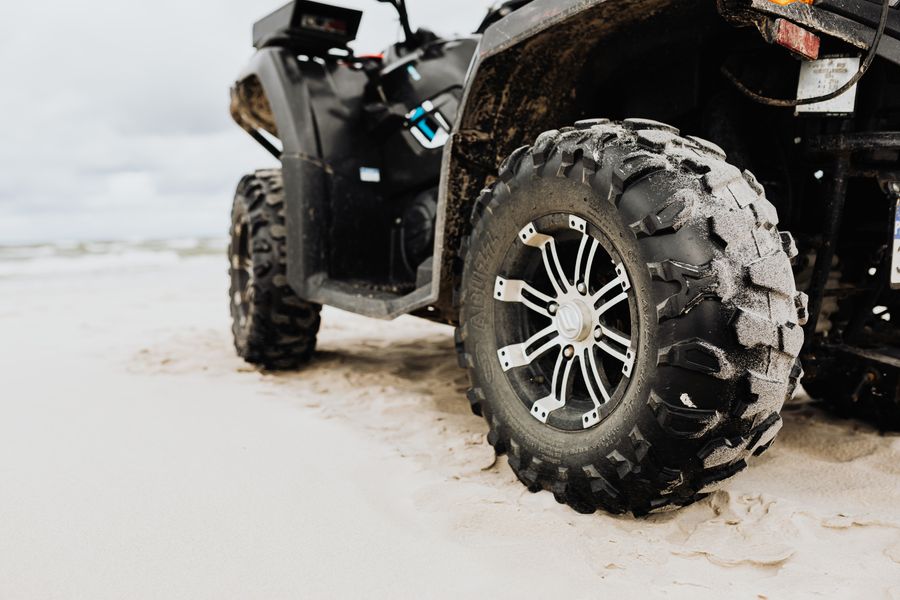
Round-top all-terrain tires with moderate lug depth handle dirt, gravel, roots, and rock. A lighter set of ATV tires steers quickly, and UTV tires usually gain comfort from radial construction. On rocky routes, a slightly higher pressure within the label range protects the sidewall and wheel lip.
Mud: Deep Lugs and Open Spacing
Mud tires carry lugs close to an inch deep or more. Wide gaps sling mud out as the tire spins. Angled, V-shaped lugs push slop away from the centerline and keep the contact patch clean. Most run 6 ply or more, and UTVs need sturdier casings because of their weight and torque.
Heavy lugs add rotating weight that strains a belt drive, and they wear quickly on pavement. Air down in small steps, since beadless wheels can lose the tire below roughly 2.5 psi. A quick mud aftercare routine handles the cleanup.
Sand: Paddles in Back, Smooth Tires in Front
Rear paddles scoop sand backward for drive, while smooth or lightly ribbed fronts steer and stay on top. These tires are usually lightweight 2-ply builds, so they float well but suit little besides soft sand.
Dune riders air down far below trail pressure, and specialists quote anything from single digits to around 12 psi. Beadlock wheels keep the tire seated at those pressures. Keeping a second set of UTV wheels with sand tires saves your all-terrain set from soft-sand wear.
Work Use: Load Ratings and Sturdy Sidewalls
Work puts weight on the tires every time the machine moves. Many manufacturers list separate pressures with and without cargo, plus maximum load and speed limits. Utility-sized tires often carry 500 to over 900 pounds each. Choose tires that match or exceed stock load capacity and ply rating.
Farm and ranch riders often step up to 8-ply radials, and 10-ply suits heavy hauling or thorny pastures. Pure mud tires wear fast on gravel and ride rough between fields.

Tire Pressure by Terrain and Load
Air pressure in an ATV’s tires sits far below a car’s, and the vehicle label outranks every chart. Quad labels commonly list 3 to 5 psi, while side-by-side labels run roughly 7 to 20 psi.
| Use | ATV | UTV |
| Trail | Label pressure, commonly 3 to 5 psi | Label pressure, commonly 7 to 20 psi by model |
| Mud | Lower in 1 psi steps, staying near 2.5 psi or higher | Many riders run 4 to 6 psi with beadlock wheels |
| Sand | About 2.5 to 3 psi on soft surfaces | Roughly 3 to 12 psi, based on weight, power, and wheels |
| Work loads | With-cargo pressure from the label | With-cargo pressure from the label |
Check pressure cold, at the riding site, with a low-pressure tire gauge. A standard car gauge reads poorly at 3 psi, and altitude shifts the reading. A 30 degree drop can pull a 5 psi tire down about 1 psi. The sidewall number is a maximum for seating the bead, not a target.
Bigger Tires Change More Than the Look
A larger diameter raises the effective gear ratio, so acceleration softens and a CVT belt runs hotter. Tuning shops commonly recommend clutch adjustments once tires grow a couple of sizes beyond stock. The speedometer also reads lower than true speed.
Width and offset matter as much as height. Each half inch of rim width changes tire section width by roughly 0.2 inch. The wrong offset pushes tires into A-arms or fenders. Axles and wheel bearings need to handle the added leverage.
Road Rules and Fitment Checks
A few checks before you buy and mount keep tires legal, safe, and well matched.
Road Use
No ATV or UTV tire carries DOT approval, because no federal standard covers them. Tire standards class them as not for highway service, which allows temporary road use at most. State and county rules differ, so check local law before crossing pavement.
Can ATV Tires Go on a UTV?
Only when size, load rating, and wheel fitment match what the UTV requires. ATV tires usually carry less load and lower ply ratings than side-by-side tires. Compare rim diameter and width with your wheels, and keep load capacity and ply rating at or above stock. Bolt patterns like 4/110, 4/137, and 4/156 are all common, so verify yours.
Mount, Torque, and Rotate
Tighten lug nuts in a crisscross pattern with a torque wrench, and recheck them after the first ride. Factory specs run from about 27 to 120 foot-pounds, so follow your manual. Directional tires rotate front to rear on the same side, with the arrow pointing the way the wheel turns. Staggered sets swap left to right only, and you should replace at least a full axle at a time.
Pack a Trail Repair Kit
Carry a tire repair kit, tire sealant, and a portable air compressor, and most punctures become a short stop. Sealants typically handle holes up to about 3/16 inch, and plugs fix tread punctures on tubeless tires. Many tire changing tools from the truck double as trail gear.
Equip the Whole Garage for the Next Ride
Your thirst for adventure doesn’t have an off-season, and the right tires keep every ride rolling. The JC Whitney Performance Hub on CarParts.com stocks ATV and UTV tires, wheels, lug nuts, gauges, and repair gear. More than 100 years of parts heritage and a vehicle selector remove fitment guesswork. Match tires to terrain, and everything in the driveway keeps moving.
Keep Reading: Related Posts


Any information provided on this Website is for informational purposes only and is not intended to replace consultation with a professional mechanic. The accuracy and timeliness of the information may change from the time of publication.