Air springs are the right choice when you need adjustable ride height or extra support under your vehicle’s load, but they only work well when you match the bag style, size, and system parts to your vehicle and how you drive. This guide on how to choose air springs for your car focuses on fitment first, then capacity, then the supporting hardware that keeps leaks and bad ride quality out of the picture.
Key takeaways
- Start with your goal: leveling under load, improved ride, or full height adjustability.
- Match the air spring style to your space and weight needs, not just what looks similar online.
- Size the system around real loads and frequency, and don’t exceed your vehicle’s ratings.
- Quality fittings, hose routing, and clean wiring matter as much as the bags themselves.
- Plan for serviceability: moisture control, drain points, and easy access save headaches later.
Decide what you want the air springs to do
Air suspension systems are used in two common ways, and mixing them up leads to wrong parts.
Load-leveling support
These systems help prevent sag when you tow or haul. They’re usually paired with your vehicle’s existing suspension and primarily add support when you need it. They help avoid rear-end squat, headlight aim changing, or bottoming out with cargo.
Full ride-height adjustability
This is the classic air ride approach where the air springs become a major springing element and you raise or lower your vehicle as needed. It can improve comfort and control when designed correctly, but it demands more planning because bag placement, shock travel, and geometry matter a lot.
Match the air spring style to your vehicle and packaging
Not every air spring design fits every chassis. Space, travel, and intended weight capacity will push you toward certain bag types.
Convoluted bellows
These are larger, robust bellows-style bags that typically provide higher support and are common in heavier-duty applications. Choose this style if you’ve got room and you need real capacity.
Rolling lobe and sleeve-style designs
These are typically more compact and can fit tighter spaces. The tradeoff is that smaller designs often have lower capacity than larger bellows. They can be a good match for smaller vehicles or tight suspension packaging where a big bag simply won’t fit.
Hybrid arrangements
Some systems combine mechanical springs with air assistance for stability and ride quality. If you want a stable daily driver feel with adjustability, this type of approach can be a smart middle ground.
Do the math on load and capacity the right way
Capacity isn’t just a marketing number. You’re balancing what the bags can support, what the mounting points can handle, and what your vehicle is rated to carry.
Start with real-world loading
Ask yourself the following:
- How much weight do you add, and how often?
- Is it tongue weight from a trailer, bed cargo, passengers, or all of it?
- Do you need support occasionally, weekly, or every day?
This is where choosing air springs based on load capacity becomes practical. You’re aiming for a bag that can reach your desired ride height without running near its limits all the time, while still having enough adjustment range for lighter driving.
Never treat air springs as permission to overload
Air springs can level your vehicle and improve stability, but they don’t increase your legal or mechanical weight ratings. Stay within Gross Vehicle Weight Rating (GVWR) and axle ratings and use air pressure as a leveling tool, not a workaround.

Don’t ignore the supporting parts that make the system reliable
A dependable system is more than bags. Leaks, slow response, and inconsistent ride height are usually due to the components and installation details.
Compressor, tank, and duty cycle
If you’re often adjusting your vehicle’s height or carrying varying loads, you’ll need enough compressor performance to recover pressure without overheating. A small compressor that runs constantly will wear out faster and frustrate you. A tank adds reserve so that adjustments are quicker and the compressor cycles less.

Pro Tips are nuggets of information direct from ASE-certified automobile technicians working with CarParts.com, which may include unique, personal insights based on their years of experience working in the automotive industry. These can help you make more informed decisions about your car.
Pro Tip: Dual compressors are often preferred for faster fill times and redundancy. Ensure they are mounted with vibration isolators to keep cabin noise down.
Lines, fittings, and sealing
A big chunk of air suspension problems come from installation errors and low-quality parts. Use quality fittings and hose, protect lines from heat and abrasion, and route them so that suspension movement can’t pinch anything. If you want maximum durability, hard lines reduce the chance of damage compared to exposed plastic lines, but only when installed correctly. Quality air spring hardware also matters when you’re trying to prevent leaks and loose connections.
Valves, manifolds, and controllers
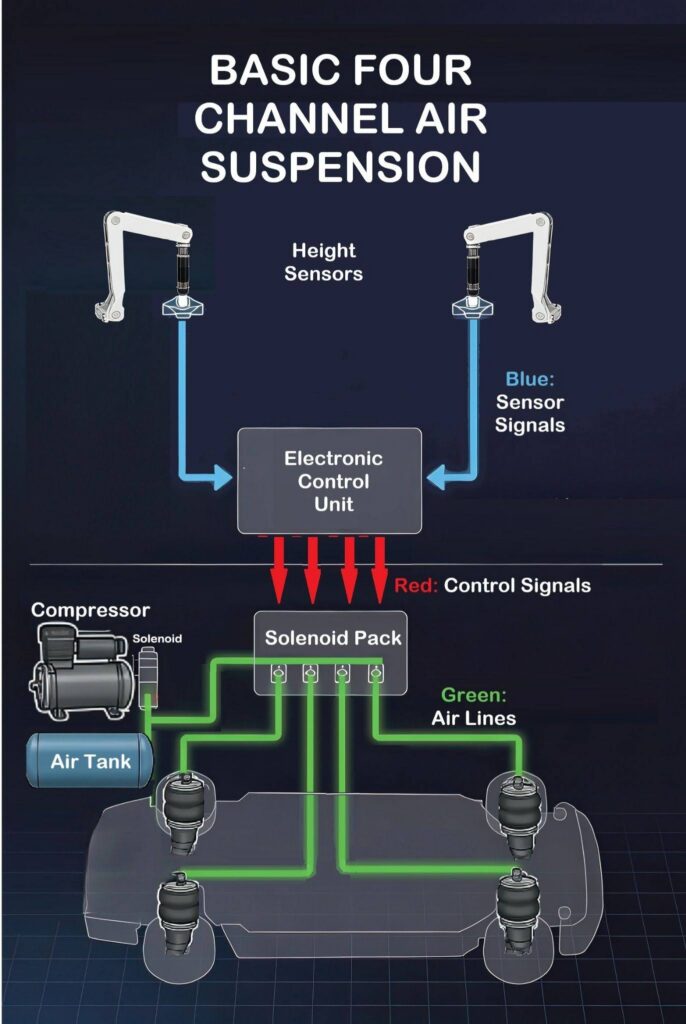
Basic manual control can work fine for simple setups. More advanced systems add height sensors and electronic control that can automatically maintain a set height and compensate for changing loads. If you want set-it-and-forget-it ride height, plan for sensors and a controller designed for that job. If a system has valve problems, related parts such as air suspension solenoids may also need attention.
Electrical load and clean grounds
High-output air suspension compressors can pull 30-60 amps, so make sure you use connection methods at power and ground points that can handle this kind of current flow. This is often overlooked. Also, make sure the air manifold and compressor or compressors have dedicated, clean grounds to the chassis to avoid control-module interference.
If you suspect the compressor is already failing, testing the compressor can help you confirm whether the problem is the compressor itself, wiring, a relay, or another part of the system.
Choose between pressure-based and height-based leveling
You have two main choices for how the air ride system handles leveling:
- Pressure-based systems monitor the air pressure (psi) in each bag. This type is easier to install but can be inaccurate if the vehicle’s load distribution changes significantly, such as with a heavy passenger or a full tank of gas.
- Height-based systems use physical sensors mounted between the control arms or axle and the frame. This type of system is more complex to calibrate but ensures the car returns to the exact same height every time.
This is critical for maintaining proper alignment, particularly on the front wheels, since front spring height, if too low, will cause negative camber.
Consider four-corner height control for advanced setups
Higher-end systems will have four ride height sensors and four air bags and can control the height of each corner of the vehicle separately. This is the gold standard for custom builds and high-end SUVs. By using a dedicated sensor and air bag for each corner, the ECU can compensate for uneven weight distribution, like a heavy driver or a lopsided trunk load.
Some advanced systems can use the sensors to detect body lean in a corner and briefly increase pressure to the outside bags to keep the vehicle level.
Without independent 4-corner control, air can sometimes transfer between bags during a turn in some setups, which is sometimes called the “seesaw” effect. This can make the handling feel floaty and unpredictable.
Pro Tips are nuggets of information direct from ASE-certified automobile technicians working with CarParts.com, which may include unique, personal insights based on their years of experience working in the automotive industry. These can help you make more informed decisions about your car.
Pro Tip: Rear-only systems will typically have a single ride height sensor in the rear, but may have a sensor for each side.
Plan geometry, travel, and shock choice together
Air systems ride well when the suspension still has enough travel at your normal driving height. If you build a setup that looks right aired out but has almost no usable travel at ride height, it’ll feel harsh and unpredictable.
Keep the bag in a happy range at ride height
At normal driving height, you’ll want the bag to be operating in a pressure and height range that doesn’t force extremes. If it takes near-max pressure to hold your car up, the bag is undersized or poorly positioned. If it takes almost no pressure, you might be giving up control and stability.
Shocks aren’t optional
Air springs don’t replace damping. Shocks control oscillation and keep your tires planted. Choose shocks with correct length for your ride height and travel, and consider adjustability if you’re tuning for comfort and handling.
In some full air ride setups, air suspension struts may be part of the system design. Match them to the vehicle, desired ride height, and suspension travel instead of choosing by appearance alone.
Wheel and tire clearance checks
Check clearance through full suspension motion: aired out, at ride height, and near full extension. Air systems can move differently than stock, and tire-to-fender or tire-to-frame contact can show up only at certain heights.
Think through installation difficulty before you buy
Some kits are close to bolt-on. Others require fabrication, welding, or custom brackets. Be honest about your tools and experience.
Serviceability matters
You’ll thank yourself later if you plan for the following:
- Easy access to valves, compressor, and electrical connections
- A drain strategy for the tank and a way to manage moisture
- Protected routing for lines and wiring
Safety note
Suspension work affects steering, braking stability, and tire contact. If you’re unsure about mounting integrity, alignment changes, or shock travel, have a qualified shop inspect the work and perform an alignment. A system that sits right but handles poorly isn’t a win.
Because many suspension parts can affect alignment, don’t skip this step after any installation that changes ride height or geometry.
Build a simple checklist before you buy
Use this quick list to keep your decision grounded.
- Vehicle fitment designed for your vehicle’s year, make, and model or proven universal dimensions
- Bag style that matches available space and target support needs
- Load plan based on realistic weights and frequency
- Hardware quality including fittings, lines, valves, and electrical capacity
- Controls such as manual, in-cab, or sensor-based systems
- Installation plan including bolt-on versus fabrication and alignment needs
- Budget that includes the total cost including installation, extras, and maintenance items
If you’re planning an air suspension setup, write this checklist down and fill it out before ordering parts. It’s the fastest way to avoid mismatched components.
FAQ
Are air springs the same thing as air ride?
People use these terms interchangeably, but context matters. Air springs are the spring component, while air ride often refers to a complete system that includes controls, valves, a compressor, a tank, air lines, and sometimes sensors.
Will air springs improve ride quality?
They can, especially if the system is designed with proper suspension travel and matched shocks. But ride quality can worsen if the suspension has limited travel at ride height or the bags are undersized.
How do I know if I need a bigger compressor or a tank?
If you adjust height often, carry varying loads, or want a quick response, a tank and a compressor with sufficient duty cycle make a noticeable difference. A simpler setup can work for basic load leveling with occasional adjustments.
What causes most air suspension leaks?
Most leaks come from poor sealing, low-quality fittings, damaged lines, or routing too close to heat and moving parts. Careful installation and protection of air lines prevent many common issues.
Can I install air springs myself?
Many load-leveling kits are DIY-friendly if you’re comfortable working under your vehicle and following torque specifications. Full air ride systems are more complex due to suspension geometry, wiring, plumbing, and alignment requirements.
Do air springs increase towing capacity?
No. Air springs can improve leveling and stability, but they don’t change GVWR, axle ratings, or hitch limits. Use air springs to keep the vehicle level, not to exceed its rated capacity.
Do I need an alignment after installing air springs?
Get an alignment if the installation changes ride height, control arms, or suspension geometry. Even small changes can affect tire wear and vehicle handling.
Choosing the right air springs comes down to matching fitment, capacity, and component quality to how you actually drive and load your vehicle. If you plan the system as a whole, you’ll get consistent ride height, predictable handling, and fewer leak issues. When you’re ready, choose air suspension parts that fit your vehicle and build the system around your needs.
Keep Reading: Related Posts




Any information provided on this Website is for informational purposes only and is not intended to replace consultation with a professional mechanic. The accuracy and timeliness of the information may change from the time of publication.