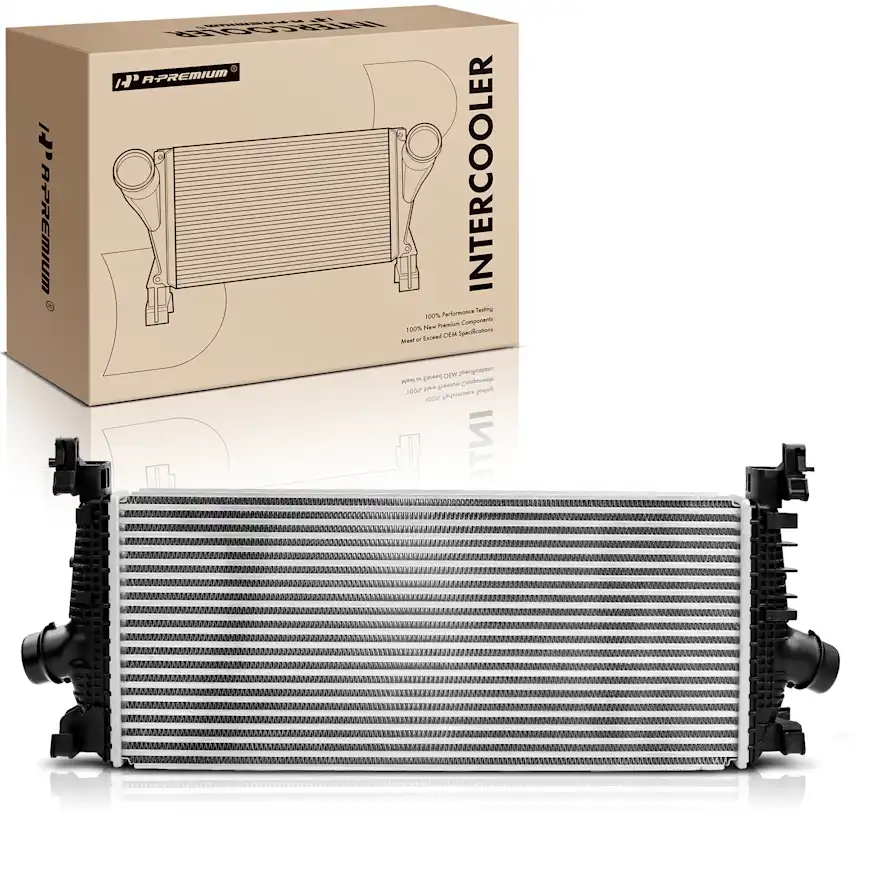
The intercooler sits between the turbocharger or supercharger and the intake manifold. Its job is simple: cool the compressed air charge before it enters the engine. The part comes in enough configurations and sizes that “close enough” means a second order.
Don’t start with “which intercooler is cheapest?” Start with “what needs to go in the cart to finish this job once?”
The intercooler connects to piping, hoses, and clamps. Some of those may not transfer from the old unit. Application splits vary across makes, models, engine families, and trim levels.
The Job in One Sentence
Replacing an intercooler restores the charge air cooling that keeps a forced-induction engine making consistent power. It eliminates heat-soak and reduces the risk of detonation.
The job isn’t just swapping a core. It involves reconnecting the inlet and outlet charge pipes. Every connection in the pressurized air path needs resealing. The replacement unit must match the original’s port orientation and mounting geometry.
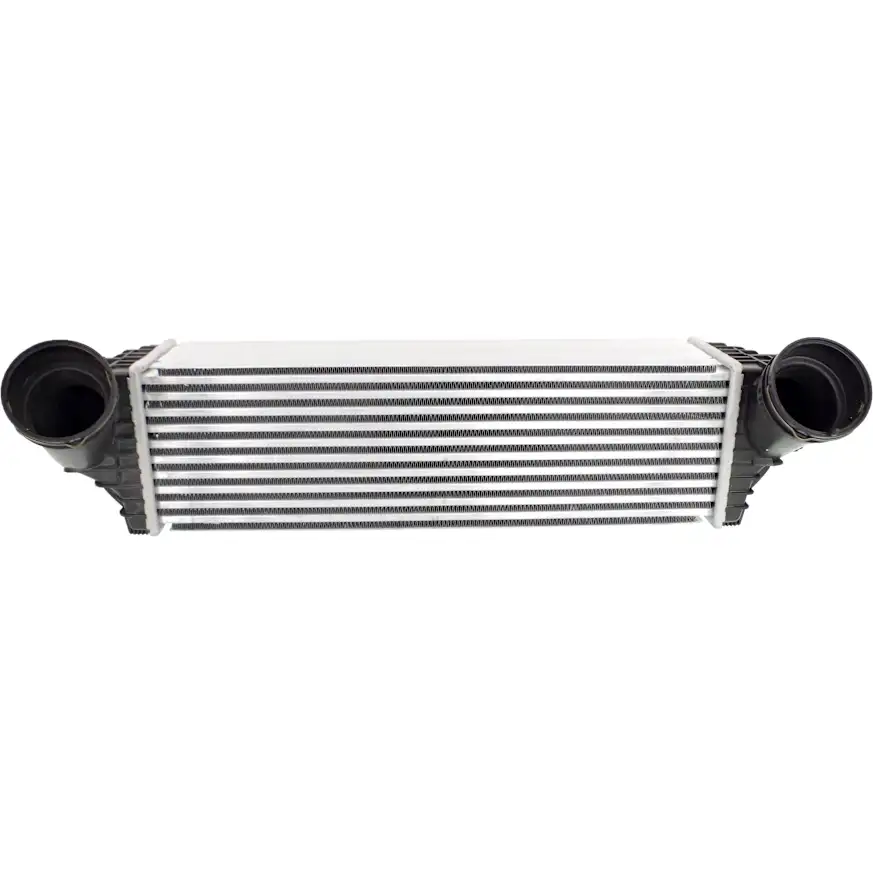
To understand more about what intercoolers do within the forced-induction system helps clarify what the repair is restoring. A bare intercooler core is the typical unit sold. Some applications use assemblies that include end tanks, mounting brackets, or pre-attached hose connections. Knowing which type fits the vehicle determines whether additional hardware and hoses belong in the cart from the start.
Choose Your Cart Size
1. Minimum Viable Repair
Choose it if:
- The intercooler itself is confirmed leaking or damaged and the charge piping’s in good shape
- The vehicle has moderate mileage and no history of boost leaks elsewhere
- All existing clamps, hoses, and hardware are still serviceable
Typical cart:
- Replacement intercooler (direct-fit for year/make/model/engine)
- Penetrating lubricant for removing corroded clamps and fittings
2. Smart Same-Access Refresh
Choose it if:
- Charge hoses are more than five years old or show cracking at the bends
- Clamps are the original spring-type units that’ve weakened over time
- The repair opens access to adjacent boost circuit connections
Typical cart:
- Replacement intercooler
- Charge air hoses (inlet and outlet, sized to application)
- Hose clamps, worm-gear or T-bolt style depending on the application
- Silicone coupler boots if the vehicle uses separate coupler sections
3. High-Mileage / Do-It-Once Reset
Choose it if:
- The vehicle’s above 100,000 miles and hasn’t had the charge air system refreshed
- There’s evidence of oil contamination in the charge pipes from the turbo
- The goal is long-term reliability without reopening this area again
Typical cart:
- Replacement intercooler
- Full charge air hose and coupler kit
- New clamps throughout the boost circuit
- Turbo inlet hose if it’s accessible from the same area
- Rags, cleaner, and an inspection light for checking oil residue before reassembly
What’s Commonly Ordered Together on This Job
Charge Air Hoses and Couplers
These are the most commonly forgotten items. The intercooler connects to the rest of the boost circuit through charge air hoses.
These rubber, silicone, or composite hoses harden and crack with age and heat cycling. Buyers often assume the old hoses will reinstall cleanly, then discover a boost leak on the first drive. If the hoses are original and the vehicle has real miles on it, they belong in the cart.
Hose Clamps
Spring-type clamps weaken over time. Worm-gear clamps can strip. Either way, a fresh set of correctly sized hose clamps costs almost nothing relative to the labor already invested. Know the hose diameter at each connection before ordering.
Silicone Coupler Boots
Many applications use short silicone couplers between the intercooler end tanks and the charge pipes. These are sold separately from the intercooler itself and are frequently overlooked until teardown.
Sealing Hardware and Gaskets
Some intercooler applications use a gasket or O-ring at the connection point. This is especially common in confined mounting areas or integrated charge air cooler housings. Verify whether the replacement unit includes these or whether they’re sold separately.

What People Forget Until the Vehicle’s Already Apart
A few reminders that belong on the bench before teardown starts:
- Does the replacement unit include mounting brackets, or do they transfer from the old one?
- Are end tanks included, or is this a bare core?
- What’s the inlet and outlet port diameter on the replacement versus the original?
- Do the port orientations (top, bottom, side) match the vehicle’s charge pipe routing?
- Are the hose couplers on hand, or is the assumption that the originals will reuse cleanly?
- Is there oil contamination in the charge circuit that needs cleaning before the new unit goes in?
- Does the vehicle need a boost leak test after reassembly before returning to normal boost levels?
- Are the mounting points on the replacement unit identical in position and thread size?
When Replacing Only the Intercooler Is False Economy
If the turbocharger intercooler hoses are original and the vehicle has significant mileage, reusing them is a short-term fix. Replacing just the intercooler while skipping the hoses is a common mistake.
Aged hoses softened by heat cycles can fail within months of the repair. The resulting boost leak costs nearly as much to diagnose and fix as the original job. The hoses and clamps are inexpensive relative to the labor involved in accessing the intercooler on most applications.
On a younger vehicle with low mileage and no charge circuit wear, replacing only the intercooler is fine. The goal is an honest look at what condition the adjacent components are in, not a reflexive upsell. If the hoses look good and clamp down correctly, leave them alone.
The Fitment Splits That Break Intercooler Orders
Engine Differences
This is the most critical split. The same model year and trim can come with multiple engine options. Each intercooler is sized for a specific displacement and boost output. A unit for a 2.0L turbo won’t fit the 2.7L twin-turbo version of the same truck or SUV.
Port Orientation and End Tank Configuration
Some units route the inlet on the driver side, others on the passenger side. Some have top-mounted charge ports. Even within the same application, aftermarket units vary in end tank geometry. Verify port orientation matches the existing charge pipe routing before ordering.
Body Style
On European makes, body style changes the intercooler mounting location. That shifts the unit dimensions and port positions. Confirm body style before selecting a part.
Trim and Submodel
Performance trims on the same nameplate often use a larger or differently configured intercooler. Confirm whether the vehicle is the base turbocharged variant or a higher-output sport or performance trim.
Assembly vs. Bare Core
Some listings include charge air hoses or mounting hardware. Others sell the core only. Two listings for the same application can have very different included components. Read the listing carefully.
Delivery-Day Inspection Checklist
Compare the replacement unit to the original before starting teardown:
- Inlet and outlet port diameters match the original
- Port orientation matches the vehicle’s charge pipe routing
- Mounting bracket holes align with the original or with the transferred brackets
- End tanks are included if the application requires them integrated
- No shipping damage to fins or end tanks
- Any included seals or O-rings are present and undamaged
- Overall dimensions are consistent with the original unit
- Included hardware matches what the installation requires
Your One-Job Order Sheet for an Intercooler
- Confirm the Vehicle: year, make, model, engine displacement, and trim level. For diesel applications, note the engine family or variant.
- Confirm the Repair Scope: isolated intercooler failure only, or is the charge circuit getting refreshed at the same time?
- Confirm What the Listing Includes: bare core, assembly with end tanks, or assembly with brackets? Any seals or hardware included?
- Add the Charge Air Hoses and Clamps: aged hoses or a high-mileage reset means ordering them with the intercooler. Don’t wait until after the fact.
- Check Port Orientation Before Ordering: match the inlet/outlet position to the existing charge pipe routing.
- Choose the Right Ownership Logic: a minimalist cart’s fine on a young, low-mileage vehicle. On a high-mileage turbo application, the adjacent refresh is almost always worth it.
The Smart Way to Shop Intercoolers
An intercooler with the wrong orientation, wrong port size, or missing end tanks is an expensive delay. A matching thumbnail is not enough.
Start with the full vehicle specification. Then confirm what the listing includes and what the charge circuit actually needs. If turbo wear or failure is already a concern, address the full boost circuit during the same access.
The best order gets the boost system back together without a second parts run. Spend the time upfront on fitment verification and charge circuit condition, and the job gets done once. Shop replacement intercoolers at CarParts.com to find the right direct-fit unit for the vehicle.
Keep Reading: Related Posts





Any information provided on this Website is for informational purposes only and is not intended to replace consultation with a professional mechanic. The accuracy and timeliness of the information may change from the time of publication.