The vapor canister vent solenoid sits underneath the vehicle near the fuel tank, mounted on or right beside the charcoal Evaporative Emission Control System (EVAP) canister. In many crossovers, SUVs, and trucks, it’s tucked in above the rear differential or clipped to a frame rail, hidden behind plastic undercar shields. It isn’t under the hood. The solenoid you’ll find in the engine bay is the purge valve, which controls the opposite end of the same system, and mixing up the two is the single most common reason people replace the wrong part.
Key Takeaways
- The vent solenoid lives under the car, close to the fuel tank and charcoal canister.
- The area directly above the rear differential is a frequent mounting spot on AWD models.
- The purge valve sits in the engine bay on the driver’s side, so don’t confuse the two.
- Error codes like P1450, P2418, and P2450 often point to vent or purge faults.
- Most solenoids twist off with a small turn, and new O-rings need lubrication plus firm pressure to seat.
What the Vent Solenoid Does
Your vehicle’s evaporative emissions system captures fuel vapor from the tank and stores it in a charcoal canister instead of letting it escape into the air. The vent solenoid is the gate that lets fresh air into this canister. It stays open during normal driving so the tank can breathe, then closes on command when the powertrain control module runs a leak test and needs to seal the system.
Because it’s the air inlet for the system, it has to sit near the canister, and the canister sits near the tank. That’s why the part ends up in the dirtiest part of your vehicle. Road spray, salt, and dust are what kill these solenoids over time.
Vent vs. Purge in Plain Terms
The vent solenoid pulls in fresh air at the canister. The purge valve releases stored vapor into the intake manifold so the engine can burn it. One is underneath the vehicle, while the other is under the hood, and they fail in different ways with overlapping symptoms.
If you’re staring at a solenoid in the engine compartment on the driver’s side, near the intake plumbing, you’ve found the purge valve. Keep looking underneath for the vent unit.
Where To Look First
Under the Vehicle Near the Fuel Tank
Start at the fuel tank and trace the vapor lines rearward. The charcoal canister is a black plastic box or cylinder strapped to the underbody, and the vent solenoid is either bolted directly to it or connected within a few inches by a short hose. Many owners search the engine bay for an hour before someone points them under the car.
Above the Rear Differential
On several Ford applications, including the 2.0L EcoBoost Edge, the vent valve mounts directly above the rear differential. Getting to it is easier with the left rear wheel removed, which opens a path through the frame. It’s an arm-length reach, not a comfortable one, but it doesn’t require dropping the tank.
Behind Undercar Shields
Plastic undercabin shields cover the canister and solenoid on most modern vehicles. Once those panels come off, both parts are usually visible together. If you can see the canister and still can’t spot the solenoid, check the far side of the canister body where the electrical connector routes.
How To Confirm the Vapor Canister Vent Valve Location on Your Vehicle
Layouts shift between model years and drivetrains, so verify before you buy parts.
- Follow the electrical connector. The vent solenoid has a two-wire connector with a colored lock tab, and the harness runs along the underbody toward the tank. Tracing the harness backward from a known EVAP connector usually lands you on the part.
- Look for the fresh air line. The vent solenoid always has one open port or a short filtered line that draws in outside air. The purge valve doesn’t.
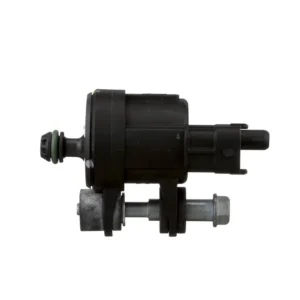
- Check the part shape. Vent solenoids are typically short cylinders with a quarter-turn locking collar. Purge valves tend to be squarer with two hose ports.

Codes That Point to the Vent Solenoid
P0446, P0449, and P1450 commonly show up when the vent circuit or the valve itself misbehaves. P2418 and P2450 appear in combination for some Ford applications where both the vent solenoid and the purge valve are involved. Intermittent codes are typical, since a solenoid can stick one week and work fine the next.
A stuck-closed vent solenoid can make the tank hard to fill because pressure has nowhere to go. A stuck-open unit usually triggers large leak codes since the system never seals during testing.
What Removal and Installation Look Like
Step-by-Step Basics
Support your vehicle safely on jack stands and pull the rear wheel closest to the solenoid if access is tight. Disconnect the battery, then unplug the electrical connector by lifting the lock tab. Most vent solenoids release with a small clockwise or counterclockwise turn of the locking collar, and the original often comes free with light hand pressure once the tabs clear.
Installation is where people struggle. New units ship with fresh O-rings that create real resistance, so lubricate them with a light coat of clean oil or silicone grease first. Push firmly while turning the body to engage the locking tabs. A 15mm open-end wrench on the flats gives you the leverage to turn and press at the same time in a cramped space.
Safety Notes
You’re working around fuel vapor lines, so keep sparks and open flames away and let your vehicle cool before you start. Don’t yank on brittle plastic vapor lines, since a cracked line turns a small repair into a leak. If you smell raw fuel at any point or see wet fuel staining near the tank, stop and have the system inspected before driving.
FAQ
They’re in the same area. The canister is the storage box, and the solenoid mounts on it or within a short hose length of it, so finding one gets you to the other.
Usually yes, for short periods, though the check engine light will turn on and your vehicle might fail an emissions test. Fix it promptly if the tank is hard to fill or you smell fuel.
Most applications don’t require it. Removing a rear wheel and the undercar shields is typically enough.
Plan on one to two hours for a first attempt, including cleaning corrosion off the mounting area.
A cracked vapor line, a loose fuel cap seal, or a failing purge valve can throw similar codes. Smoke testing the system finds the rest.
Keep the Tank Breathing Right
Finding the part is most of the battle, and the rest comes down to patience with tight clearances and stubborn O-rings. Once you know what you need, CarParts.com carries vent solenoids, purge valves, and EVAP canisters for a wide range of makes and model years. Check your fitment, order the right part, and get the light off your dash for good.
Keep Reading: Related Posts




Any information provided on this Website is for informational purposes only and is not intended to replace consultation with a professional mechanic. The accuracy and timeliness of the information may change from the time of publication.