The short answer is: usually no, but it depends on your engine. For most modern vehicles, replacing cylinder head bolts after removal is the right call. The longer answer involves knowing what type of bolts your engine uses, what the manufacturer actually says about reuse, and whether the money saved is worth the risk of redoing the job.
Most vehicles today are equipped with engines with torque-to-yield head bolts. These fasteners stretch during installation to create a precise, consistent clamping load across the head gasket. Once that stretch happens, the bolt does not return to its original dimensions.

Pro Tips are nuggets of information direct from ASE-certified automobile technicians working with CarParts.com, which may include unique, personal insights based on their years of experience working in the automotive industry. These can help you make more informed decisions about your car.
Pro Tip: What that means is that you torque the bolt to a specific setting, then it’s tightened further by degrees, which provides the proper stretch.
Putting it back in and torquing it again produces unpredictable clamping force, and that is exactly the kind of variable you do not want in a head gasket job. A replacement bolt set for most passenger cars runs anywhere from $25 to $80, which is a small cost compared to pulling the head a second time.
It is a challenge to find a modern OEM engine that still uses old-fashioned reusable head bolts.
The automotive industry has almost universally shifted to Torque-to-Yield (TTY) fasteners for cylinder heads because they provide a more consistent clamping force, which is critical for modern all-aluminum engines and multi-layer steel (MLS) gaskets. That being said, torque-to-yield head bolts don’t always require replacement. Take for example this shop manual procedure from the 2008 Honda shop manual regarding head bolts:

Pro Tips are nuggets of information direct from ASE-certified automobile technicians working with CarParts.com, which may include unique, personal insights based on their years of experience working in the automotive industry. These can help you make more informed decisions about your car.
Pro Tip: Most technicians will replace any and all torque-to-yield bolts.
When Can Cylinder Head Bolts Be Reused?
Reuse makes sense only under a specific set of conditions: the factory service manual for your exact engine allows it, the bolts are standard reusable fasteners rather than TTY hardware, and every bolt passes a thorough visual and dimensional inspection. Some manufacturers, like Mercedes-Benz, actually publish a maximum bolt length before reuse becomes unsafe, which takes the guesswork out of the decision. Most do not.
If the tightening procedure for your engine involves torquing to a value and then rotating an additional number of degrees, treat that as a strong indicator that the bolts are TTY and should not go back in. The torque-plus-angle method is closely associated with stretch-type fasteners, though not exclusively.
Torque-to-yield shop manual instructions typically require lubrication of the threads and beneath the bolt head. But the type and amount of lubricant are strictly dictated by the engineer who designed the joint.
Because TTY bolts rely on a highly specific friction coefficient to ensure the “turn-of-the-nut” angle results in the correct clamping force, getting the lubrication wrong can lead to either a loose head or a snapped fastener.
When you turn a bolt, a significant portion of your effort is spent overcoming friction rather than actually stretching the bolt.
Lubricant prevents galling, or metal-to-metal welding, and ensures the bolt moves smoothly into the block. Under the head, as the bolt is rotated to its final angle, there is immense pressure between the bolt head and the cylinder head or washer. Without lubrication, the bolt can stutter or bind, causing the torque-angle measurement to be inaccurate.
Premium aftermarket fasteners operate differently. These are engineered for repeated service and higher clamping loads, which makes them popular for turbocharged builds, performance engines, or any application that sees regular disassembly. They are not a drop-in swap for stock hardware, and they require the torque specs and lubrication instructions from the fastener manufacturer, not the factory service manual.
How to Inspect Head Bolts Before Reuse
If your service information permits reuse, inspection still needs to be thorough. Reject any bolt that shows thread galling, rust, pitting, polished bands on the shank, or visible necking where the diameter has narrowed. Check the bolt head for tool damage or rounding. Look at the threads closely for debris, old sealant, or embedded material.
Where the manual provides a service length limit, measure every bolt against it. If one bolt exceeds the limit, replace the full set. Mixing new bolts with marginal old ones creates uneven clamp load, which undermines the whole point of replacing them at all.
Bolt holes in the block deserve just as much attention. Oil, coolant, or debris sitting at the bottom of a blind hole can hydraulically resist tightening, giving a false torque reading and potentially cracking the block. Clean the holes thoroughly before installation.
Situations Where Replacement Is the Right Move
Some circumstances are too high-risk that reuse does not make sense even if the bolts would technically pass inspection. Replace the head bolts if the engine overheated severely, if the gasket failed from combustion gas leakage, if the bolts came out of an engine with an unknown rebuild history, or if the block threads needed any kind of repair work. Turbocharged engines and vehicles used for heavy towing fall into this category as well.
The value calculation here is straightforward. Head gasket jobs involve significant labor time and often machine shop work for resurfacing. Saving $40 to $80 on bolts while putting hundreds of dollars in labor at risk is not a trade most experienced mechanics would take.
What to Buy and What It Costs
Replacement head bolt sets vary in price depending on engine size and complexity. Standard sets for most passenger vehicles fall in the $25 to $80 range. More involved applications, including larger displacement or diesel engines, typically run $80 to $200 or more. Performance stud kits from ARP can exceed $300 depending on the application.
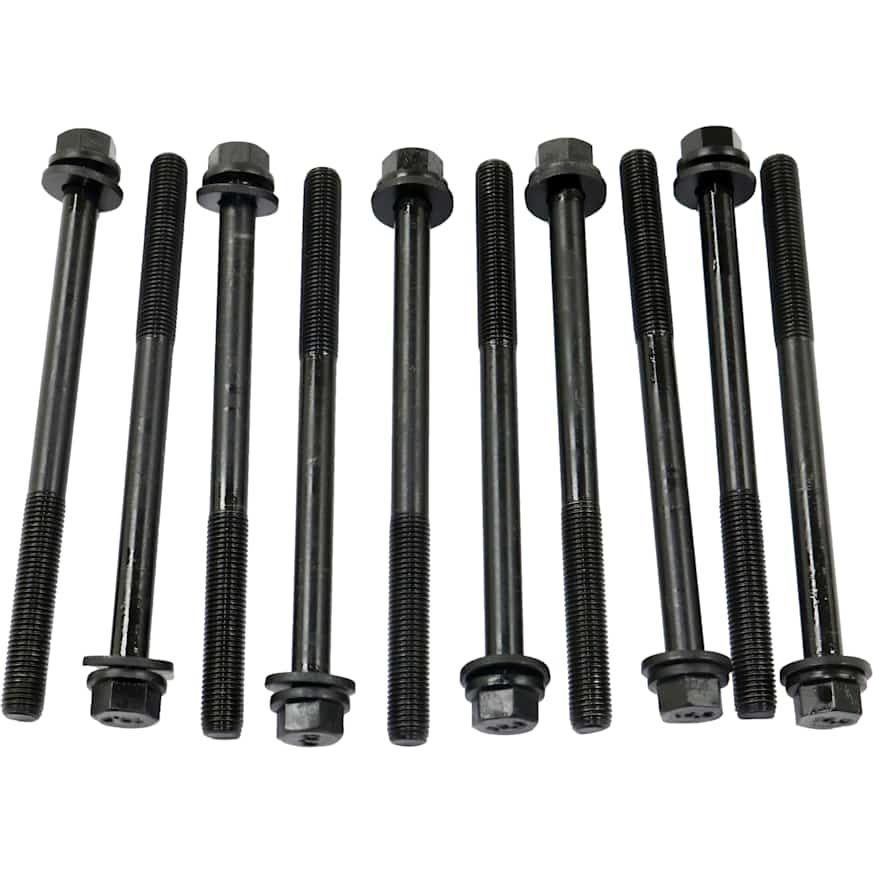
Most standard head gasket sets typically do not include bolts. They generally contain the head gasket, intake manifold gaskets, exhaust manifold gaskets, valve cover gaskets, and valve stem seals.
Head bolt sets are almost always sold as a separate part number.
Some premium brands, like Fel-Pro with their Permatorque line or Victor Reinz, offer head gasket sets with bolts. You will usually see this clearly labeled on the box or in the catalog description.
Before ordering, confirm the exact year, make, model, and engine code. On V-configuration engines, check whether the set covers one head or both. Verify that bolt lengths, washer requirements, and torque specs match your specific application, not just the general engine family. Some engines within the same platform use different bolt configurations depending on the model year or production revision.
Installation Mistakes That Ruin Head Gaskets
New bolts cannot save a sloppy install. Head gasket failures often trace back to process errors rather than bad parts. It’s important for the head and block surfaces to be clean and flat. Bolt holes need to be cleared of any fluid or debris.
The head and the block need to be as clean as possible, and both need to be checked for flatness, particularly if there was an overheating issue that led to head gasket replacement.
Pro Tips are nuggets of information direct from ASE-certified automobile technicians working with CarParts.com, which may include unique, personal insights based on their years of experience working in the automotive industry. These can help you make more informed decisions about your car.
Pro Tip: It’s best to take the heads to a machine shop along with the valve stem seals that came with the head gasket set and let the machine shop check the head to make sure it’s flat. The shop can also do a valve job, which will include checking the valve guides for wear, grinding the valves, replacing any worn valves, guides, and seats, and installing the new valve stem seals.
Lubrication, sealant, or dry installation depends on what the service information specifies for that fastener. Tighten in the correct sequence using the exact torque and angle values for your engine, not numbers pulled from a general guide or forum thread.
If the engine suffered serious overheating, the inspection scope should extend beyond the gasket and bolts to include the head surface, block deck, cooling passages, and thread condition in the block.
Finding the Right Parts Online
Shopping online gives better access to part number cross-referencing, fitment verification tools, and price comparison than most local store shelves allow. That matters on head bolt jobs because ordering the wrong set adds delay while the engine sits open.
CarParts.com makes fitment checks straightforward and carries quality replacement and aftermarket options from brands like JC Whitney and Replacement. If the rest of the repair calls for a head gasket set or related hardware, comparing bundled options there can save time and simplify the parts sourcing process without chasing unreliable listings elsewhere.
Keep Reading: Related Posts


Any information provided on this Website is for informational purposes only and is not intended to replace consultation with a professional mechanic. The accuracy and timeliness of the information may change from the time of publication.