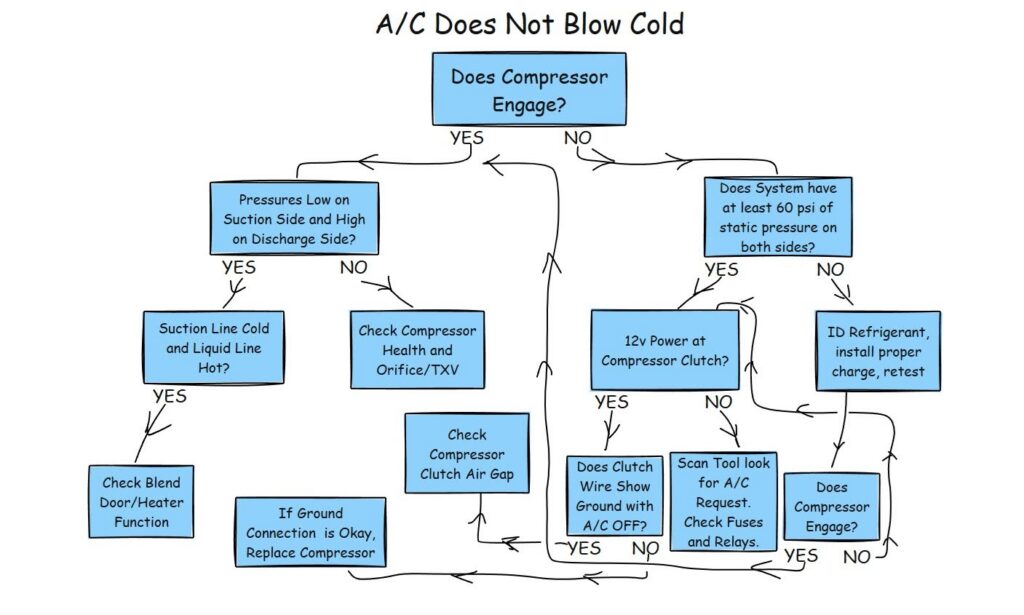
If your car’s A/C needs attention, start with a few simple checks. Look at the airflow first, then make sure the cooling fan and compressor are working properly. If the system still won’t cool, it’s time to stop guessing. A/C performance depends on maintaining the right pressures, having steady airflow across the condenser, and keeping refrigerant sealed inside the system.
How do you fix a car A/C that isn’t cold?
Most cooling problems come down to one of three things: low refrigerant from a leak, poor airflow through the condenser, or a compressor that isn’t engaging when it should. The fastest way to fix it is to diagnose it correctly. Start by checking airflow and fan operation, then verify the compressor is engaging, and only after that should you move on to testing the charge or looking for leaks.
Follow this order:
- Check that cabin airflow is strong and coming from the right vents. Make sure the blower speed, vent selection, and recirculation are set correctly.
- Confirm the condenser fan (or fans) run when the A/C is turned on. Many vehicles turn the fans on whenever A/C is requested.
- Make sure the compressor is being commanded to turn on. On belt-driven units, that means watching for the clutch to engage. On electric compressors, it’s an electronic signal.
- If everything points to low refrigerant or a leak, you’ll need professional service. Proper recovery, evacuation, leak testing, and recharging by weight all matter. DIY top-offs are easy to get wrong and usually make cooling worse.
Safety and legal note: Releasing refrigerant into the air is illegal. Proper service uses recovery equipment instead of venting. Always work in a well-ventilated area. Refrigerant vapors are heavier than air and can displace oxygen in low-lying spaces. Also, if you work on another person’s A/C for pay, you’re supposed to be ESCO certified or you’re breaking the law.
Common signs your A/C is losing cooling power
The pattern you notice often points directly to the cause.
- Air feels cool but never cold, especially in hot weather: Usually low refrigerant, restricted airflow across the condenser, or a weak fan.
- Cold at highway speeds but warm at idle: Typically points to a condenser fan issue or blocked airflow.
- Strong airflow with no temperature change: The compressor may not be running, or a blend door or control issue might be mixing heat in.
- Cold for a short time, then warm: Can happen with a low charge cycling on and off, pressure protection shutdowns, or evaporator icing from airflow problems.
- Musty smell from the vents: Often moisture or bacterial growth on the evaporator, or a saturated cabin filter.
- Oily residue near fittings or hoses: A common sign of a refrigerant leak carrying compressor oil with it.
- Operates normally at first but then totally stops cooling: This will usually be related to the compressor air gap or an issue with the thermal expansion valve, if equippe).
The most likely reasons an A/C blows warm
An automotive A/C system is sealed. Refrigerant doesn’t get “used up.” If the charge is low, it’s almost always because it leaked out. Stop leak clogs things up, so don’t use it. Furthermore, keep in mind that no refrigerant leak will ever fix itself.
Common causes:
- Low refrigerant from leaks at O-rings, service valves, the condenser, compressor seals, hose crimps, or the evaporator. The compressor itself is a very common leak point.
- Poor condenser airflow from a failed fan, damaged shroud, blocked fins, or bent condenser fins
- Compressor problems like a failed clutch coil, internal damage, control module issues, or belt problems
- Pressure sensor or switch shutdowns when the system detects unsafe pressures
- Restricted metering devices like a clogged orifice tube or expansion valve
- Blend door faults where cold air is being produced but gets mixed with heat before reaching the cabin
Quick symptom-to-cause reference
| What you notice | What it usually means | What to check next |
| Cold while driving, warm at idle | Weak condenser airflow | Fan operation and condenser blockage |
| Little change when A/C is turned on | Compressor or blend door issue | Compressor engagement and HVAC door movement |
| Rapid cold-warm cycling | Low charge or pressure protection | Leak evidence and proper evac/recharge |
| One side cold, other warm | Dual-zone blend door fault | Actuator calibration or diagnostics |
| Hissing with weak cooling | Likely leak or pressure equalization | Leak inspection with dye or detector |
Checks you can do in 5–10 minutes without tools
These quick steps solve many A/C problems without ever opening the system.
Set the controls correctly
Use max A/C (or the lowest temperature setting), high blower speed, recirculation on, and windows closed. If your vehicle has an ECO A/C mode, turn it off.
Watch the condenser fans
With the engine running and A/C on, the radiator or condenser fans should be spinning. If cooling only improves while you’re moving, airflow is the likely culprit.

Pro Tips are nuggets of information direct from ASE-certified automobile technicians working with CarParts.com, which may include unique, personal insights based on their years of experience working in the automotive industry. These can help you make more informed decisions about your car.
Pro Tip: If your vehicle has a belt-driven fan and stops cooling along with a belt squeal, put a fan in front of the vehicle blowing through the condenser. If the belt stops squealing then, you may have a bad fan clutch.
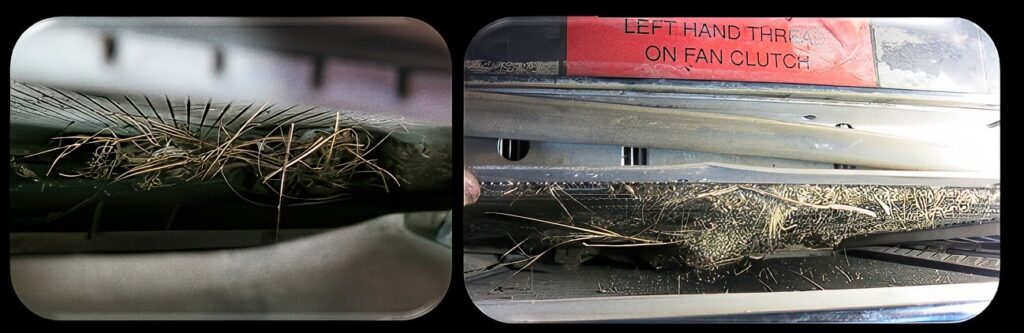
Look for blocked airflow at the condenser
Look through the grille for leaves, plastic bags, or heavy bug buildup. Clean it gently—avoid bending the fins.
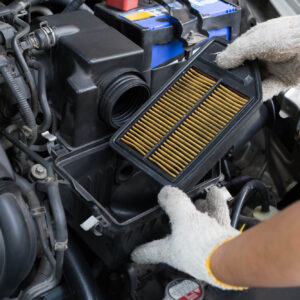
Check the cabin air filter
A badly clogged filter can restrict airflow across the evaporator and kill your cooling. Weak airflow at all vents is a dead giveaway. But not every vehicle has a cabin air filter, so investigate your vehicle to see if it has one. If so, check it anyway. You might be surprised how dirty it is.
Inspect basic electrical items
Check the A/C fuse or relay listed in your owner’s manual. If the A/C light comes on but you never notice a change in engine load or fan behavior, the problem is likely electrical or control-related.
Scan for obvious leak clues
Oily grime near hose crimps, the condenser, or the compressor can point to a leak. Don’t loosen any fittings.
Why the blower works but the air never gets cold
When airflow is strong but the temperature barely changes, the blower is rarely the problem. The issue is usually one of these:
- The compressor isn’t running or has been disabled by the control system
- The system has shut itself down because pressure is too low or too high
- A blend door is stuck, mixing heated air with cooled air
- Refrigerant charge is too low to absorb enough heat at the evaporator
Here’s a simple clue: with the A/C on, most vehicles show a slight load change at idle, and the fan speed increases. If you notice no change at all, it often means the system isn’t being allowed to operate.
What to test next if basic checks don’t help
Deeper diagnosis focuses on charge level, heat rejection, and control logic.
Confirm the refrigerant type and factory charge
Check the under-hood A/C label. It lists the refrigerant type and exact charge amount. Never assume based on model year alone.
Measure vent temperature correctly
Use a thermometer at the center vent with recirculation on and the engine at a steady speed. This gives you the most accurate reading. Keep in mind that actual numbers vary with humidity, ambient temperature, and vehicle design.
Check for leaks with proper tools
UV dye and a UV light can reveal many leaks. Electronic detectors are often used to find evaporator leaks hidden behind the dash.
Avoid pressure-only guesswork
A/C pressure changes dramatically with ambient temperature. Charging by pressure alone often leads to overcharging or undercharging—both of which hurt cooling.
If the system is empty or was opened, stop here
Professional service is the smart move. Proper recovery, vacuuming, and recharging by weight remove the air and moisture that damage performance and reliability.
A note on R-1234yf systems
Many newer vehicles use R-1234yf refrigerant. It’s classified as mildly flammable and requires specific service equipment and the correct compressor oil. Service guidelines emphasize good ventilation because the refrigerant can collect in low-lying areas.
Is it safe to keep driving with broken A/C?
Most of the time, yes. But there are exceptions.
Usually safe: The A/C blows warm, engine temperature stays normal, and there are no strange noises or smells.
Stop driving and investigate if:
- Engine temperature rises when the A/C is on
- You notice smoke, burning smells, or belt squeal near the compressor
- The system cycles rapidly with loud clicking and poor cooling
Practical concern: In extreme heat, lack of A/C can reduce alertness and make it harder to defog your windshield in humid weather.
Costly misdiagnoses to avoid
These mistakes waste time and money:
- Assuming low refrigerant without actually finding the leak. Adding more refrigerant can actually prevent the A/C from cooling.
- Replacing the compressor when the real problem is airflow, charge level, or a restriction
- Ignoring condenser airflow problems that look just like low refrigerant
- Using stop-leak products, which can react with moisture and create bigger service headaches down the road
Typical A/C repairs and what gets replaced together
The right repair depends on what failed, but many A/C jobs bundle related parts to prevent repeat failures.
- Leaks at fittings or hoses: Replace O-rings and the affected line or connection
- Condenser replacement: Often includes new O-rings and sometimes a receiver-drier when the system is opened
- Compressor replacement: Usually paired with a new receiver-drier or accumulator and often a new expansion valve or orifice tube, along with proper oil handling and flushing if there’s contamination
- Fan or fan-control repairs: May involve a motor, relay, resistor, control module, or wiring issue affecting airflow at idle
When buying A/C parts, always confirm fitment by year, make, model, and trim. Using the VIN helps avoid mistakes. If you’re ordering major components like a compressor or condenser, verifying VIN fitment before you order can save a lot of headaches.
How much does it cost to fix car A/C?
Costs vary based on refrigerant type, leak severity, and whether running low damaged other components.
Evacuation and recharge: Often around $200 for R-134a systems, with higher costs for R-1234yf due to refrigerant and equipment differences
Compressor replacement: Commonly falls in the $1,000–$1,400 range, but can go higher depending on access and bundled parts
Leak diagnosis and minor repairs: Can be relatively modest for accessible O-rings or valves, but climbs quickly for evaporator leaks or multiple leak points
What pushes A/C repair costs higher?
- Refrigerant type and required service equipment
- Leak location, especially evaporators and hard-to-reach hoses
- Parts bundled with major repairs
- Previous quick fixes that complicate recovery or diagnosis
How long do A/C repairs usually take?
Basic diagnosis and a recharge can often be done the same day. Component repairs vary.
Fan or relay repairs: Often quick if access is good
Condenser replacement: Moderate time with front-end access
Evaporator replacement: Often a full-day job due to dash disassembly
Compressor replacement with flushing and recharge: Time depends heavily on access and system condition
Mistakes that lead to repeat A/C failures
- Overcharging or undercharging the system
- Skipping proper evacuation after opening the system
- Using the wrong refrigerant or compressor oil
- Not replacing moisture-control components when required
- Adding sealants that can clog equipment or contaminate the system
Keep Reading: Related Posts






Any information provided on this Website is for informational purposes only and is not intended to replace consultation with a professional mechanic. The accuracy and timeliness of the information may change from the time of publication.