Most engine control module (ECM) orders go wrong before the box even ships. You see a part that seems to fit your vehicle’s year, make, and model, clicks add to cart, and assumes that’s the end of it. With an ECM, this assumption is the single biggest source of returns, no-starts, and second orders.
An ECM isn’t a generic plug-in part. Even on many pre-OBD-II vehicles, you need the right ECM or processor. Terminology varied by manufacturer and model year, and some automakers used the term PCM before 1997. It’s the engine’s brain, but the correct unit depends on the vehicle’s hardware requirements, calibration, and option content. On many vehicles, programming also uses the VIN. Two trucks built on the same line in the same week can need different ECMs. Order the wrong one and you’re not close enough. You’re stuck.
That’s why this purchase shouldn’t start with “What’s cheapest?” or “What looks like the right shape?” It should start with one question: what exactly needs to go in the cart so that your vehicle’s engine starts, runs, and clears codes after installation?
The Job in One Sentence
You’re replacing the engine’s command center and bringing it back online with the correct calibration for your specific vehicle.
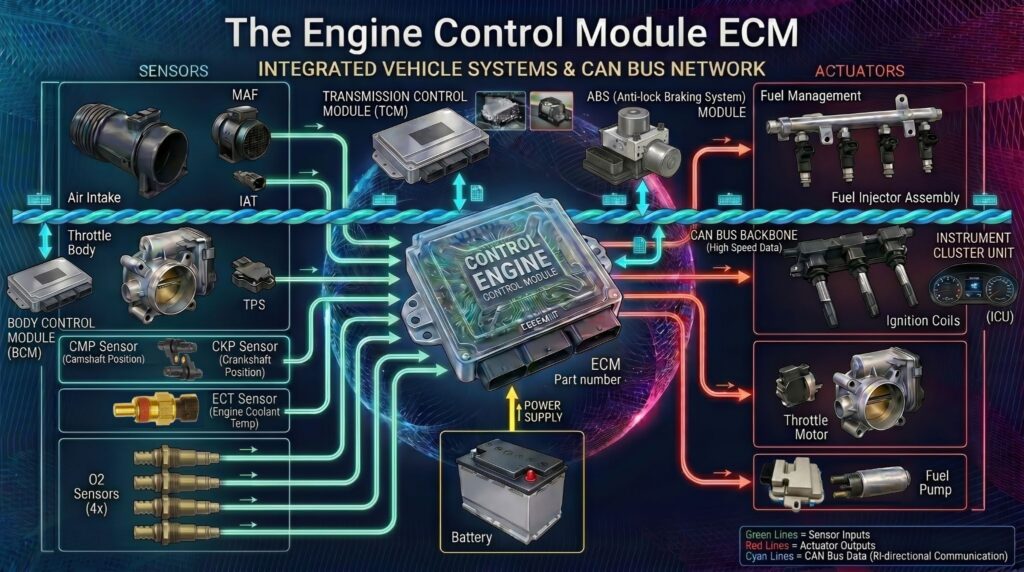
The ECM, also called an engine control unit or ECU, and sometimes a powertrain control module when it also controls the transmission, reads dozens of sensor inputs and decides how the engine fuels, sparks, idles, and meets emissions requirements. When it fails, you don’t just need a matching box on the shelf.
You need a module that can be programmed (or comes preprogrammed) to your VIN, that pairs cleanly with your vehicle’s anti-theft system, and that doesn’t show up missing the bracket, harness pins, or hold-down hardware you assumed would be included.
That’s why the ECM cart is rarely a single item. The order has to cover the module, the programming path, and the small details that decide whether the installation ends in a running engine or a tow truck.
Depending on the manufacturer, modern diagnostic trees use phrases like:
- “Perform PMI, or Programmable Module Installation.”
- “Upload or download As-Built Data.”
- “Replace the module and program it using the factory scan tool.”
- “Carry out the initialization procedure.”
- “Verify network communication and configuration.”
When the procedure is intended to rule out a module failure, it may also say:
- “Install a new module and perform PMI.”
- “Replace with a properly programmed module.” • “Verify the module powers up and communicates on the network.”
Choose Your Cart Size
Not every ECM job has the same scope. Pick the cart that matches your situation.
Minimum Viable Repair
This is the cleanest order: a confirmed bad ECM with no other failure signs in the system.

Pro Tips are nuggets of information direct from ASE-certified automobile technicians working with CarParts.com, which may include unique, personal insights based on their years of experience working in the automotive industry. These can help you make more informed decisions about your car.
Pro Tip: That being said, confirming that the ECM/PCM is faulty can be very tricky because there are many ways wiring faults and other modules can fool you into believing the ECM/PCM has failed.
Choose it if:
- Diagnosis points clearly to the ECM, not a sensor or wiring issue
- Battery and grounds have already been checked and are healthy
- The harness, connectors, and pins on your old module look clean
- You have a programming plan in place (preprogrammed unit, dealer flash, or qualified shop)
Typical cart:
- Replacement engine control module (correct application)
- Programming service or pre-programmed listing confirmation
- Mounting hardware if the listing doesn’t include it
Smart Same-Access Refresh
When the cover is off and connectors are out, a few small items earn their place in the cart.
Choose it if:
- Your vehicle has high mileage and you’ve never touched the electrical grounds
- The ECM connectors look corroded or green or have spread terminals
- You suspect a marginal battery or charging issue contributed to the failure
- You don’t want to come back to this area for another decade
Typical cart:
- Replacement engine control module
- Programming service
- Battery terminal cleaner and protector spray
- New ground strap or cleaned and replaced ground hardware
- Battery test or replacement if it’s borderline
High-Mileage / Do-It-Once Reset
For older vehicles, vehicles that haven’s been used for a long time, or failures tied to a charging or anti-theft event, the cart should reflect the full risk picture.
Choose it if:
- Your vehicle is past 150,000 miles and on its original electrical hardware
- Your vehicle has had repeat sensor failures or intermittent codes
- The failure was tied to a jump-start, water intrusion, or a parasitic draw
- You want to reset the system completely and stop chasing ghosts
Typical cart:
- Replacement engine control module (preprogrammed if available)
- New battery
- New battery cables and terminals
- Engine and chassis ground straps
- Dielectric grease and connector cleaner
- Any sensors flagged in scan data before the ECM gave up
- Anti-theft relearn plan (locksmith, dealer, or capable scan tool)
Don’t force yourself into the biggest lane. The minimum viable cart is the right answer for a lot of jobs. The larger lanes only make sense when the symptoms or mileage justify them.

What’s Commonly Ordered Together on This Job
The ECM rarely ships with everything you’ll want at the bench. Build the cart with the gaps in mind.
Programming and Calibration
This is the most-skipped line item in ECM orders. Many replacement modules are blank or carry a generic file. They have to be flashed to your vehicle’s VIN and option content before the engine will run correctly. Decide up front whether you’re buying a preprogrammed unit (you provide VIN at checkout), a blank unit that you’ll have programmed at a dealer or independent shop, or a unit that requires a specific J2534 pass-thru tool plus a manufacturer subscription. If the listing doesn’t make this clear, treat that as a red flag, not a green light.
Anti-Theft and Immobilizer Relearn
In most modern vehicles, the ECM talks to the immobilizer or body control module. After installation, the system has to be relearned to your keys. This can mean a dealer visit, a locksmith, or a capable bidirectional scan tool. Order the module without confirming this path and you can have a perfect part that won’t crank the engine.
Electrical Service Items
When the ECM connectors are unplugged, it’s the right time to address what they’ve been sitting in for years. Common adds include dielectric grease, electrical contact cleaner, replacement terminal pins or pigtails if any are spread, burnt, or pushed out, and heat-shrink butt connectors for any harness repairs.
Battery and Charging Support
Low or unstable voltage is a known cause of ECM faults and a known cause of failed flashes. A weak battery can brick a brand-new module mid-programming. Many shoppers add a battery tester or load test before installation, a replacement battery if it’s near end of life, a battery terminal kit, and a memory saver for the installation.
Hardware and Mounting
Some ECM listings are bare modules. Others include the bracket, cover, or hold-down hardware. These items may not be included with the replacement module, so confirm the listing and order any missing parts separately.
What People Forget Until the Vehicle Is Already Apart
- Is the replacement preprogrammed, or do you have a flash plan ready before installation?
- Did you record the original module’s hardware and software part numbers from the label?
- Does your vehicle need an immobilizer or anti-theft relearn after installation?
- Are the connector counts and pin layouts on the new module identical to the old one?
- Is the bracket included, or does it transfer from the old unit?
- Is the cover or shield included, or does it transfer?
- Is your vehicle’s battery healthy enough to support a programming session without dropping voltage?
- Do you have access to a scan tool capable of any required idle, throttle body, or crankshaft position sensor relearn after installation?
- If your old ECM was water-damaged, have you fixed the water intrusion path so that the new one doesn’t fail the same way?
- Are you ordering the version that matches your transmission type (some ECMs are engine-only, while others are PCMs that also control the trans)?
When Replacing Only the Engine Control Module Is False Economy
Sometimes a module-only cart is exactly right. If the diagnosis is clean, the rest of the system tested healthy, and your vehicle isn’t ancient, there’s no reason to load the cart with parts you don’t need.
But there are cases where a one-item order is the expensive choice. If the ECM failed because of a chronic charging issue, a corroded ground, or water intrusion, installing a new module without addressing the cause means you’re scheduling the next failure. If the connectors are corroded, the new ECM is sitting on borrowed time. If the battery is at the end of its life, a programming session can fail mid-flash and turn a working core into scrap.
Ask why the original ECM failed. If the answer is old age, a minimum cart is fine. If the answer is charging system, water, repeat codes, or jump-start damage, the cart should reflect that.
The other false-economy trap is skipping programming. A bare module without a flash plan isn’t a repair. It’s a box on a shelf in your garage.
The Fitment Splits That Break Engine Control Module Orders
Year, make, and model isn’t enough for an ECM. These are the splits that send orders back.
Engine Differences
Two of the same vehicle in the same year with different engines need different modules. The hardware part number is tied to the engine family, displacement, and sometimes the cylinder configuration. A V6 ECM and a V8 ECM aren’t interchangeable, even if the connectors look similar.
Transmission Type
Some vehicles use a separate ECM and TCM. Others use a combined PCM that controls both. Manual versus automatic can drive a different part number even when the engine is identical. Confirm before ordering.
VIN-Specific Programming
This is the one that catches the most shoppers. Even when the hardware part number is correct, the software calibration is tied to your vehicle’s VIN, build options, axle ratio, tire size, and emissions package. A used ECM from a salvage yard with the right hardware number can still refuse to run your vehicle until it’s reflashed.
Production-Date or Midyear Splits
Manufacturers change ECM hardware mid-model-year. A January build and a July build of the same year and trim can take different modules. Production date or VIN range may be the deciding factor.
Emissions: Federal vs. CARB
Vehicles built or sold for California, and the states that follow CARB rules, often run a different calibration and sometimes different hardware. Mismatching this split is a common cause of “won’t pass smog” complaints after a working installation.
Trim, Submodel, and Option Content
Tow packages, heavy-duty packages, off-road packages, and forced-induction options can change the ECM. The base trim ECM and the loaded trim ECM aren’t always the same module.
Connector Count and Pin Configuration
Even within the same vehicle line, connector counts and layouts shift across years. Lay the new module next to the old before tearing into the harness.
New, Remanufactured, or Refurbished
These are different products with different programming requirements and different return policies. Confirm which you’re buying and what programming it includes.
Delivery-Day Inspection Checklist
Before you unbolt anything, compare the new module against the old one on the bench. Check for the following:
- Connector count matches
- Connector shape, color, and key matches
- Pin count in each connector matches
- Mounting hole pattern matches
- Bracket included if needed, or transferable from the old unit
- Hardware part number printed on the label is the expected number
- If preprogrammed, the documentation lists your VIN
- Case and connectors are free of cracks, bent pins, or shipping damage
- Any included hardware (bolts, hold-downs, gaskets) is in the box
- The unit is sealed against moisture, with no signs of prior installation
If any one of these is off, stop and verify before unbolting the original.
Your One-Job Order Sheet for an Engine Control Module
Use this as the final pass before you check out.
- Confirm the vehicle. Year, make, model, engine, transmission, trim, and emissions market. VIN ready for the listing or seller.
- Confirm the repair scope. Is this an isolated ECM failure, or part of a bigger electrical or charging issue? Pick the cart lane that matches.
- Confirm what the listing includes. New, reman, or used. Preprogrammed or blank. Bracket, cover, and hardware in or out of the box.
- Confirm the programming path. Pre-programmed to VIN, dealer flash, independent shop, or your own J2534 setup. Don’t skip this step.
- Add the consumables and adjacent items. Dielectric grease, contact cleaner, ground hardware, battery service items, and any sensors flagged in scan data.
- Plan the anti-theft relearn. Know who’s doing it and when, before the old module comes out.
- Bench-check before teardown. Compare the new module to the old on connectors, pins, mounting, and labels before you commit to the installation.
The Smart Way To Shop Engine Control Modules
The cheap-looking order is one module, no programming plan, and no thought about why the original failed. The correct order is the module, the calibration path, the small electrical items that protect the installation, and an honest read on the rest of the system’s health.
Engine control modules don’t reward shopping by thumbnail or by “looks close enough.” They reward shopping by repair scope, vehicle specifications, and ownership goals. The right cart is the one that gets the engine running, completes the required programming and relearns, clears the codes, and gets your vehicle out of the bay.
Build the order around the job, not the part name, and you’ll only need to do this once.
Keep Reading: Related Posts





Any information provided on this Website is for informational purposes only and is not intended to replace consultation with a professional mechanic. The accuracy and timeliness of the information may change from the time of publication.