They’re the two frame-mounted brackets that hold the ends of a leaf spring. The hanger is the fixed mount at the front spring eye. It bolts or welds to the frame and doesn’t move. The shackle is the short pivoting link at the rear spring eye. It swings on two bolts so the spring can change length as it flexes. Fixed vs. pivoting is the main difference, and it explains how each part behaves, how it wears, and how hard it is to replace.
Key Takeaways
- Hangers anchor the spring to the frame and don’t pivot.
- Shackles link the rear spring eye to the frame and swing to absorb the spring’s length change.
- Harsh ride, a lean to one side, clunking over bumps, and repeat spring breakage point to worn shackles.
- Shackle replacement is a common driveway job. Hanger replacement is more complex.
- Hangers and shackle hangers are sized to spring width, so measure before you order.
How Leaf Springs and Shackles Mount to the Frame
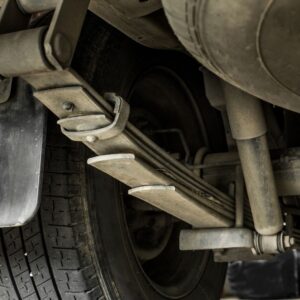
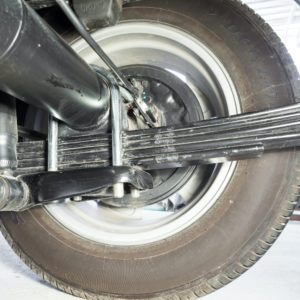
A leaf spring is an arc. When you hit a bump and the suspension compresses, this arc flattens and the spring gets physically longer between its two eyes. When the suspension drops back down, the arc returns and the spring gets shorter again. This length change has to go somewhere.
The front eye handles none of it. It sits in the hanger, held by a single bolt that lets the spring rotate but not travel. The rear eye handles all of it. It attaches to a shackle, and the shackle pivots forward and back through its arc to take up the slack. Without this pivot, the spring couldn’t flatten properly, the suspension would bottom out early, and ride quality and handling would both suffer.
The Hanger
A hanger is a bracket with two ears and a hole. It either bolts through the frame rail or welds to it, depending on the truck and application. Because it doesn’t move, it’s a simple part that mostly fails from rust, impact damage, or elongated bolt holes rather than from wear. It also sets the spring’s mounting point, which is why lowering or relocating a spring usually means changing hangers, not shackles.
The Shackle
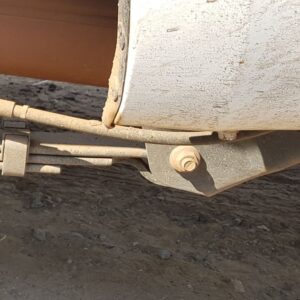
A shackle is a pair of plates or a forged link with a bolt at each end. One bolt goes through the frame-side shackle hanger, while the other through the rear spring eye. Bushings at both ends absorb the constant articulation. These bushings are the wear item, and they carry load in every direction the truck moves.
Leaf Spring Shackles vs. Hangers
Both mount to the frame, so people mix them up. The practical differences matter more than the definitions.
- Movement: the shackle pivots, while the hanger doesn’t. Anything you want to change about spring travel happens at the shackle end.
- Wear rate: shackle bushings and bolts wear steadily because they move constantly. Hangers stay put and last much longer, though rust and cracked welds still take them out.
- Replacement difficulty: shackles are a quick, inexpensive swap with basic hand tools. Hangers can be a long fight, especially when you’re removing factory rivets or a welded bracket. An air chisel turns a miserable job into a manageable one.
- Effect on ride height: longer shackles raise the rear slightly and add down travel. Raising the rear spring eye also tilts the axle housing, which changes pinion angle and can introduce driveline vibration. Shorter shackles drop the rear and tilt the pinion the other way. On a leaf-sprung front axle, shackle length affects caster instead, which shows up as heavy or vague steering. Either way, stay conservative with length changes unless the rest of the suspension is set up for it.

Symptoms of Worn Shackles
- Harsh ride: If your truck skips or crashes over bumps that it used to soak up, seized or collapsed bushings are stopping the spring from flattening freely.
- A lean to one side: One worn or sagging shackle changes the effective spring rate on that corner and drops ride height unevenly.
- Clunking, popping, or snapping: Loose bolts and shot bushings let metal rub against metal every time the suspension cycles.
- Repeat spring failures: If leaves keep cracking, the shackle might not be releasing the spring’s length change, and the spring is taking the load instead.
A shackle can also invert, meaning it rotates past its normal arc and locks in the wrong position. This usually announces itself with a loud snap and a puff of rust dust, and it stops the spring from working. Address it right away. Suspension mounting hardware carries the full weight and control of your vehicle, so if you find cracked brackets, elongated bolt holes, or a bolt you can turn by hand, have the assembly inspected before you drive it loaded or tow with it.
How To Replace Leaf Spring Shackles Step-by-Step
- Park on level ground, chock the front wheels, and lift the rear of the truck with a floor jack.
- Set jack stands under the frame and lower the vehicle onto them so the suspension hangs free.
- Support the axle with a second jack to control it once the spring is loose.
- Remove the lower mounting bolt connecting the rear shackle to the rear spring eye.
- Remove the upper bolt connecting the shackle to the frame-side hanger.
- Pull the old shackle out and set the new one in place with fresh hardware.
- Line up the spring eye and start the lower bolt by hand so you don’t cross-thread anything.
- Install both bolts and snug them, leaving them loose enough to move.
- Raise the truck, remove the jack stands, and set it back on the ground.
- Torque the shackle bolts to spec with the suspension loaded at ride height, then recheck after the first 50 to 100 miles.
Torquing at ride height matters. Bushings that get clamped at full droop stay preloaded and tear themselves apart early.
Choosing the Right Size and Style
Hangers are sold by spring width, not by truck. Common sizes cover 2 ½-inch, 2 ¾-inch, and 3-inch wide springs, with inside widths listed to match. Measure the spring pack before ordering, because a hanger that’s a quarter inch wide will let the pack shift.
Shackle hangers come in a few mounting styles. Flush mount versions sit tight against the frame for maximum clearance. Centered versions position the shackle bolt in line with the bracket for more predictable geometry. Frame outriggers move the mounting point outboard when you’re widening spring spacing. Heavy-duty steel brackets typically run in the $30 to $50 range per pair, which makes them cheap insurance compared to the damage a failed mount causes.
Repair the Spring Right Away
Worn shackles cost you ride quality, spring life, and eventually the springs themselves, so don’t put off the replacement once the symptoms show up. CarParts.com stocks leaf spring shackles, hangers, bushings, and hardware for a wide range of trucks and SUVs, with fitment tools to confirm you’re getting the right part. Order today and get your suspension back to doing its job.
Keep Reading: Related Posts



Any information provided on this Website is for informational purposes only and is not intended to replace consultation with a professional mechanic. The accuracy and timeliness of the information may change from the time of publication.