Most drivers don’t think about steering linkage until something feels off. By then, the car’s already wandering, knocking, or eating one tire edge faster than the other. The steering linkage assembly is the mechanical connection between the steering gear and the front wheels, and when it wears, the whole front end lets you know.
What Does a Steering Linkage Assembly Do?
The steering linkage assembly translates rotational motion from the steering gear into the lateral movement that turns the wheels. The gear converts driver input into a push-pull force, and the linkage carries that force out to the steering knuckles at each front wheel. Without it, there’s no mechanical path between the steering wheel and the road.
The linkage also has to accommodate vertical suspension travel while transferring steering force. Ball-and-socket joints throughout the system handle that dual movement. Once those joints wear, the steering develops play and input stops reaching the wheels cleanly.

Pro Tips are nuggets of information direct from ASE-certified automobile technicians working with CarParts.com, which may include unique, personal insights based on their years of experience working in the automotive industry. These can help you make more informed decisions about your car.
Pro Tip: Many older vehicles use parallelogram steering with a steering box, while rack-and-pinion steering is more common on newer passenger vehicles. Some trucks and SUVs still use steering boxes.
What Parts Make Up the Assembly?
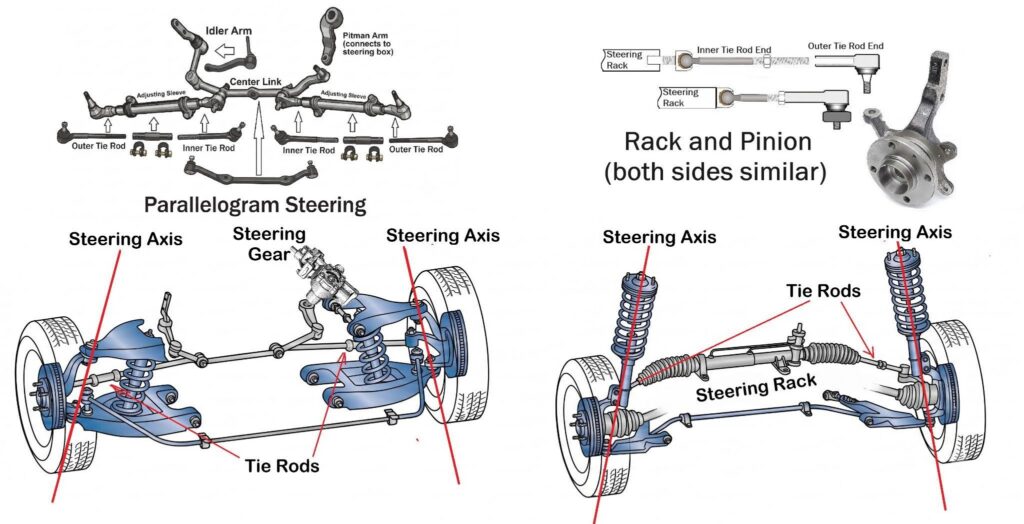
The exact components depend on whether the vehicle uses a rack-and-pinion or a parallelogram steering system. Most street cars and trucks share these core parts. There are a few variations of non-rack-and-pinion steering systems on older vehicles, but most rack-and-pinion systems are very similar in basic design.
Tie Rods (all conventional systems have these)
Tie rods, both inner and outer, connect the steering gear or center link to the steering knuckle on each side. The outer tie rod end is a grease-filled ball-and-socket joint sealed by a rubber boot. A torn boot lets the grease escape and the joint deteriorates quickly. On rack-and-pinion systems, the inner tie rod end is hidden inside the accordion boot, but it can also wear out and develop play like the outer tie rod end.
On both types of steering system, the outer tie rod end connects to the steering knuckle, which supports the hub and bearing assembly that carries the front wheel and tire.
Center Link and Pitman Arm (only found on non-rack-and-pinion systems)
The center link, sometimes called a relay rod, is the lateral bar on parallelogram systems that connects the pitman arm to the idler arm. It’s the anchor point for both inner tie rods. The pitman arm bolts to the steering gearbox output shaft and converts the gear’s rotation into side-to-side force that moves the center link.
Idler Arm (only found on non-rack-and-pinion systems)
The idler arm sits on the passenger side and mirrors the pitman arm’s position, keeping the center link level. Worn idler arm bushings introduce vertical play into the center link, which throws off toe alignment on both front wheels at once.
Tip: On rack-and-pinion systems, the rack itself replaces the center link, pitman arm, and idler arm. It connects directly to the inner tie rods, which cuts component count but concentrates all the wear into fewer parts.

What Are the Symptoms of a Worn Steering Linkage?
The most common sign is a vague, wandering feel at the wheel. The car drifts without input, and the driver ends up making constant small corrections to hold a straight line. That dead spot comes from worn ball-and-socket joints in the tie rod ends, creating extra play throughout the linkage.
Front-end clunking when turning or hitting bumps is another reliable tell. If the steering stops are dry, they can also squeak during slow, tight turns over rough ground, so that noise alone does not confirm a worn linkage joint. Clunking from a worn joint can come from excess internal clearance as the parts shift under load. At speed, a worn tie rod end socket can also cause front-end shimmy.
Warning: Excessive play in a tie rod end can let a wheel shift its toe angle suddenly mid-corner. That’s not a minor handling annoyance. It’s a real loss-of-control risk at highway speeds.
Uneven tire wear is the other giveaway. A worn idler arm lets the center link sag, misaligning both front wheels at once, and the tires show accelerated wear on the inner or outer edge even after a recent alignment.
How Do You Check the Linkage Without a Lift?
A basic inspection doesn’t require a shop. Here’s how to check it at home:
- Set the parking brake and turn the engine off.
- During the dry park check, watch each steering-linkage joint while an assistant rocks the steering wheel a small amount from side to side. Look for movement within a joint rather than normal movement of the linkage as a whole.
- To supplement the dry park check with a wheel-rock test, safely raise and support the front of the vehicle on jack stands. Never work under a vehicle supported only by a jack. Grip each front tire at the 3 and 9 o’clock positions and rock it side to side while an assistant watches the tie rod joints. Visible play at a tie rod joint indicates wear, but wheel movement by itself does not identify which component is loose.
- Have someone slowly turn the steering wheel while listening from outside near the front wheels. Clunking or popping can point to a failed joint. Sometimes a bad or binding strut mount bearing can cause a similar noise. If you place a hand on the coil spring while a helper turns the steering wheel and feel popping through the spring that corresponds with the noise, the strut mount bearing is a likely source.
- Look at the outer tie rod boots. A cracked or split boot does not by itself prove that the joint is worn out, but it can allow grease to escape and contaminants to enter, so the joint should be inspected closely for play or damage.
Pro Tips are nuggets of information direct from ASE-certified automobile technicians working with CarParts.com, which may include unique, personal insights based on their years of experience working in the automotive industry. These can help you make more informed decisions about your car.
Pro Tip: Mechanics often perform a "dry park check." With the vehicle parked, have an assistant move the steering wheel back and forth while you inspect the linkage for unwanted movement. The engine is usually off for this check. If there's enough clearance to inspect safely without raising the vehicle, this is one of the quickest ways to locate worn steering-linkage parts. Follow up with the checks below:
Note: A vehicle with confirmed excessive steering-linkage play should not be driven until the worn part is repaired. Tie rod ends don’t always fail gradually. They can let go with little warning. Ball joints can also fail, sometimes even when their boots look intact, and a failure can occur during low-speed maneuvering or at road speed.
Does a Worn Idler Arm Actually Matter?
It gets overlooked, but the idler arm is a real failure point on parallelogram steering systems. It holds the passenger-side end of the center link at the correct height, and when the pivot bushing wears, the center link sags and both front wheels lose their alignment geometry at once.
With the front end safely raised and supported, apply moderate hand force to the idler arm or center link and check for vertical movement. Compare any movement with the vehicle manufacturer’s specification; excessive vertical play indicates a worn idler arm or bushing. Always get a wheel alignment after replacing it. [RED]Avoid choosing an idler arm based on low price alone. Use a reputable replacement that matches the vehicle’s specifications and intended use.[/RED]
What Should You Check Before Buying Replacement Parts?
Fitment is where most online orders go wrong with steering linkage components. Confirm year, make, model, and trim before ordering, because steering system configurations can vary by suspension package within the same model year. Also, identify whether the vehicle uses rack-and-pinion or parallelogram steering, since the parts aren’t interchangeable.
Check whether the vehicle has power or manual steering, since some assemblies are built for one type only. Many tie rod ends and idler arms are also side-specific, so note driver or passenger before adding anything to a cart.
Buy carefully: Always cross-reference the part number against the vehicle’s VIN using the fitment tool at CarParts.com before ordering. Confirming compatibility upfront avoids returns and delays. Steering geometry is too precise to leave to chance. Verify compatibility first, and plan on a wheel alignment immediately after installation.
Where to Find the Right Steering Linkage Assembly
Dealer-sourced steering linkage components can cost more than aftermarket replacements. Quality aftermarket parts from reputable manufacturers can offer OE-style fit and performance at a lower price, depending on the brand and application.
CarParts.com carries steering linkage assemblies from multiple aftermarket brands. The fitment filter helps narrow the options before checkout, and parts can ship in as fast as two business days. Most eligible items can be returned within 30 days of delivery, subject to the return policy.
Keep Reading: Related Posts




Any information provided on this Website is for informational purposes only and is not intended to replace consultation with a professional mechanic. The accuracy and timeliness of the information may change from the time of publication.