An air conditioning (A/C) refrigerant hose order usually goes wrong at the fitting, not the hose. The new line arrives with a bolted block where yours has a spring-lock coupling, or it lacks the service port the recharge machine connects to. By then, the refrigerant’s already been recovered and the system sits open to humid air.
An open A/C system pulls in moisture every hour it waits for parts. So before you sort by price or compare product photos, ask the question that saves the job: “What exactly needs to go in the cart for this job?”
A/C refrigerant hoses carry more wrong-order risk than most hoses. One vehicle can use three different lines, and each can change with the engine, the refrigerant, or a rear A/C package. Once the system’s opened, it also needs fresh seals, oil, and a new drier before it takes a charge again.
The Job in One Sentence
The job is to restore a sealed refrigerant path between two A/C components so the system holds a vacuum, takes a full charge, and keeps oil moving to the compressor.
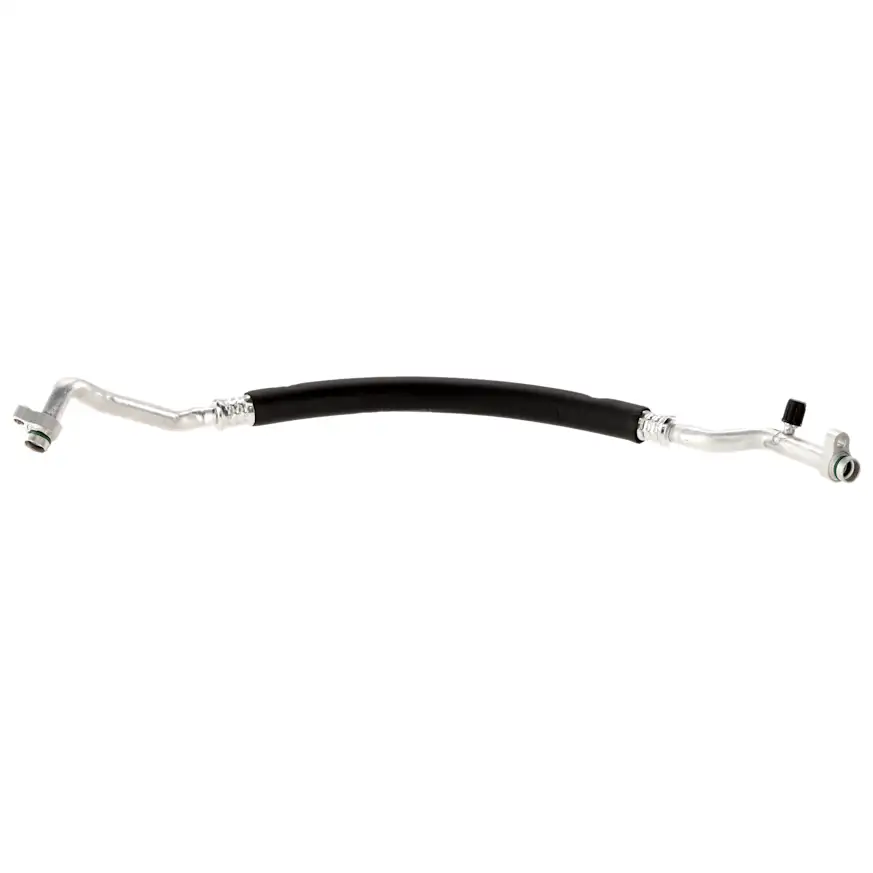
An A/C refrigerant hose carries refrigerant and oil between the compressor, condenser, and evaporator. Opening the system lets in air and moisture, so the real job also includes new seals, an oil top-up, and a professional recharge.
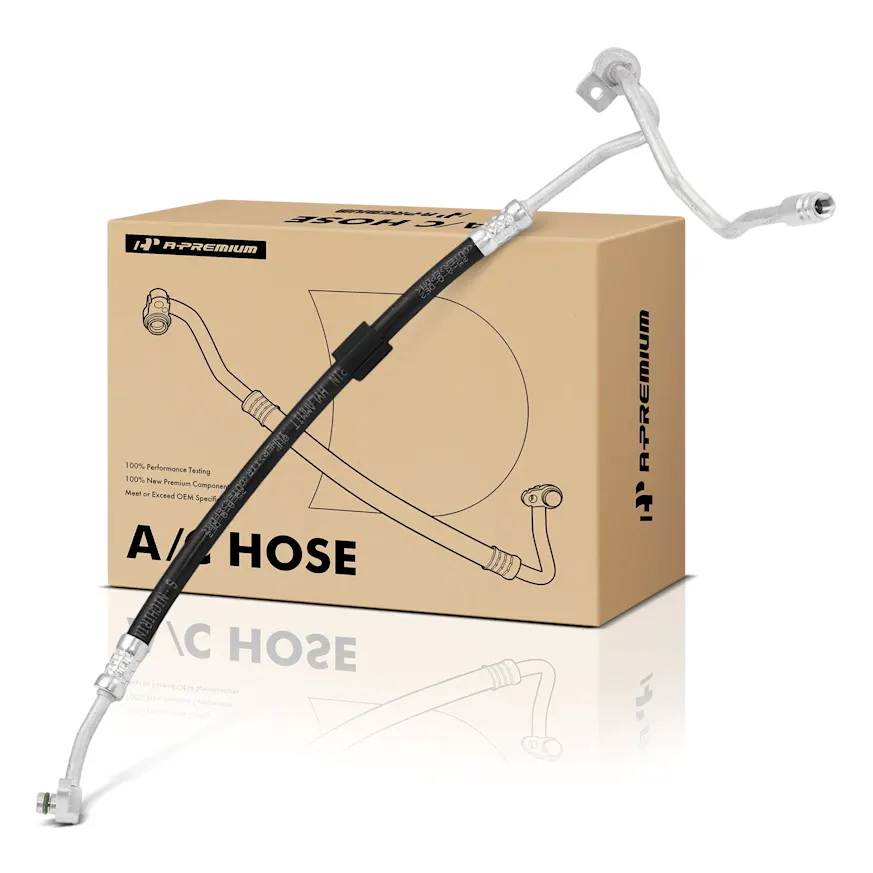
You’ll find single hoses labeled suction, discharge, or liquid, plus manifold assemblies that join two hoses at one compressor block. Some include seals while others ship bare, so check the box contents before you compare prices.
Choose Your Cart Size
Pick a lane based on how the system lost its charge, the condition of the compressor, and how long your vehicle stays in the driveway. Even the smallest lane includes a drier, because every opened system exposes its desiccant to moisture.
1. Minimum Viable Repair
This lane covers one leaking hose in an otherwise healthy system.
Choose it if:
- You’ve traced the leak to one hose crimp or fitting
- The compressor ran quietly and cooled normally before the leak
- The other lines stay dry at their crimps and connections
Typical cart:
- One A/C refrigerant hose matched by line type and end fittings
- Hydrogenated nitrile butadiene rubber (HNBR) O-rings or sealing washers for each joint you’ll open
- The specified oil to replace what the old hose held
- A receiver drier, accumulator, or condenser desiccant cartridge
- A recovery, vacuum, and recharge service
2. Smart Same-Access Refresh
This lane fits jobs where reaching the bad hose means disconnecting its neighbors anyway.
Choose it if:
- The failed hose shares a manifold or compressor block with another line
- Nearby hoses show oily residue at their crimps
- You want one recovery and recharge to cover every tired line
Typical cart:
- The full manifold and hose assembly, or both hoses at the compressor
- O-rings or sealing washers for every connection you’ll disturb
- A receiver drier or accumulator
- An orifice tube or expansion valve if the job opens its joint
- The specified oil and the recharge service
3. High-Mileage / Do-It-Once Reset
This lane suits older systems and any compressor failure that pushed debris through the lines.
Choose it if:
- The compressor failed and shed metal or dark sludge into the system
- Your vehicle still runs its original hoses at high mileage
- You plan to keep it for several more summers
Typical cart:
- A compressor if yours failed, plus every hose with a muffler or debris trap
- A condenser if yours is a parallel-flow design that won’t flush clean
- A receiver drier or accumulator, plus an orifice tube or expansion valve
- A complete O-ring kit and A/C flush solvent for the lines you’ll keep
- A full oil charge to the system specification
One leaking hose in a healthy system belongs in the first lane. Save the third for compressor failures and long-term keepers.
What Is Commonly Ordered Together on This Job
Plan to buy the A/C refrigerant hose alongside fresh seals, the right oil, and a new drier.
O-Rings and Sealing Washers
A/C seals are single-use parts. Replacement O-rings are usually HNBR and sized for each joint. Many hoses ship with seals for both ends, but not all do. Compressor block fittings might call for a flat sealing washer instead, and spring-lock couplings in many Ford applications take their own seal set.

Receiver Drier or Accumulator
Expansion valve systems use a receiver drier, and orifice tube systems use an accumulator. Both hold desiccant that saturates once the system opens, and many compressor warranties require a new one. In some vehicles, the drier is a cartridge inside the condenser. If your repair job opens the orifice tube or expansion valve joint anyway, add this part to your cart too.
Refrigerant Oil
Every hose removal takes some oil with it. Order the polyalkylene glycol (PAG) grade or R-1234yf-approved oil your vehicle’s A/C system specifies, enough to replace what the old hose and drier held. Hybrids with electric compressors often need a dedicated oil, so skip the leftover bottle from your last repair job.
Recovery and Recharge Service
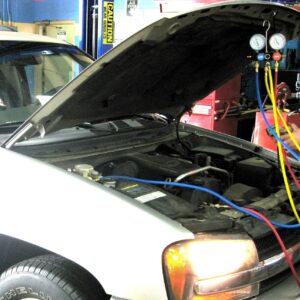
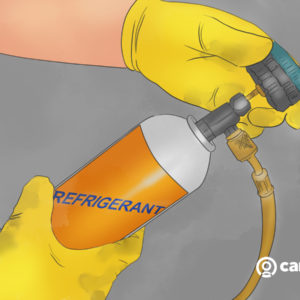
Federal law prohibits venting refrigerant, so a shop has to recover it before the old hose comes off, then vacuum and recharge the system by weight. Book this appointment before the parts arrive so that the A/C system doesn’t sit open.
What People Forget Until the Vehicle Is Already Apart
Settle these questions before anyone recovers the refrigerant.
- Does the A/C system run R-134a or R-1234yf? Check the under-hood label and remember that the two use different service ports.
- Does the new hose carry the same high- or low-side service port as the old one?
- Does the old hose have a pressure switch or transducer port, and does the new one?
- Did the listing include seals for every joint, including the compressor block?
- Does your vehicle use spring-lock couplings, and do you own the release tool?
- Does your vehicle have rear A/C, and does this change which front line you need?
- Is the drier a separate canister or a cartridge inside the condenser?
When Replacing Only the A/C Refrigerant Hose Is False Economy
Replacing only the A/C refrigerant hose is the right call when one line leaks and the compressor’s healthy. Add the drier, seals, and oil, and you’ll have everything you need for a complete repair.
But the lean approach costs more when the failed hose shares its age and access with another line. If one side of a manifold assembly leaks, the other side has lived through the same heat cycles. Swapping both now adds one hose to the cart. Waiting adds another recovery, another vacuum, and another drier.
Compressor failure changes the math entirely. Debris from a failed compressor collects in hose mufflers and in parallel-flow condensers, and flushing can’t reliably clear either one. Bolt a new compressor to contaminated lines and you’ll risk destroying it. In addition, most compressor warranties won’t cover this failure.
Still, an old hose with dry crimps doesn’t need replacing just because the A/C system’s open. Buy the parts that need to be replaced, not for the biggest possible cart.
The Fitment Splits That Break A/C Refrigerant Hose Orders
A/C refrigerant hose listings split first on line type and refrigerant, then on engine, options, and the hardware at each end. Product photos rarely show the difference.
Line Type: Suction, Discharge, or Liquid
The suction hose returns vapor to the compressor and has the largest diameter. The discharge hose runs from the compressor to the condenser and often carries a muffler. Meanwhile, the liquid line feeds the evaporator and is often mostly aluminum tubing. Listings can identify a hose by its line type, its route (such as “condenser to evaporator”), or both, so confirm that whichever label appears matches the hose you’re replacing.
Refrigerant Type: R-134a vs. R-1234yf
Many vehicles built since the mid-2010s use R-1234yf, but the changeover year varies by model. The two refrigerants use service ports with different sizes and threads, so a hose with the wrong port won’t accept the right recharge equipment. Some R-1234yf systems also add an internal heat exchanger that merges two lines into one assembly.
Engine Differences
Compressor location shifts with engine choice, so a suction hose built for a model’s four-cylinder engine often won’t reach the compressor in the V6 version.
Front-Only vs. Rear A/C
SUVs, minivans, and full-size vans with rear A/C run extra lines to a second evaporator. Their front lines often add a tee or an extra port to feed it, but this difference is easy to miss in a thumbnail.
End Fittings
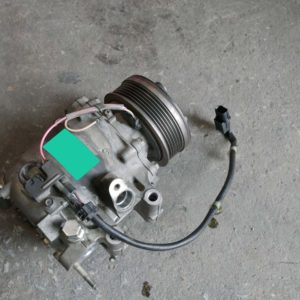
Compressor ends usually use a bolted block fitting with a specific stud and port layout. Other joints can use spring-lock couplings or threaded O-ring fittings, depending on application. Match both ends, not just the one you can see.
Service Ports and Sensor Provisions
A hose can carry a service port, a pressure switch or transducer boss, or a temperature sensor fitting. Lose one of these, and you might end up with no clutch engagement, pressure signal, or place to connect the recharge machine.
Orifice Tube Inclusion
In orifice tube systems, the tube often sits inside the liquid line. Some replacement liquid lines ship with it installed, but with others, you’ll need to buy the tube separately.
Production-Date Splits
Some manufacturers changed refrigerant or fitting style partway through a model year. If a listing names a build date or vehicle identification number (VIN) range, compare it against the build date printed on the door-jamb sticker.
Delivery-Day Inspection Checklist
Check the new hose against the installed one while the A/C system’s still sealed and charged.
- The line type and route label match the hose you’re replacing
- Each end uses the same fitting style as the original: block, spring-lock, or threaded
- The block fitting’s bolt hole and port spacing line up with the compressor
- Service port size and high- or low-side position match the original
- Switch, transducer, and sensor ports appear wherever the old hose has them
- Length, bends, and bracket tabs follow the original routing
- Included O-rings or sealing washers fit each joint
- Crimps and tubes show no dents, and port caps are still in place
Your One-Job Order Sheet for an A/C Refrigerant Hose
Work through these six checks to build a complete A/C refrigerant hose order.
1. Confirm the Vehicle and Refrigerant
Match the engine and any rear A/C package, then read the refrigerant type off the under-hood label.
2. Confirm the Line and Repair Scope
Identify the line as suction, discharge, or liquid. Then decide between one hose, a manifold assembly, or a full set of lines.
3. Confirm What the Listing Includes
Look for seals and service ports first, then sensor bosses and any installed orifice tube.
4. Add the Seals, Oil, and Drier
Add an O-ring kit, the specified oil, and the receiver drier or accumulator the A/C system uses. Book the recovery and recharge at the same time.
5. Compare Against the Old Hose
Check the installed hose’s ends, ports, and bracket tabs, and note any valve core or sensor that has to transfer.
6. Match the Cart to Your Ownership Plan
Keep it lean for a single leak in a healthy system. Go wider after a compressor failure or for a vehicle you’ll keep for years.
The Smart Way To Shop A/C Refrigerant Hoses
Two A/C refrigerant hoses can follow the same route and still differ in refrigerant, port layout, and end fittings. Shop by repair scope, and treat a close resemblance in a product photo as a starting point, not a match.
A bargain order holds one hose that looks like the old line. Meanwhile, a correct order gives you the matching hose plus new seals, the right oil, and a fresh drier, with the recharge already on the calendar.
How much belongs in this order depends on your vehicle’s refrigerant and options, the compressor’s health, and how many more summers you expect from it. Settle these before checkout, and you can finish the A/C job with one recovery and one recharge.
Keep Reading: Related Posts


Any information provided on this Website is for informational purposes only and is not intended to replace consultation with a professional mechanic. The accuracy and timeliness of the information may change from the time of publication.